
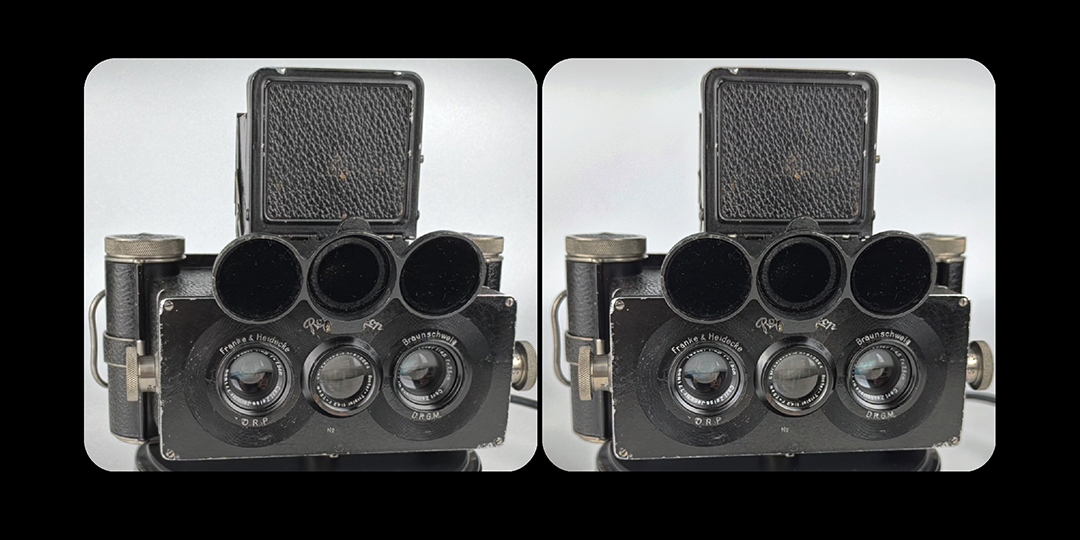
To celebrate 100 years of the Rolleidoscop stereoscopic camera (or the official English spelling: Rolleidoscope), first released by Franke & Heidecke, Braunschweig, Germany, in 1926, we’re now going to meet the beautiful camera itself, with an introduction, specifications, user guide and review.
Introduction
The Rolleidoscop was Franke & Heidecke’s first dedicated reflex roll-film camera; it was released after their popular Heidoscop, which originally used glass plates. Franke & Heidecke were world-renowned legendary German manufacturers due to their reputation for high-quality cameras and accessories, and their ability to adapt to the market, later becoming known as Rollei. The Rolleidoscop is said to have paved the way for the Rolleiflex, with both cameras still much sought-after and respected by photographers and collectors today. To learn more about the early history of the company and their cameras, please see this blog.

The Rolleidoscop model I have is a ca.1930, 6x13cm, which takes 120 film, which will be the focus of this post. Other versions include the 117-format, a thinner roll of 6x6cm film, and the 127-format, or 4x4cm. You can read about the history of this camera here.
Franke & Heidecke described the Rolleidoscop as:
| The all-round instrument for travel and Sport ! The Rolleidoscope is the photographic precision instrument for the achievement of unique performance with simple manipulation ; not only for stereoscopic, but also for ordinary single-lens photography. It is a stimulating companion for all excursions, never burdensome and always ready for use. The economical use of negative material and the rarity of failures will soon repay the cost of this veritable jewel among cameras. …The cameras from Franke & Heidecke are almost the loveliest thing connected with stereoscopy. Your photo-dealer will be glad to let you examine them without obligation, and to show you a series of beautiful stereo pictures. He will also tell you how simple it is to make good stereo slides. Should you become the possessor of a Heidoscope or Rolleidoscope, you will never again travel or take a holiday unaccompanied by your treasure. You will be able to exhibit to your friends and acquaintances, with justifiable pride, perfect little masterpieces of the photographic art and, envied by many, thank the lucky day when you first learned to appreciate the beauty of stereoscopic relief. |
Whilst these particular stereoscopic cameras command high prices, which are between 85 and 100 years old, from their quality and functionality, you can understand why they still are so valued.
Specifications
Based on a ca.1930 6x13cm model:
- Lenses: Taking lenses: twin Zeiss Tessar, 75mm, f4.5; Viewing lens: Zeiss Triplet 75mm, f4.2.
- Focusing range: 1m – infinity (marked distances: 1, 2, 4, 6, 12m, infinity).
- Apertures: f4.5-25 (marked: f4.5, 6.3, 9, 12.5, 18, 25).
- Shutter speeds: 1s – 1/300s (marked: 1, 1/2, 1/5, 1/10, 1/25, 1/50, 1/100, 1/300s). M, B, Z mode: Moment: instant exposure, or ‘normal’ mode used with shutter speeds, Bulb: long exposure, stays open for as long as you hold the release, Z: Zeit, Time, the shutter opens when you press the release and closes when you press it a second time.
- Weight: 1.6kg.
- Dimensions: 18 cm length, 10.5cm width, 9.5cm high.
- Film format: 120-roll film, producing five stereo pairs, ca. 6×6.5cm each half, plus one mono frame per roll of 12-frame film. The actual size of the negative image area, without the film border, is 5.6cm high, 6.2cm wide per single (half) frame of the stereo pair (see image further below).
Features summary:
- The viewing lens is positioned in the centre, projects the scene through a mirror and onto a top-down ground-glass focusing screen.
- Two identical, high quality matched lenses to expose the stereoscopic pair of images onto the film. The lens-cover doubles up as a sunshade.
- A highly accurate specialized, synchronized stereo shutter mechanism that fires both taking lenses simultaneously.
- A reflex viewfinder and hood: A spring-loaded, folding, four-panel spring-loaded hood protects the ground-glass focusing screen, which is the same size of the negative, and the back panel acts as a flip-out magnifier for precise focusing.
- A metal winding knob and an external red window on the camera back, used to visually align the frame numbers for precise stereo spacing.
- Aperture, focus and shutter controls are conveniently found at the front and side of the camera for easy access.
- A sliding camera front for photographing tall buildings and Sir Brian May, so upright lines do not become tilted.
- The light-trapping between the shutter and the camera-housing is done not in velvet, but in metal, so that there is no risk of subsequent light leakage.
- A metal mirror to enable the camera’s use at eye-level, useful for crowded situations where the camera needs to be held higher (the mirror on mine shows signs of age and I can’t get a clear enough picture to try this feature – see the photos at the bottom of this post for a demo).
- Reportedly works in very low temperatures, with successful results from the camera near the Arctic Circle. I’ve been unable to test this, but it anyone fancies a road trip with some cool stereo cameras (literally), let me know.
- Per standard roll of 120 film, with 12 6x6cm frames, you will get five stereoscopic negatives and a single mono negative at the end because of the 12x6cm stereo format.


User Guides
There are some great free manuals available online for personal use, and I’m grateful they’ve made them accessible:
- J. R. Thurston has very kindly made a scan of the instructions for the Rolleidoscope freely available on his website for personal use: https://stereo.thurstons.us/rolleidoscop_instructions.htm
- M. Butkus has also very kindly made a scan of a Heidoscop-Rolleidoscop brochure freely available on his website for personal use: https://www.cameramanuals.org/stereo/heidoscop_rolleidoscope.pdf
Step-by-step
Loading the Film
- Load 120 film into the camera in low-light, as per the photographs below.


- Wind the frame number to the correct rear window number in sequence for each photograph (as per manufacturer guides):
- For the first stereo frame number 1 is aligned to window mark 1.
- For the second stereo, align film frame number 2 to window mark 2.
- For the third stereo, align film frame number 4 to window mark 4.
- For the fourth stereo, align film frame number 5 to window mark 5.
- For the fifth stereo, align film frame number 7 to mark 4|1 [I find it’s better if you actually wind it to mark 4, otherwise stereo four and five have no separation – see the photo of the negatives produced].
- For the last mono photo, align frame number 8 to window mark 5|2 [again, if you’ve moved the last stereo to mark 4, please move this last mono to mark 5].


- I made a lanyard to carry around with the camera, the geek that I am, so I don’t lose track of which mark I need to use for each frame, but this becomes second-nature the more you used the camera. I’ve also got into the habit, as with all my cameras, of winding the film on to the next frame as soon as I’ve taken a photo, so I don’t accidentally take a double exposure, and know where I am into the film.
Taking the Photographs
(Diagram based on a Heidoscop, but features shared with a Rolleidoscop are labelled)

- To set the shutter speed from 1s – 1/300s, use dial 6 (ensuring dial 4 is set to M for manual, or see the specs above for different shutter settings).
- To set the aperture from f4.5 to f25, use dial 2.
- Open the focusing hood by pressing lever 12, and position the camera to frame the desired scene on the screen.
- You can check the level of the camera with the spirit level inside the focusing screen. I use a tripod to help me keep it level, but there are metal tabs so you can use the camera with a neck strap too.
- Flip over the magnifier panel (13) and use the focussing knob (1) to accurately focus the subject of the scene.
- When you’re happy with the settings, framing and focusing, tension the shutter by cocking the shutter-tension lever (3).
- Take the photo by pressing shutter button (5).
- Wind the film on to the next frame in the sequence.
- When the film roll is finished, wind it tightly all the way on to the left spool, in low-light, open the back, pull up the left winder knob and remove the film, carefully securing it closed with the ‘exposed film’ tab, ready for developing.
- Remove the empty spool in the right chamber and place it in the left chamber, ready for the next film.


Post-Processing
- Depending on what you have available, either develop the film at home or use a film lab, ensuring they process the type of film you’ve used (negative or slide, B&W or colour). As usual with stereoscopic negatives/slides, please also make sure the lab is aware of the frame format/camera used to specify that the film should be left uncut; if they chop it to the standard mono camera frame-format, it will slice through your images.
- Either use scans of the film to make stereo images, or use the negatives to make prints, the format work well as contact-prints, including cyanotypes, transpose the halves and mount them on card or use mounts for slides (please see this post for general post-processing options with analogue stereo cameras).


Photos taken with the Rolleidoscop


Review
I absolutely love using this camera; it can produce fantastic results and its high quality and sturdiness means it still works well as a 120 stereo camera nearly 100 years after being made, with film readily available. It’s difficult to describe, but, as a camera in general, it feels special to use it and I look forward each time I have an excuse to use it; in the words of Franke & Heidecke, it’s ‘almost the loveliest thing connected with stereoscopy’. On the other hand, it has taken me years to finally be able to own a working example due to the price tag, which I think is justifiable in the quality and practical functionality of the camera, but I appreciate it’s not the most accessible. I’ve been very lucky and have twice been offered to borrow other people’s Rolleidoscops, and I highly recommend to jump at any opportunity. It is 1.6kg and quite big, so it may not be the most practical camera to take on travels with luggage restrictions, especially if you also have a tripod in tow, but for me, that wasn’t at the forefront of my decision in choosing the camera, and in comparison to other 120 film ‘mono’ cameras, it’s not that much extra in weight or size anyway.
You can see with the example photos I’ve shown in this post, which I’ve tried to keep impersonal, and are therefore quite boring, that with such a special camera, with the current high price of film, and with five and a half precious stereo pairs per 120-roll, you need to chose your subjects wisely. You need to factor in how quickly you can set up a shot (which, if you’re not into patience and mindfulness, may lose its appeal very quickly), the optimal distance from the subject for the lens separation and stereoscopic depth, how many layers of depth you have to make the scene interesting to view in 3-D, and keep track of which frame number you’re on and where you need to align it, which can take some getting used to.
As Franke & Heidecke predicted, I’ve wasted very few frames with this camera, and am grateful there are lens shades and a focusing screen hood enclosure, so I can use it quite confidently outdoors. There have been two occasions, however, where I’ve been caught out by light reflecting off lower surfaces outdoors, such as windows, and causing a light streak on the film (see the kitty image), so something to keep in mind.
With everything factored in, this is one of my favourite stereoscopic film cameras, and certainly my favourite 120-film stereo camera. It is pure joy to use, and I look forward to my next outing with it.
#StereoscopyDay

Copyright © The Stereoscopy Blog. All rights reserved.
For Boris: How to use the metal mirror as an eye-level viewfinder:
I hope these make sense, but on the diagram in the text, you use lever 14 to pull the mirror forward to 45 degrees and then flip over the magnifier so you can see the mirror and the reflection of the screen through the back of the housing. It relies on that tiny metal prong I’ve circled still being in place. You can see the mirror on mine is showing its age so I don’t use this feature!


Hi Rebecca:
What an amazing coincidence! Yesterday – the very same day you posted about this camera – I had my Heidoscop out for the first time in… gosh, I’m not sure, possibly three years. I was in Raleigh, NC, photographing some trolls there. I’ll be sending the film out today, and can’t wait to see how it turns out.
I’ve not used the camera much, still feel clunky with it. Mine has a custom made roll film back (made for a modern 6×13? camera). It is this exact camera. One thing I’ve not yet figured out is how to use the little metal mirror within the pop-up focussing contraption, to get that eye-level view of ground glass through the finder eyepiece. I can’t figure out how to anchor the mirror at the needed 45 degree angle. I’ll study the (Thurston-scanned) Rolleidoscop manual to see if the answer is in there.
Cheers from VA.
Boris
LikeLike
Hello Boris, lovely to hear from you, I hope all is well.
That’s AWESOME! A Heidoscop and trolls! Yesterday was also International Garden Gnome Day, not quite trolls, but close! I’ve read they made film-back adapters for the 6 x 13cm Heidoscops, but I’ve yet to see them, would love to learn more about any made at any point.
Denis also has a Heidoscop, and whilst the front is very similar to the Rolleidoscop, I can see his is missing a prong, which means the mirror which moves to allow the camera to be used at eye-level, doesn’t stay in place. I’ll take photos of mine and maybe a video tomorrow – the spring and its connected prong which allows the mirror to move to 45 degrees are very small, so might be difficult to pick up, but we’ll try. If I remember rightly, the instructions don’t really show or explain it other than there’s a button to press to move the mirror (probably because it’s difficult to show).
LikeLike
The link I gave to pictures of my camera, as described on another website (https://www.worthpoint.com/worthopedia/heidoscop-stereo-camera-custom-medium-1912641122) shows a picture of the roll film back. It’s loaded in an inverse sort of fashion – emulsion facing you as you load it (somewhat reminiscent of loading a Hasselblad roll film back cartridge) – then you attach the loaded film back onto the Heidoscop. Also of interest, the numbering over that film “window” allows a tighter spacing of the exposures, so with this back I can get a full six stereo pairs on my film, unlike what the Rolleidoscope instructions suggest… how with that camera you get only five stereo pairs, and then a final flat image. All that said, I believe my camera is unique, the roll film back being “common” 6×13 back, and then hand-made/adapted to the Heidoscop by some hobbyist. (A post I made on my Patreon about a repair to my Heidoscop – https://www.patreon.com/retroformat/posts/heidoscop-light-138711803 – shows that the roll-film back is not the modified part. The camera plate holder area was modified to accept the modern roll film back.) I’ll send you some pictures of just the film back, as it is quite interesting.
LikeLike
It’s not letting me share photos in the replies, so I’ll add them and an explanation to the bottom of the post.
LikeLike