
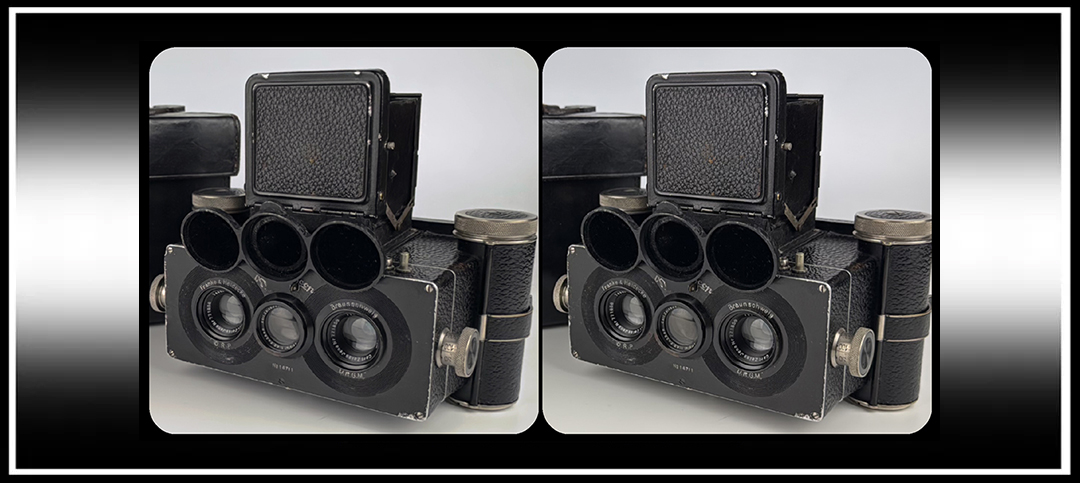
Today we celebrate the 5th International Stereoscopy Day, 188 years to the day when Sir Charles Wheatstone officially presented his theory of binocular vision and stereoscope to the Royal Society, on 21st June 1838.
2026 also marks 100 years of Franke and Heidecke’s stereoscopic film camera the Rolleidoscop, or the English spelling, the Rolleidoscope, which was first released late in 1926 in Germany. This blog post is both a celebration and a tribute to a very special and still much sought-after stereoscopic camera.
Franke & Heidecke
In his 1992 book Rollei TLR – The History, Ian Parker traces the beginnings of Rollei to 1909, when 18 year old Paul Franke joined Voigtländer & Sons as an unpaid apprentice in the export accounts department, before moving on to the optical firm Gerhard two years later as a junior. Reinhold Heidecke was already working for Voigtländer in their camera design department, and Parker said this overlapping time with him and Franke at the company laid the foundations for their later partnership.
During the First World War, Franke lost his job at Gerhard, and went on to open a photography and optical instrument dealership in Berlin around 1917. Parker said German officers had requested easily portable cameras from Franke, which lead him back to Voigtländer, where he met up again with Heidecke, who had been promoted to the production manager of cameras. Heidecke had noticed there were no simple roll-film cameras available in Germany in 1916, and between then and 1918 he made a prototype twin lens reflex roll-film camera, however, Voigtländer were not interested in any new designs at that time as they were selling all the cameras they could make.
In 1919 stereoscopic photography was reportedly back in fashion, with Voigtländer still manufacturing their 45mm x 107mm plate stereo cameras, the twin-lens focusing-viewfinder reflex Stereflektoskop, first released in 1914, and their non-focusing-viewfinder Stereophotoskop, first released around 1905, both of which Heidecke had worked on.
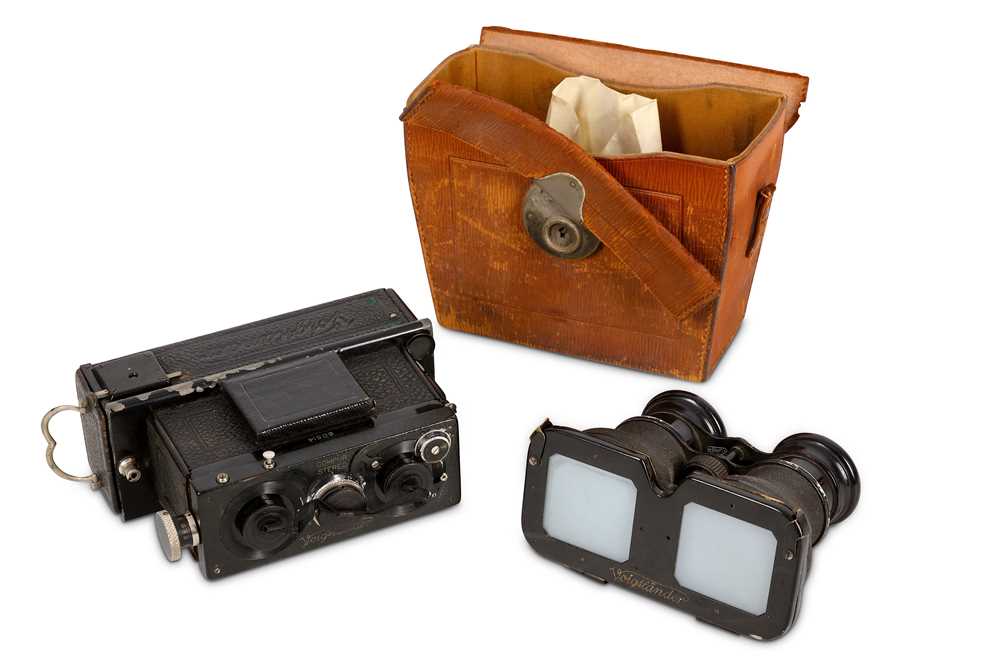
Voigtländer Stereflektoskop Stereo Camera, c.1923. Chiswick Auctions, 2020.
Heidecke appears to have gone rogue and decided to try and start manufacturing his own twin lens reflex camera. However, he couldn’t get the required financial backing from a bank, who were already overstretched in providing loans to returning soldiers, but they advised him to seek financial and commercial backing from elsewhere. Heidecke then approached Franke when he next visited Voigtländer in 1919, and, as Franke was in a position to offer the finances and was also very interested in moving from Berlin to Braunschweig, where Voigtländer and Heidecke were based, he agreed. However, Franke was insistent that the first camera to be produced should be a stereo camera as he knew they would be a commercial success at his store in Berlin, to which Heidecke readily agreed.
The Franke & Heidecke partnership was officially registered, and commenced in January 1920. The first camera they produced, the Heidoscop (or Heidoscope the official English spelling), a 45x107mm glass plate stereoscopic reflex camera, was released late in 1921, and was said to resemble the Jules Richard Vérascope camera, but you can certainly see the similarity with the Stereflektoskop.

Verascope Stereoscopic Camera, by Jules Richard, Paris, c. 1927, History of Science Museum Collection. © History of Science Museum, University of Oxford, inv.79152

The Heidoscop was a reported success, with 158 cameras having been completed by the end of 1922. The following year, Heidecke made a number of modifications to improve the design of the Heidoscop, along with a camera to take 117 roll-film, initially naming it the Heideckeoscop. A larger 60x130mm glass plate Heidoscop was also added to their product line, around 1925; this format was used because the average human inter-pupillary distance is 60-65mm, and Franke & Heidecke also later described it as optimal for projection.
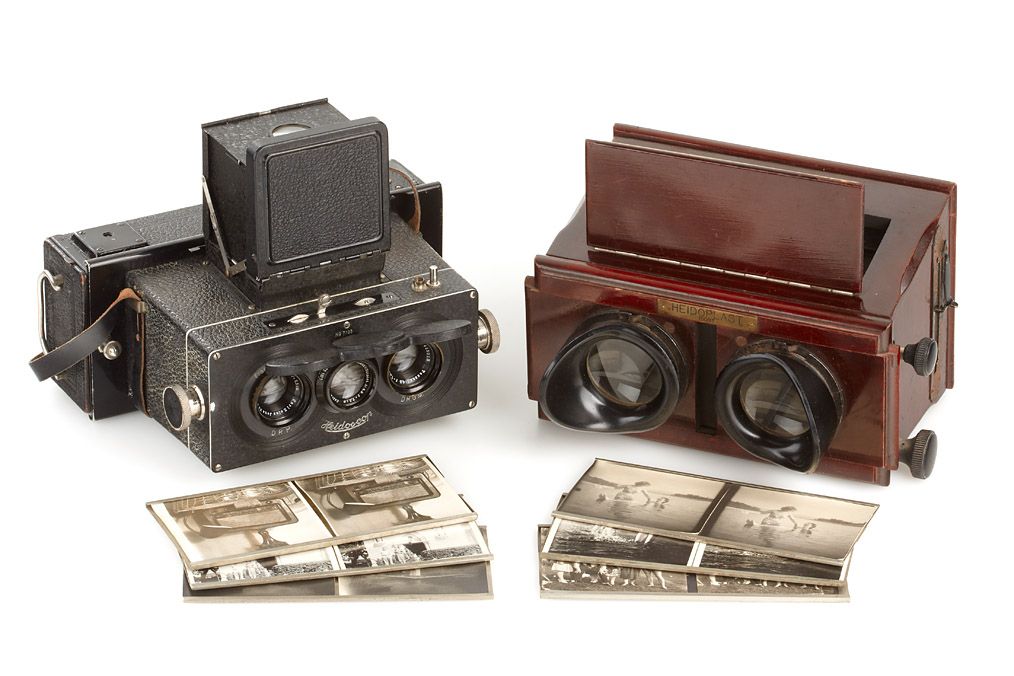
Rollei Heidoscop, 6x13cm, last (4th) model. Leitz Auctions.
The Rolleidoscop
In 1926 the Franke & Heidecke 117 roll-film stereo reflex camera went on public sale, which became known as the Rolleidoscop. 117 film is now an obsolete format; it is similar in frame-size to 120 roll film, but only had half the number of frames per roll. Many of the original 117 Rolleidoscop cameras are said to have been converted to 120-film.


In 1927, the ‘baby Rolleidoscop’, which made pairs of 4x4cm exposures on 127 film, was released. Parker reported that in that same year, Franke & Heidecke were still going from strength to strength due to their high-quality products and the export market, with their annual production reaching 12,090 cameras.

Franke & Heidecke finally released the hugely popular Rolleiflex Twin-Lens Reflex camera in 1929, and described it quite affectionately as:
| ….a Rolleidoscope in half, so to speak. The experience gained in the construction of stereo precision instruments and the distinctive features of these models, such as the brightly illuminated image on the focusing screen, ensuring a quickness and accuracy of action hitherto unknown, were transferred to a roll film camera. |
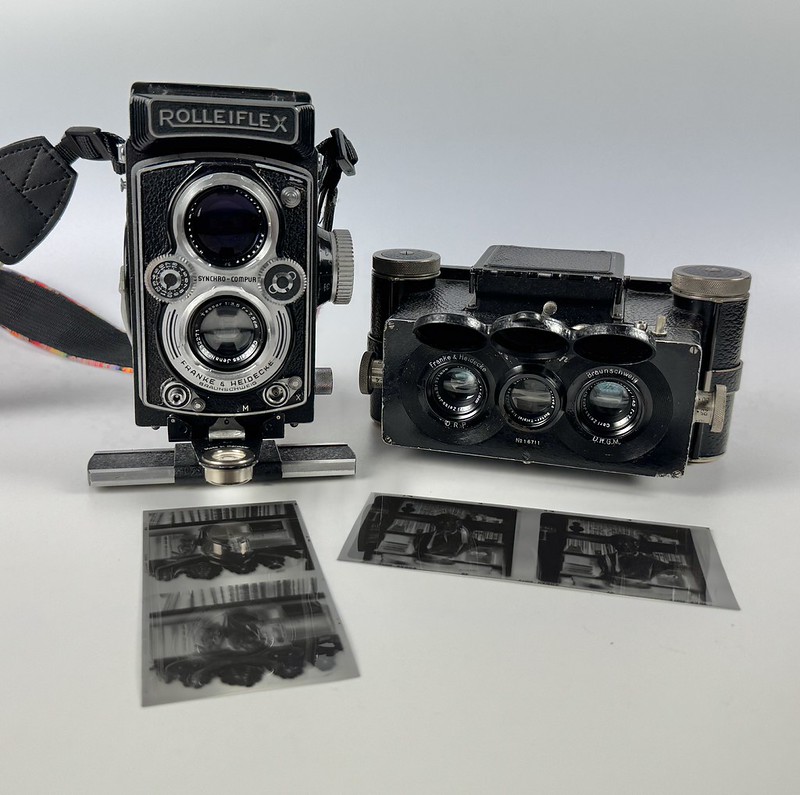
1950s Rolleiflex and 1930s Rolleidoscop, with their respective negative formats.
Parker stated that the Rolleiflex camera’s back was enlarged in 1932 to allow it to accept 120-film (or Agfa B-2 film as the propreitary version was known in Germany) instead of the 117-film, which was prone to curling and had a limited number of exposures. In the absence of an official source, therefore, we can probably make an educated guess that the Rolleidoscop was also officially converted to 120 around this time, or slightly earlier as my own has a serial number dated to around 1930, and accepts 120-film. If you’re able to find a copy of Ian Parker’s book Rollei TLR: The History, I really recommend a read of it as he shares later examples of prototype stereo cameras designed and made by Rollei which, regrettably, never made it to commercial production.
The Rolleidoscop cameras feature high quality twin Zeiss Tessar f4.5 lenses, and a Zeiss antistigmatic f4.2 view-finder. It has a four-panel articulated reflex hood with a bright focusing-screen and spirit-level, a fold-over magnifier for accurate focussing, and a mirror for use at eye-level. The front panel of the camera can be shifted upwards for photographing tall buildings, Sir Brian May, etc. The frame format is actually slightly larger than a pair of 6x6cm slides, producing a 6x13cm stereo image, which means with a 120-film you get 5 stereoscopic pairs, and a mono frame. For full specifications, please see the upcoming post on this blog.

The Rolleidoscop cameras, reflecting the trends and market of stereoscopic photography, were produced up until 1941. However, you can still see them and Heidoscop cameras being discussed in stereoscopic photography books from the 1950s as being one of the best stereoscopic cameras:
| One of the best modern cameras available for the serious amateur or professional worker is the Heidoscope stereo-reflex model. This camera enables an extensive choice of negative material to be made and colour photography to be undertaken. It is particularly applicable to technical photography, including that connected with machinery, plant, industries, buildings, etc., intended for publicity or propaganda work by engineers, architects and salesmen. …The camera is made in both 45x107mm and the 60x130mm sizes, and in each case film packs can be employed. The Heidoscope controls are conveniently arranged on the top in such a manner that the work is divided between the two hands. …Another form of the Heidoscope type of camera is made for taking roll film of standard size. This camera is known as the Rolleidoscope and is made in both the 45x107mm and the 60x130mm sizes. These cameras are appreciably lighter than the plate cameras previously described. |
Today, these iconic high-quality cameras are still hugely popular and much sought-after, reflected in the high prices they can command. You can find examples in Museum collections, such as the the UK’s National Science and Media Museum:
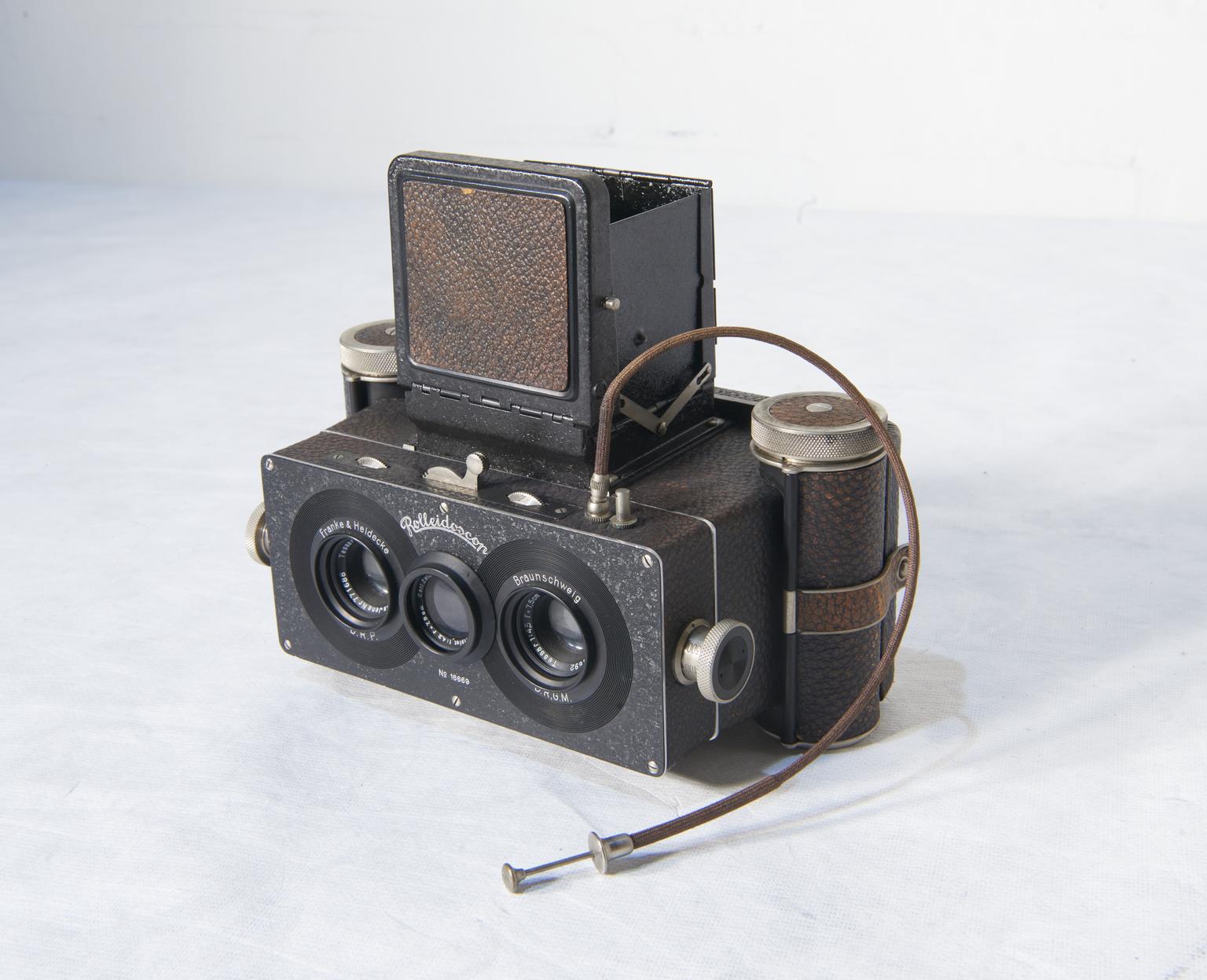
Rolleidoscope stereo-reflex roll film camera. Object Number: 1929-411. National Science and Media Museum Collection.
We’re pushing the boat out today to celebrate the Rolleidoscop’s centenary, and soon you will be able to enjoy a virtual stereoscopic tour of the Franke & Heidecke Factory in 1938, as well as getting to grips with an example of the camera itself.
Happy Birthday Rolleidoscop! 100 years young and it’s still an amazing stereoscopic camera!

#StereoscopyDay

Copyright © The Stereoscopy Blog. All rights reserved.
Sources:
- Brian Coe, 1978, Cameras: From Daguerreotypes to Instant Pictures.
- Jac G. Ferwerda, 1987, The World of 3-D: A Practical Guide to Stereo Photography.
- Franke & Heidecke, ca. 1930, Heidoscop-Rolleidoscop.
- Franke & Heidecke Ltd, ca. 1930, Working Instructions: Heidoscop-Rolleidoscop.
- Arthur Judge, 1950, Stereoscopic Photography.
- Dr. Hermann Lùscher, 1928, Räumliches Sehen und Die Wichtigsten Grundbegriffe der Stereo-Photographie, published by Franke & Heidecke.
- Ian Parker, 1992, Rollei T.L.R. – The History.
- Raumbild-Verlage, 1938, Visitors being shown over the camera works of Franke & Heidecke, Brunswick.


Thankyou Rebecca for your wonderfull Gratulation to 100 year of ROLLEIDOSCOP and greetings from Hamburg (Germany)
LikeLike