
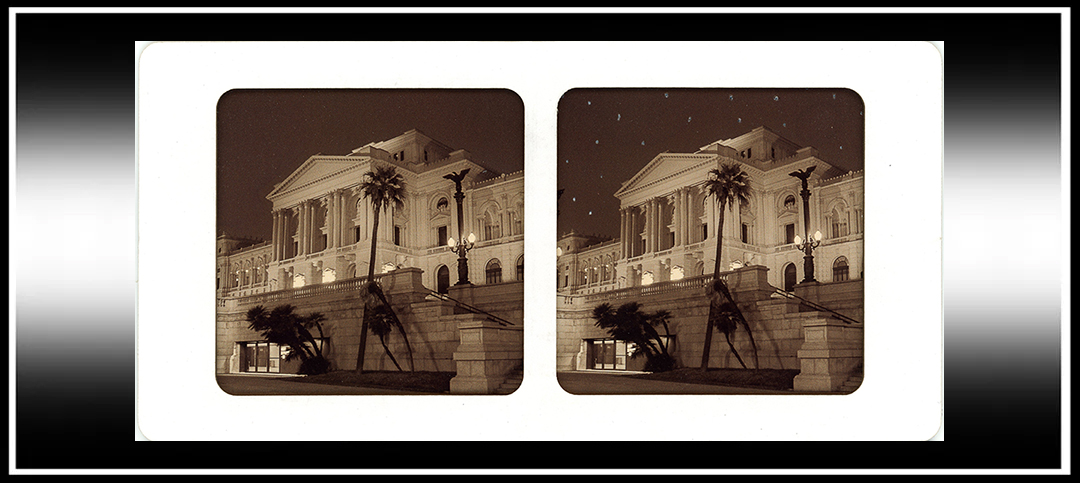
Last year I was very fortunate to take part in a workshop given by Brazilian photographer and educator Roger Sassaki, who is also organiser and researcher of the Imagineiro project. In this blog post, I am going to share a little about the background of tissue stereoscopic photographs, the workshop with Roger, and the resulting tissue stereo card I made.
Tissue stereoscopic photographs, or French tissues, as they are sometimes called, were mostly produced in France between 1858 and 1875, and were considered a very popular novelty, as they allowed a scene to be viewed in black and white when front-lit, but when back-lit, they burst into colour, often with little pinholes allowing light through to add special effects, like stars, a surprise moon, sometimes even a fire. Some of the best known examples of tissue stereoviews are the Diableries stereo cards, thanks to the research and work put into the London Stereoscopic Company’s book ‘Diableries: Stereoscopic Adventures in Hell‘.
French Tissues were albumen prints on very thin paper, hence the term ’tissue’, and this paper was coloured on the reverse, with pin-pricks or holes also added. In addition, a second layer of thin paper was included behind, to diffuse the light through the photograph when the scene was back-lit, showing colourful surprises, long before the first colour photographic process was commercially available. The thin layers of paper were most commonly sandwiched in cardboard mounts, which helped to make them sturdy and useable in a stereoscope. You can learn more about the history of French tissues and see some beautiful examples from the Howarth-Loomes Collection at National Museums Scotland on the FutureLearn website, and find early research about Diableries: French Tissues, on the London Stereoscopic Company website.


Collection of Denis Pellerin
Roger Sassaki very kindly made a special workshop for making French Tissues for three of us who were unable to attend his first one at the National Stereoscopic Association’s 3-D Con, and we commandeered a spare table in the hotel corridor. He had prepared the materials by printing monochrome stereoscopic photographs on thin (100gsm) photographic paper, making two mat mounts using laser-cut 1.2mm mat board, one for the front, and one for the back, provided watercolour paints, brushes, a cup of water, glue, hinge tape, pins, a second thin piece of paper for use as the diffuser, and made his own light-tables so everything could be back-lit. He gave us a brief tutorial on French Tissues, the workshop, and how he had prepared the photographs, followed by a demonstration.


We placed the thin photographic print upside-down on a light table, back-lit it with a phone, and used the watercolours, in my case, to paint the sky, a moon (which could have been better!), and the lights in the scene. Once the paint was dry enough, I then used a pin to poke stars on to one half of the stereo image.


Once everything was dry, we carefully glued the edges of the mounts and stuck one piece of thin paper to each half of the mount mat, carefully aligning the photographic print in the centre of the mount, and then hinged the mount mats together, using a strip of tape to make the hinge.


Once the glue was dry, all that was left was to enjoy our ‘French tissue’ stereoviews in Roger’s very own self-made stereoscope!


A huge thank you to Roger for this workshop, it was really enjoyable and educational.
Additional photos in this post are courtesy of Roger Sassaki.
#StereoscopyDay

Copyright © The Stereoscopy Blog. All rights reserved.

