
It is strange, sometimes, how articles start getting written. Take this one, for instance. It all began with an email I got out of the blue from a collector of 35 years who is currently streamlining his collection. I had already been in touch with this very nice person – let’s call him John – and had bought from him some stereoscopic glass slides of the 1931 British Colonial Exhibition. Knowing I am always looking for things out of the ordinary, he contacted me a couple of weeks ago to ask me if I was by any chance interested in some Verascope Richard stereoscopic glass slides of “bird men” (his words). I was obviously intrigued, and even more so when he sent me six scans showing men and women dressed as birds (there was also a rabbit) in what seemed like some kind of dressing room. I bought the images at once but since I was busy planning a work trip to France and working on a couple of presentations, I didn’t start doing any research on the subject at once, as I usually do. John wrote to me again a few days later to announce he had found four more slides from the same provenance. I purchased them immediately so that they were all kept together and when I got back from my trip I scanned the ten images now im my possession and started having a closer look at them. Most of them did not have any caption, except two which had the name Chantecler written on them. The name rang a bell and when I Googled it, along with the patronym Dorival found on a slide showing a person dressed up as an eagle owl, I immediately got the answer to the puzzle of the “bird men”. What I had bought were photographs taken in the dressing room of a Paris theatre of some of the actors of the 1910 production of Chantecler by Edmond Rostand [1]. Chantecler is a play in four acts and in verse by the author of Cyrano de Bergerac (1897) and L’Aiglon (1900). It was premiered at the Théâtre de la Porte Saint-Martin [2], in Paris, on 7 February 1910. It was also in the same theatre that Rostand had his most famous play, Cyrano de Bergerac, premiered on 28 December 1897. I knew I had a stereoscopic photograph of that theatre somewhere, taken some time before or after 1900. I managed to locate the card, scanned it and when I blew it up and examined it on my computer screen I realised the photo must have been taken in 1898 or 1899 when Cyrano was still being performed there, as evidenced by the five posters in the image bearing the title of Rostand’s play !

01. Stereoscopic photograph of the Théâtre de la Porte Saint-Martin by S.I.P. (Société Industrielle de Photographie) taken when Edmond Rostand’s Cyrano de Bergerac was being performed. Author’s collection.

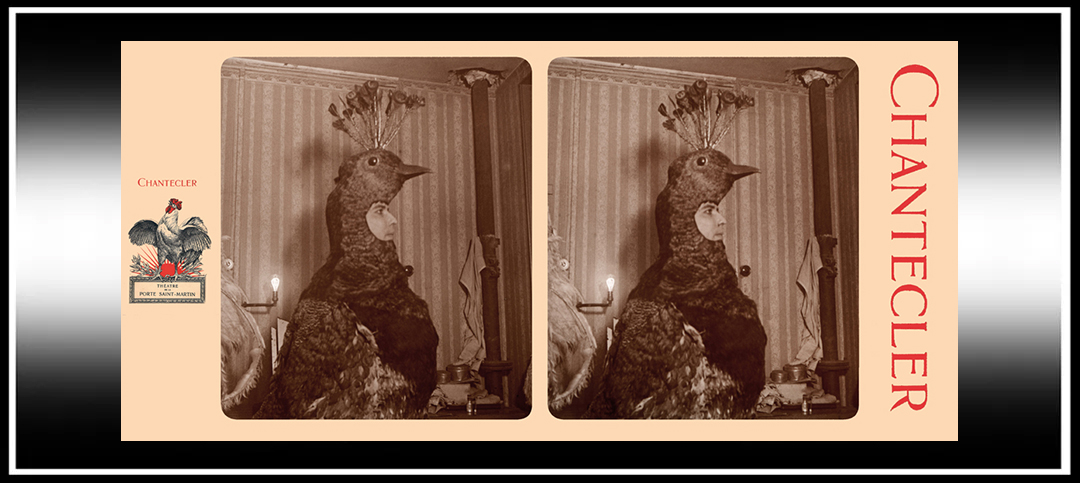
02. The two Verascope Richard stereoscopic glass slides bearing the name Chantecler on them. The original images are 45 x 107 mm in size. Author’s collection.
Chantecler, or Chanticleer in English, is a rooster, the king of the barnyard, who thinks that his crowing makes the sun rise every morning. The play is an allegorical fable about idealism and spiritual sincerity (Chantecler) as opposed to cynicism and artificiality (the Blackbird, who represents modern critique, the peacock, and the fancy-bred roosters Chantecler meets at the Guinea Fowl’s soirée). A creature of the light, Chantecler is hated by the denizens of the night, the cat and the owls, who plot to lure him to a soirée held by the Guinea Fowl and to have him killed by a game cock they have invited to attend. The two cockerels fight and although Chantecler is badly wounded he saves the day by protecting the barnyard animals from a hawk before finally defeating his opponent. Another important character in the play is a Pheasant hen who falls for Chantecler and wants him to love her more than he does the sun and the dawn. This is, however, something he cannot do, which she ends up accepting.
The title role was originally written for Benoit Constant Coquelin [3] who had created the part of Cyrano in 1897 but Coquelin died of a heart attack before the end of the rehearsals and the part was consequently given to Lucien Guitry [4]. The play has a large number of characters – over seventy – and some actors had to play several parts which involved changing costumes during the performance. All the costumes of the original creation were designed by Rostand himself.

03. Cover of the original programme of the play. Author’s collection.

04. Six of the pages of the programme showing the author and some of the actors in the play. Author’s collection.
There is no indication in the glass stereos as to when they were taken but there is no doubt all the images were made in the dressing rooms of the Théâtre de la Porte Saint-Martin some time in 1910. There may be other images somewhere showing other characters of the play and I will most certainly look for them. The ten glass slides I have do not show any of the main actors and actresses in the cast – Chantecler, the Pheasant-hen, the Blackbird and Patou the dog – maybe because someone has them in their collection or because the anonymous photographer considered these actors too important to be disturbed and did not photograph them for the stereoscope. Fortunately they can all be found in a set of ten postcards which was produced at the time.

05. Chantecler (Lucien Guitry) Patou the Dog (Jean Coquelin) and the Blackbird (Félix Galipaux). Postcards from a set of ten published by E.L.D. (Ernest Le Deley). Author’s collection.

06. The Pheasant-hen (Pauline Benda, better known in the theatrical world as Madame Simone or Simone Le Bargy) from the same set of cards. Author’s collection.
Since Verascope Richard stereoscopic glass slides are not easy to view in a lorgnette type viewer once they have been enlarged, I have turned all the images into more traditional stereoscopic cards.
Let’s start with the two pictures I have of Augustine Leriche [5] who played the part of the Guinea Fowl. She was already in her mid-fifties when Chantecler was first produced but this versatile actress kept appearing on stage well into the 1920s. Here she is making up and looking at the headwear she had to keep on while performing.

07. Verascope Richard glass slide. Augustine Leriche as the Guinea Fowl in one of the dressing rooms of the Théâtre de la Porte Saint-Martin. Author’s collection.

08. Verascope Richard glass slide. Augustine Leriche with her headwear on making up before going on stage. Author’s collection.

09. Augustine Leriche as the Guinea Fowl. Postcard from a set of ten showing some of the characters of Chantecler. Author’s collection.
Next are two photos of Dauchy, the actor who played the part of the peacock. I could not find any information about this person and the fact that a lot of performers at the time were only known under a single name, which was generally not their family name, does not really help. The costume of the peacock obviously came with a tail but there can’t have been enough space in this small shared dressing-room for Dauchy to put it on for the photograph. Pity !

10. Verascope Richard glass slide. Dauchy as the peacock. Author’s collection.

11. Verascope Richard glass slide. Close up of Dauchy’s headwear. Author’s collection.
I have already mentioned the name Dorival as being written on one of the glass slides of the Chantecler set and helping me realise what I had bought. It refers to stage and screen actor Georges Dorival (1871 – 1939) whose real name was Georges Edouard Lemarchand. Dorival was a very interesting character. Apart from being a talented and versatile actor with a booming voice, he was an avid and expert art collector who had in his house paintings by Manet, Renoir, Toulouse Lautrec, Modigliani, Max Jacob and many others and who was friends with lots of contemporary artists. He was also the voice of the French “speaking clock” from the mid 1930s to the early 1970s. According to one source he also recorded the famous “il n’y a pas d’abonné au numéro que vous avez demandé” (the number you dialled is not attributed to anybody) for the French public telephone company. Although his real love was the theatre, Dorival appeared in dozens of silent movies (including the 1911 Madame Sans-Gêne – there is an article devoted to that play on this blog) and several “talkies” including one made by Sacha Guitry, the son of Dorival’s fellow actor Lucien. Dorival was originally playing the part of the Eagle Owl in Chantecler but when the play left Paris to tour the provinces he took over the title role from Lucien Guitry.

12. Verascope Richard glass slide showing Georges Dorival as the Eagle Owl (le Grand Duc). Author’s collection.

13. Postcard published by Le Deley, showing Dorival as the Eagle Owl. Author’s collection.
The next photograph shows Léontine Bouchetal (1872 – 1932) in the costume of the Old Hen, also known as Mère Marguerite. Underneath is the same old hen with two chicks in one of the postcards published by Le Deley.

14. Verascope Richard glass slide showing Léontine Bouchetal as the Old Hen. Author’s collection.

15. Postcard published by Le Deley, showing Léontine Bouchetal as the Old Hen with two chicks. Author’s collection.
I have unfortunately not yet been able to identify the young man in the bird costume below but I will keep looking. There were two rabbits in the play, played respectively by Laurier et Dutain (no firsts names and no further information). There were also several toads (not frogs) so it is not possible to know for sure who the person in the costume is in the stereoscopic image. One of these amphibians was played by Pierre Renoir (1885 – 1952), the son of impressionist painter Pierre Auguste Renoir and the brother of filmmaker Jean Renoir. Could it be him in the toad costume ? The last of the stereoscopic image shows a gander, played by someone whose stage name was Adam (again, just a single name and no further information).

16. Verascope Richard glass slide. Unidentified bird and actor. Author’s collection.

17. Verascope Richard glass slide showing one of the two rabbits in the play. Author’s collection.

18. Verascope Richard glass slide showing one of the toads. Author’s collection.

19. Verascope Richard glass slide showing Adam as the Gander. Author’s collection.

20. Postcard from another set of Chantecler images showing the Gander in Chantecler. The drawings are by an illustrator named Roberty and the set includes at least 18 images. Author’s collection.
Rostand’ Chantecler was not as huge as success as his Cyrano, maybe because the critics and part of the public who attended the literary salons did not appreciate being made fun of. However, it led to the publication of several sets of postcards (the 1910s were the golden age of postcards in France). I have mentioned two already but there was another important one showing in ten images the four acts of the play and the different sets. Here are four samples, one for each of the acts.

21. Four out of the ten postcards showing the characters and sets of Chantecler. Author’s collection.
Another curious set was made in which the characters of the play were clay models. I am not sure how many cards are in this rarer set but I have seen five so far: Guitry as Chantecler, Madame Simone as the Pheasant-hen, Coquelin as Patou, Galipaux as the Blackbird and Edmond Rostand in his uniform of académicien, holding a lyre and surrounded by barnyard animals. The latter is aptly captioned “L’auteur de Chantecler” (The author of Chantecler). The postcard showing Rostand is all the more interesting as it was used as an invitation card. The sender, who signed Kokoriko (cock-a-doodle-doo, but normally spelt “cocorico”), begged the young Alfred Fabre-Luce [6] (he was less than a month away from his eleventh birthday) to attend a special Easter performance of the play on 27 March 1910 at the théâtre de la Porte Saint-Martin.

22. Postcards made from photos of clay models showing actor Lucien Guitry as Chantecler and the author, Edmond Rostand, with a lyre. The latter postcard was used as an invitation to attend a performance of the play. Author’s collection.
There were other postcards issued, mostly satirical, most of them emphasising how difficult and taxing it had been for Edmond Rostand to write his Chantecler (it took him nearly eight years). One of these postcards, by Molynck, shows Rostand as a hen laying an egg on which the name Chantecler is written. The caption reads “Que c’est dur!” (How hard it is!). Another one – using a clay model – shows an exhausted Edmond Rostand sitting in an armchair. Out of his bald skull comes the head of Chantecler. This time the caption reads “Accouchement laborieux” (laborious childbirth). It would takes ages, and pages, to list all the postcards that were inspired by Rostand’s play but I think it would be worth it if someone had the patience to do so. It really tells a lot about the postcard craze of the period.

23. Satirical Postcard “Accouchement laborieux”. Author’s collection.
Despite its general lack of success, the play and its main character inspired many people in several different ways. There were Chantecler hats, for instance. On a very different note, film-maker and pioneer of animation Emile Cohl (1860 – 1938) made a seven and a half minute stop motion movie called Le Petit Chantecler which was directly inspired by Edmond Rostand’s play (it is also divided into four acts) and can be watched on YouTube. Other people used the character of Chantecler to create original floats or “chars” for Carnival events. I have found photos and postcards showing such floats in Britain in 1910 and in France in 1912. There were also by-products made and sold during and after the run of the play: china figures of Chantecler, mugs, ear-rings, pendants, etc. While researching this article I even saw that someone was selling on eBay the headwear allegedly worn by Lucien Guitry when he created the part of Chantecler ! It would have been great to have been able to show my readers stereoscopic photos of it but since the seller was asking nearly £1300 for it I decided it was really too much to spend for one or two stereoscopic illustrations and resisted the temptation. Sorry !

24. Postcards showing floats inspired by the character of Chantecler. The two top ones are British and the photos were taken during the festivities for the centenary of Bournemouth in July 1910. The bottom one is French and the photo used to print it was taken in the village of Oucques-la-Joyeuse, not very far from Blois.
To conclude, I cannot but express my warmest gratitude to John for making me go down yet another fascinating rabbit hole. Stereoscopy was often advertised as a window that opened onto the world and allowed the spectator to travel anywhere without any hassle but it is so much more than that. It makes one discover so many things one would never have dreamt existed. It is the key to several amazing worlds, real or imaginary ones, like the Hell created by Habert and Hennetier in the Diableries, the staged scenes inspired by popular paintings and illustrations, or Rostand’s allegorical barnyard. On this day when we celebrate the official birth of Stereoscopy I am really thankful to Mr. Charles Wheatstone for that amazing gift: the stereoscope.
NOTES
[1] Edmond Rostand (1 April 1868 – 2 December 1918) was a French poet and playwright who was born in Marseille and died in Paris at the age of fifty as a result of the terrible flu pandemic that swept over Europe. He was only thirty-three when he was elected to the prestigious Académie Française, the youngest writer ever to have had that honour. On 8 April 1890 Rostand married poetess and author Louise Rose Etiennette “Rosemonde” Gérard (5 April 1866 – 9 July 1853). They had two children, poet, novelist and dramatist Maurice Rostand (26 May 1891 – 21 February 1968) and biologist and académicien Jean Rostand (30 October 1894 – 4 September 1977).
[2] The Théâtre de la Porte Saint-Martin was first opened in 1781 and had a history of being closed and reopened on several occasions and for various reasons, mostly political. This big theatre (1,800 seats) first made its reputation with melodramas, dramas and tragedies. Between 1840 and 1862 it turned to fairy plays before returning to dramas. The theatre was totally destroyed by fire on 25 May 1871 during the last days of the two-month revolution known as the Paris Commune. It was rebuilt on the same spot and re-opened on 28 September 1873 with a play by Victor Hugo.
[3] Benoit Constant Coquelin (Boulogne-sur-Mer, 23 January 1841 – Couilly-Pont-aux-Dames, 27 January 1909), also known as Coquelin aîné, to distinguish him from his brother Ernest, who was called Coquelin cadet.
[4] Lucien Guitry (Paris, 13 December 1860 – Paris, 1 June 1925) was a well-known actor in his time. He is the father of playwright, actor anf film-maker Sacha Guitry.
[5] Augustine Leriche (Paris, 17 June 1856 – Dax, 24 May 1938) was an actress and a singer who started her acting career at the age of nine.
[6] Alfred Fabre-Luce was born in Paris on 16 May 1899. He was the uncle of Anne-Aymone Giscard d’Estaing, the wife of the late French President Valéry Giscard d’Estaing. He died on 18 May 1983 in Paris.

Copyright © The Stereoscopy Blog. All rights reserved.


Good story and I love the postcards too. I have a little china figure of a cockerel with a man’s face in the chest which sounds like one of the souvenirs you mention. I had no idea what it was so thanks for another illuminating post!
LikeLiked by 1 person