
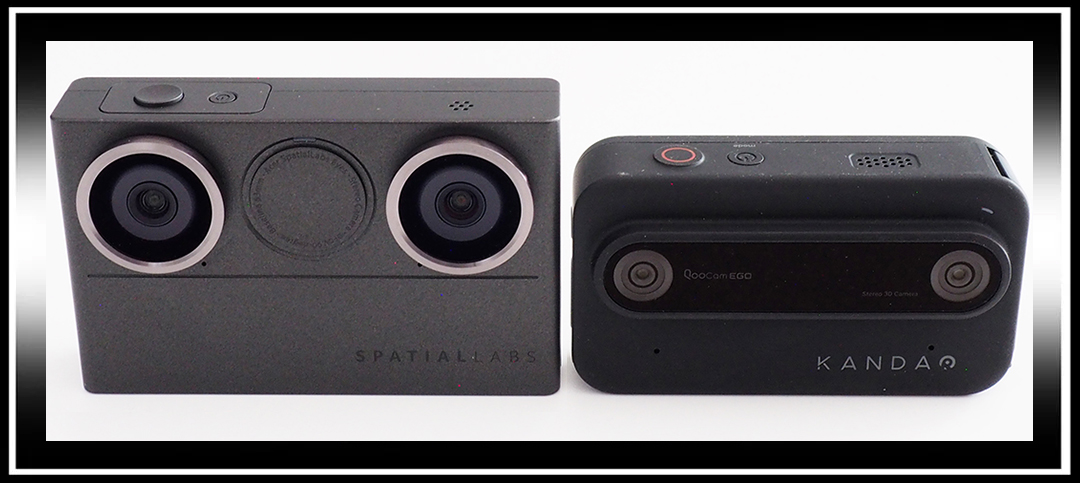
In this post for Stereoscopy Day, we’re coming back to the 21st Century, and will specifically compare the stereoscopic 3-D camera capabilities of the KanDao QooCam EGO and the Acer SpatialLabs Eyes for taking still images. Both of these digital 3-D cameras are currently available from their manufacturers (depending on location), and I’ve finally recently acquired a manufacturer-refurbished SpatialLabs Eyes to put through its paces, and try alongside the QooCam EGO. For previous individual reviews of each camera, please see this post for the Kandao QooCam EGO by Michael Taylor, and this post for the Acer SpatialLabs Eyes by Denis Pellerin.
First, let’s start with a specification comparison:
| Model | KanDao QooCam EGO | Acer SpatialLabs Eyes Stereo Camera, ASEC-1 |
| Aperture | f/1.8 | f/2.0 |
| Focal Length | 27mm | 3.0 mm (equivalent to 21mm) |
| Field of View | 66°(H) 52°(V) | 80°(H) 52°(V) |
| Lens Separation | 6.5cm | 6.3cm |
| Sensor Size & Type | 1/2″ CMOS | 1/2.8″ CMOS |
| Pixels | 12 megapixels | 8 megapixels |
| Photo Resolution | 8000 x 3000 (SBS) | 2 Photo Modes: 7680 x 2160 (SBS or SBS + L + R) 3840 x 2160 (SBS or SBS + L + R) (squeezed) |
| Video Resolution | 2 Video Recording Modes: 3840 x 1080@30fps SBS 3840 x 1080@60fps SBS | 3 Video Recording Modes: 7680 x 2160@30fps SBS 3840 x 2160@60fps SBS 3840 x 2160@30fps SBS (+HDR) |
| Photo Format | JPG, DNG | JPEG |
| Video Format | MP4 | MP4 |
| Audio Format | AAC | AAC |
| Video Bitrate | 60Mbps | 60Mbps |
| Video Coding | H.264 | H.264 |
| Purpose according to manufacturer | “Close to the interpupillary distance of the human eye, the 65mm distance between the two lenses of QooCam EGO captures the world just as you see it, presenting the most natural, comfortable, realistic, and vivid 3D effect. High display resolution of 37 pixels per degree, allows viewers to enjoy clear and lifelike content with rich details, immersing you in the moment. Using the QooCam App and QooCam Studio, you can tweak the horizontal parallax point, making the viewing experience more comfortable. Dive right into the 3D world without fretting about eye strain – it’s all about immersing yourself hassle-free. QooCam EGO outputs 3840*1080 MP4 video, which can be viewed on mainstream 3D viewing devices such as VR headsets, AR glasses, 3D tablets and projectors.” More info: https://www.kandaovr.com/qoocam-ego | “A multifaceted and intuitive camera for unparalleled 3D creation. Beyond 3D shots, it integrates with the Acer SpatialLabs platform so you can create 3D content, stream live, and join meetings in 3D. The Acer SpatialLabs Eyes goes beyond capturing stunning 3D photos and videos. From easy trimming to the fun of sharing your vision on streaming platforms including YouTube, Acer’s Acer SpatialLabs Player 3.0 makes it a breeze, while Acer SpatialLabs video call widget enables engaging in immersive 3D video calls such as Teams and Zoom. Enhance your storytelling by viewing content on Acer SpatialLabs product series from laptops to monitors or engaging through VR/AR headsets such as Apple Vision Pro, Meta Quest, and 3D projectors. So your vision is not just seen, but felt.” More info: https://www.acer.com/gb-en/accessories/cameras/acer-spatiallabs-eyes |
| Touch Screen Size | 2.54″ | 2.41” |
| Touch Screen Resolution | 1600×1440 | 640×480 |
| Screen Pixels Per Inch | 847 | 332 |
| Exposure compensation | -2EV to +2EV | -2EV to +2EV |
| Metering Mode | Multi (center AF) Spot (touch focus point link) Manual (can set to 30-35cm, 35-45cm, 45-60cm, 85-160cm, 130-460cm, 200-inf. cm) | Multi (center AF) Spot (touch focus point link) |
| Available camera shooting modes | Auto, Manual (exposure compensation -2 and +2), Sports (shutter speeds 1/100s or 1/250s) | Auto, Sport, Night, Manual (shutter time/ISO/white balance), Portrait, Landscape, manual sequential stereo available so the baseline can be changed |
| White Balance | Auto, Manual 2000-10000K | Auto, Manual 2300K~10000K |
| ISO | Auto 100 – some say 1600+ | Auto, Manual (100 – 1600) |
| Min. Shutter Speed | 1/15 sec | 1 sec |
| Max. Shutter Speed | 1/6400 sec (TBC) | 1/2000 sec |
| Best distance from subject for comfy 3D depth given by manufacturer | Not given | 50cm~INF (with pixel shift post-processing in applications) |
| Stabilization | Built-in IMU sensor and image stabilization technology | Built-in 6-axis gyroscopic stabilization, Supports IMU stabilization, Video mode: EIS |
| Shutter/ Recording Button | Both physical button on top of camera (many users have complained how difficult it is to press), and an on-screen digital button. | Physical button on top of camera, easy to press, but users have complained it can take a couple of seconds for it to take a photo whilst it focuses; using it in Continuous AF mode eliminates this delay – but it can then be pot luck what it’s focusing on. |
| Weight | 160g (without viewer, including removable battery) | 220g |
| Dimensions | 94 x 53 x 22mm (without viewer) | 104 x 65.4 x 23.2mm |
| Interface | USB-C, WiFi and phone app connection also available | USB-C |
| Memory Card | Micro SDcard, Up to 256GB | Micro SD card, U1 speed above (U3 recommend) |
| Mic | Two-channel Stereo | Built-in stereo mic |
| Battery | Replaceable 1340mAh | Built-in 1500 mAh (min: 1480mAh, typical: 1515mAh) |
| Battery Consumption | About 48 minutes (a bit vague from manufacturer, but in practice it is poor, and even worse when using WiFi, but a flat battery can be replaced with spares if you have them, and ‘battery saver mode’ is an option) | Photo: Up to180 pictures Video: Up to 37 mins |
| Camera timer | 0, 2, 5, 10s | 0, 3, 5, 10s |
| Charge Mode | USB Type-C | USB Type-C |
| Water Resistance | Water Resistant | ‘Weatherproof’, not waterproof |
| Included in the Box | Basic: Kandao QooCam EGO 3D Camera Body, Camera Bag, Camera Battery ×1, Selfie mirror, USB C Cable, Warranty & User Guide But other options at varying prices include the magnetic viewer, more batteries, a charger, micro SD card. | Acer SpatialLabs Eyes 3D Camera, Drawstring pouch, USB Type-C cable, Selfie mirror, Warranty & a very basic instruction booklet, with a QR code for a full online instruction manual. |
| Price in UK | Basic (see above, without viewer): £189. Mid-level accessories, incl. viewer: £279 Full accessories, incl. viewer, 2 batteries & MicroSD: £329 [May 2026] | Currently listed as £489.99 on the Acer website (June 2026), with a 5% reduction offered, but see below. |
| Availability in UK | Readily available from Amazon UK: https://www.amazon.co.uk/s?srs=51706732031&rh=p_89%3AKanDao | Was briefly available from the Acer UK website in 2025, but has continuously shown as out of stock until June 2026: https://store.acer.com/en-gb/acer-spatiallabs-eyes-3d-camera-ff-r2baa-001 Can sometimes find refurbished ones online; can also try stores in Europe, but keep postage, import and customs fees in mind. |
| 3-D Display? | Yes, with optional magnetic viewer, providing instant display in 3-D. | You can see a tiny side-by-side image on the screen, but it’s not really practical to see the image in 3-D. |
| Startup Time: From Holding Down the On Button to Ready to Take a Photo/Video | 20.37 seconds | 5.98 seconds |
| Firmware at time of testing (May & June 2026) | V3.0.5 | V1.003.000 |
| First Released | May 2022 | Official announcement for first release was Autumn 2024, but availability was much later. |
Images of the cameras
(Please note the Acer SpatialLabs Eyes on the left, and the Kandao QooCam EGO is on the right of the images – the other way around to my specs comparison table, well done Rebecca).


Images taken with the cameras
And now to share the comparison photographs from each camera. These images were taken under differing lighting conditions, and both cameras were set to ‘auto’, but please note, as above in the specifications, you can change certain settings to manual to improve the results. The cameras were fixed side-by-side on a bar (as in the above image) and the images were captured at the same moment (or almost!). The image files have been downloaded straight from the cameras, unedited, and uploaded at full resolution to Flickr, so please click on the image if you’d like to see the full file.
Outdoors, in the shade, freehand:
Kandao QooCam EGO:

Acer SpatialLabs Eyes:

Outdoors, in full sunshine, freehand:
Kandao QooCam EGO:

Acer SpatialLabs Eyes:

Kandao QooCam EGO:

Acer SpatialLabs Eyes:

Kandao QooCam EGO:

Acer SpatialLabs Eyes:

Outdoors, partially against the sun, freehand:
Kandao QooCam EGO:

Acer SpatialLabs Eyes:

Indoors, artificial lighting, freehand:
Kandao QooCam EGO:

Acer SpatialLabs Eyes:

Kandao QooCam EGO:

Acer SpatialLabs Eyes:

Indoors, low-lighting, on a tripod:
Kandao QooCam EGO:

Acer SpatialLabs Eyes:

Indoors, studio lighting, on a tripod:
Kandao QooCam EGO:

Acer SpatialLabs Eyes:

Outdoors, cloudy mid-summer’s day:
Kandao QooCam EGO:

Acer SpatialLabs Eyes:

Kandao QooCam EGO:

Acer SpatialLabs Eyes:

Kandao QooCam EGO:

Acer SpatialLabs Eyes:

Kandao QooCam EGO:

Acer SpatialLabs Eyes:

Kandao QooCam EGO:

Acer SpatialLabs Eyes:

Kandao QooCam EGO:

Acer SpatialLabs Eyes:

Kandao QooCam EGO:

Acer SpatialLabs Eyes:

Kandao QooCam EGO:

Acer SpatialLabs Eyes:

Kandao QooCam EGO:

Acer SpatialLabs Eyes:

Kandao QooCam EGO:

Acer SpatialLabs Eyes:

Kandao QooCam EGO:

Acer SpatialLabs Eyes:

Personal user experience:
Both of the digital stereo cameras are compact and therefore great to travel with, and can produce fantastic images, but, as ever, which one has the edge will most likely come down to personal preference and intended use.
The Kandao QooCam EGO’s optional magnetic viewer means you can instantly see the images in 3-D, in almost a View-Master style that’s nice to use, its optics are good (as long as you keep the back screen of the camera and the viewer clean), and I enjoy being able to show others the 3-D images in such a fun and immediate way. Some of the biggest drawbacks for me with the camera, however, are the length of time it takes for the camera to switch on and be ready to take the first photograph, and the relatively poor battery life, even with the most recent updates. You can, of course, switch the camera off between taking photos to save battery, but the startup time is so pronounced that it’s frustrating when you want to take an image immediately, and often miss the opportunity. The physical shutter button is very stiff when you want to take a photo, which also means you can miss important shots and/or cause camera shake, which is particularly noticeable in artificial light (see the images in a supermarket), although you can use an on-screen button to try and help get around this, but it doesn’t always resolve the camera shake.
I’ve always had a problem with my particular EGO camera since new where one lens is quite consistently out of focus and/or there’s a noticeable contrast difference between the two lenses, even with the latest updates (see this post – Kandao were contacted and have never resolved it). This most recently manifested itself last month when I was trying to photograph performers outdoors on a very sunny day, and out of the 80-ish photos I took that day, nearly all of them were unusable due to one lens blurring. It was before I had bought the Acer (and prompted me to look for one!), and actually made me wish I had taken my old Fuji W3 camera instead; whilst it might not have the resolution of the QooCam, it has been consistently more reliable over the years (see this review for the comparison). If you were to buy an QooCam EGO from new and find the same issue, especially if you buy it from somewhere like Amazon, my recommendation would be to exchange it straight away. I bought mine through a Kickstarter campaign, and wish Kandao have exchanged it instead of telling me updates would fix it (which they didn’t).

I’ve found the Acer SpatialLabs Eyes quite a reliable stereo camera, particularly with the balance between the lenses in comparison to the QooCam EGO, even with action shots, but one of the biggest drawbacks for me, as well as for Denis in his review, is the time it sometimes takes to focus, which can be a couple of seconds, even with touch-screen spot focusing, so you can miss an important shot. There is a mode where you can choose for continuous focus, but, unless you’re in very bright light, it can be hit or miss whether it’s the subject that’s in focus, particularly if you or the subject are moving.
You can see the resulting photos show the EGO’s colours, particularly of plants and flowers, are more vivid than the SpatialLabs Eyes when on Auto, but I’ve found the EGO has always struggled with blowing the highlights, but please keep in mind that I was purely using Auto mode for this post, and that exposure compensation and spot metering are available options on both cameras. Being able to tap anywhere on the screen to focus and meter is definitely a welcome addition since I bought the QooCam EGO, and it focuses quite quickly when doing so. The SpatialLabs Eyes copes better in lower light, especially with stabilisation, but you can see a strange purple hue creeps in when the light is too low, which I kind of like in an arty way, but each to their own. Both cameras would really benefit from a digital spirit-level, and lens shades.
You can see from the specs that there can also be quite a big difference in the resulting image format, and the SpatialLabs Eyes wider images definitely look more geared towards VR, whilst the QooCam EGO’s images are better intended for its snap-on viewer, and perhaps for producing stereo cards, although, with both formats, you can crop the images for stereo cards using free software StereoPhoto Maker. I’ve tried files from both cameras in a Meta Quest 2 headset and they are both fantastic quality to view in 3-D. Downloading images onto a desktop is straight forward for both cameras, with a USB-C cable, but the EGO may have an advantage for some users with its ability to connect to phones directly using its app via WiFi.
Whilst the battery life of the QooCam EGO is relatively poor, being able to physically change the battery is a definite bonus over the SpatialLabs Eyes, as I worry what will happen when the Eyes’ built-in battery needs replacing; if it’ll be an expensive replacement only the manufacturer can undertake, or if it’s even possible. The QooCam EGO also has quite a big price and availability advantage over the SpatialLabs Eyes, which will most likely be the deciding factors for many. I was very lucky and managed to buy my Acer as a like-new manufacturer refurbished camera, in its original box and with all the accessories, for less than half price of a new camera. I’m not convinced, however, that I would want to (or could!) pay the full price for the new camera, no matter how much faster it is to switch on, as the EGO can also take high quality photos…. when it wants to, just be careful you don’t buy a faulty one like mine.
Conclusion
I thought this comparison and review would be walk in the park for the Acer SpatialLabs Eyes camera compared to the Kandao QooCam EGO, based on my longer and often frustrating experience using the EGO, and reviews by people who have had the SpatialLabs Eyes for a longer time than me, but I personally couldn’t recommend one over the other. I thought by adding the Acer to my stereo camera arsenal I’d be ready to retire the QooCam, but I can see benefits and drawbacks for both of the cameras, to the point where I will keep and use both of them, depending on the subject, environment, and the intended use of the images.
The EGO’s long switching on time, poor battery life, and inconsistencies between the two lenses have really put me off the camera over the years, but when it manages to capture a good stereo photo, they are really nice to view in 3-D, especially with the optional viewer. The Eyes’ frequent delay for focusing, high price, built-in battery, and infrequent availability are big drawbacks, but, overall, it’s a much more reliable camera for me, with both lenses more closely matched and synched when compared to my EGO. I appreciate I’m trying to use stereo cameras which are more geared towards use with VR/AR, the attached viewer, and/or the manufacturer’s other ‘spatial’ products, such as screens. I still cling on to the hope, however, that one will eventually be as functional as the 2010’s FujiFilm W3 as a compact stereo camera, but with better optics, but, for me, we’re not there yet with these two.


Interesting conclusion, I also thought it would be a walkover for the Acer. That it ISN’T, tells me it’s not worth what they ask for it. And a built in battery is a no no. Nobody wants a camera that can’t take a spare battery, surely. Shame.
I’ve not used either (W3 owner, though) but the Ego would drive me nuts, I think, given all the flaws. Tempted by an XReal Beam Pro more than either of these I think but the W3 still works well.
LikeLiked by 1 person
Yes, I wouldn’t pay the current £490 they’re asking for it! There’s no doubt it’s a good camera, but I still think I’m the problem trying to use it as a stereo camera, instead of spending even more money to use it with one of their ‘Spatial’ screens. Maybe that would make me appreciate it more and see it in a different light, but I’m not willing to spend a fortune on another of their products. I know people with the EGO who love it, it really comes down to the camera working as it should do, and some patience I guess, which I don’t always have with digital. I don’t have an X Real Beam Pro, but it’s another one where some people are singing its praises, and others are totally disappointed with it, but again, it’s more for use with its AR glasses I guess. It’s definitely more affordable than the Acer though!
LikeLiked by 1 person
Yeah, I remember the confusing Acer marketing involving a screen. Nothing really about “using it as a regular camera”. Very odd design. You would think there would be a market for a regular DSLR type camera aimed at stereos. Or more stereo lenses. I see Canon do have stereo lenses for their DSLRs but they are all costing 4 figures for the lens alone. Back to the W3 I think…!
LikeLike
I have an Xreal Beam Pro and as much as I like the quality of the photos, the only way to view them is by crossing your eyes or using a VR headset (which still doesn’t have a decent stereoscopic gallery viewer).
At this stage I believe we’re just not quite there yet. I hope it doesn’t end up being a fad where all of the companies create these cameras for a short time and then give up (like we’ve seen with 3D TV’s).
I’d love to have a point and shoot stereoscopic camera with good image quality and a way to view them, but I won’t hold my breath. Until then I’m mainly using my iPhone to take spatial images and the use an app to separate them into a stereo pair (the lens distance isn’t that great, but you still get some separation).
That’s purely because I have it with me anyways and the X Real I only use if I have a dedicated reason to bring it, as it’s quite large.
Hope this can help a bit should you decide to give it a try. 🙂
LikeLike