
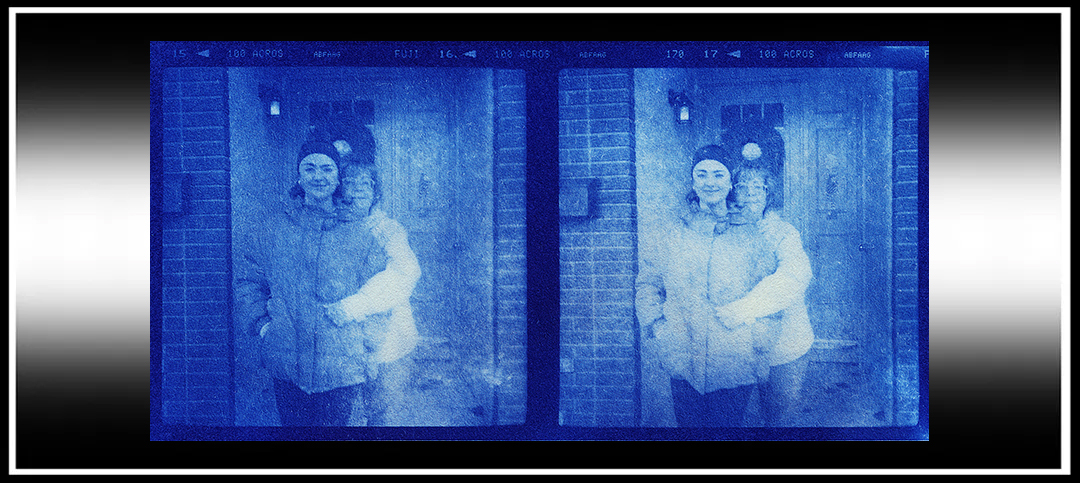
Photographer Howard Sandler has very kindly written in to share how he made a stereoscopic cyanotype straight from the negatives of an inexpensive single lens medium format (120) camera. A perfect experiment to coincide with Stereoscopy Day and the Summer Solstice in the Northern Hemisphere, and will hopefully inspire more folks to join in.
Hi Rebecca, I thought you might be interested in this experiment I did, partly inspired by your cyanotype and contact printing blog posts. I offer it as a contribution to the Stereoscopy Blog.
I noted that 6×6 cm negatives from a medium format camera are about the right size for stereo pairs on card. However, with stereo cameras, the image from the left-eye side lens will appear on the right on a negative strip because of the image turning upside down through each lens. As far as I know, stereo cards made from such cameras always require the negatives to be cut and re-arranged before or after printing to make a side-by-side view stereo card.
A sequential exposure approach is needed if the aim is to contact print the pair from a negative strip without having to cut either the strip or the contact print and rearrange the two chips.
I have a suitable medium format folding camera in which the film travels horizontally (Adox Golf 45S, an inexpensive mid 1950s folding camera). The film travels left to right in this camera, with respect to viewing the scene from the camera’s position. If I exposure the left eye view first, the negative strip has the pair adjacent and in the proper orientation for a stereo card. In some folding cameras the film travels right to left, and in this case, one would exposure the right eye view first.
I developed a roll of Fuji Acros film to get fairly contrasty dense negatives as recommended for cyanotypes. Then I cut the pair of views, laid them on watercolor paper coated as one normally does for cyanotypes, put a sheet of thin picture frame glass over the whole arrangement to press everything flat and made an exposure by mid day sunlight (10 minutes for latitude 45 degrees in Canada in early spring was about right).

I rather like the result (scan of a stereo portrait of my wife and step daughter attached). This was printed on 5×7 inch watercolor card stock and fits directly in my Owl viewer, but the image size and spacing are suitable for direct free viewing too.
Best regards,
Howard
You can find more of Howard’s stereo images on flickr: https://www.flickr.com/photos/hsandler/albums/72157674884839827 These are a mix of digital images (either sequential with a digital camera or with a Fuji Real3D W1) and analog (either sequential or with analog 35mm stereo film cameras, mostly a Revere stereo 33).
Howard also appeared on a Canadian film photography podcast to talk about stereo photography with film cameras a few years ago: classiccamerarevival.podbean.com/e/classic-camera-revival…
Thank you so much Howard for sharing this. It is such a wonderful idea; I really like the style of the film name and frame numbers of the negatives on the final prints, and this can be a great way to make inexpensive analogue stereoscopic prints, depending on your camera, with readily available cyanotype kits.
Happy #StereoscopyDay

Copyright © The Stereoscopy Blog. All rights reserved.

