
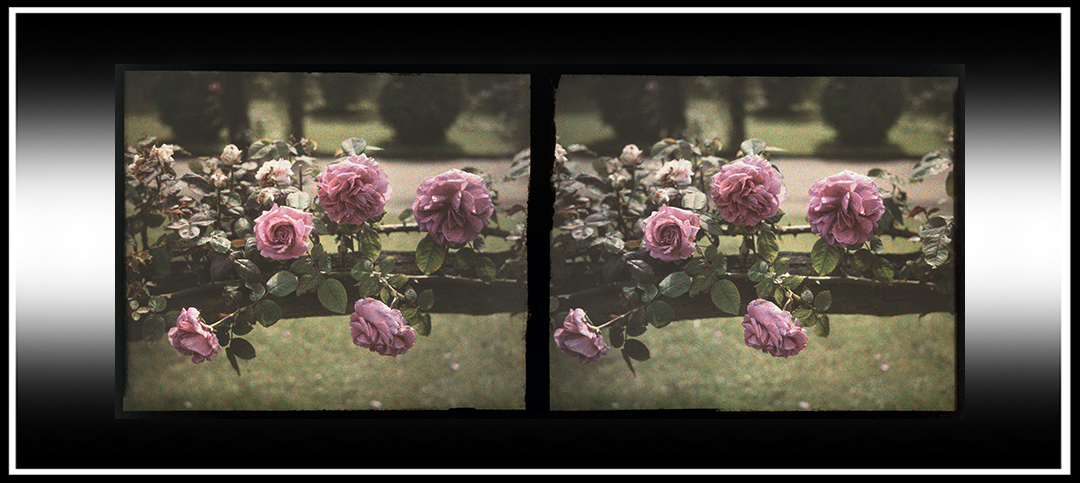
I wanted to share some amateur autochrome stereoviews from my collection so anyone unfamiliar with the process can see how beautiful they are.
Helping to make stereoscopic 3D accessible to everyone
Author: Rebecca
I wanted to share some amateur autochrome stereoviews from my collection so anyone unfamiliar with the process can see how beautiful they are.
You don't need expensive cameras or software to make your own stereoscopic 3-D images. It's relatively easy and there's currently a real buzz on social media with people making their own stereoviews with smartphones and sharing them, especially on Instagram, so this tutorial will be keeping this in mind.

Nishika 3-D N8000s were first produced in 1989 and were four lens (quadrascopic) cameras designed to produce four half-frame instantaneous images from a click of the shutters. Lenticular prints could be made from the negatives. Nowadays you're most likely to see animated 3-D GIFs or 'Wigglegrams' made from them on Instagram, especially if you follow the coolest people.

A beginner's step-by-step guide to getting started with StereoPhoto Maker, a powerful free tool to help you make your own stereoviews.

There are different ways to view images in a stereopair and they all rely on each image being viewed separately by the corresponding eye so your brain can fuse the two 2-D images into one 3-D image.

Well, it'd be a bit naughty to start a blog about stereoscopy and not say what it is! In a nutshell: Stereoscopy uses the illusion of depth to create a single 3-D image from two flat images when viewed by each eye separately.

Hello and welcome to my blog dedicated to all things Stereoscopic past, present and future. My aim is to help make stereoscopy accessible to everyone, regardless of experience and knowledge, demystify it, and show how entertaining, enjoyable, artistic and educational it is. I wanted to create a free and open resource which includes tutorials so anyone can join in and learn about the aspects of stereoscopy which interest them, in their own time and at their own pace.
 The Stereoscopy Blog