
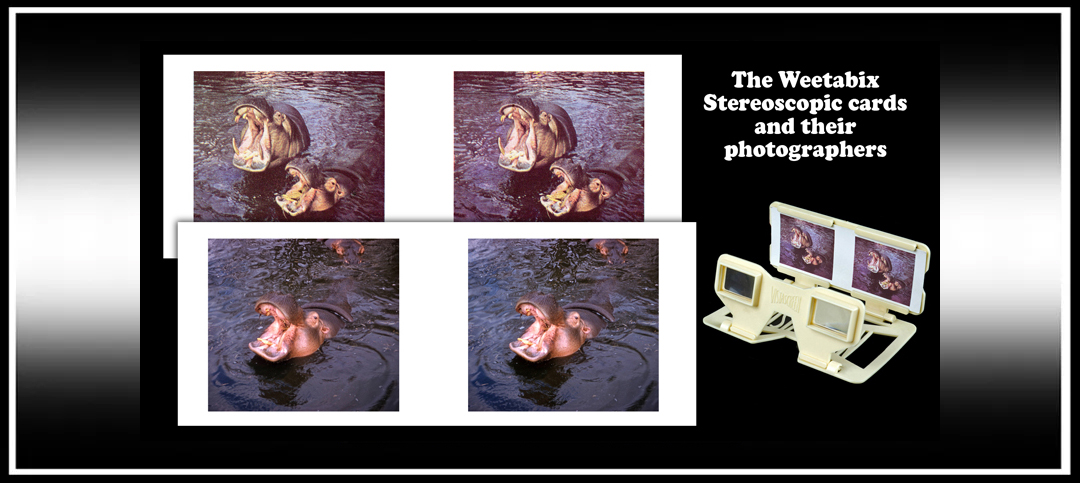
Between 1960 and 1963, the Weetabix breakfast cereals company published six sets of 25 rather crudely printed coloured stereoscopic cards which, aimed mostly at children, were offered as promotional items in their various products. Based on advertisements found in the press of the time, the sets were issued in the following order:
1960 : Animals
1960 : Working Dogs
1961 : Our Pets
1961 : Thrills
1962 : British Birds
1963 : British Cars
Up to this day, only one photographer responsible for those images has been acknowledged. Her name was Margaret Patricia “Pat” Whitehouse (1922 – 1988), and to this day she remains famous for the quality of her 3-D shows, and for the fact that she built her own cameras to photograph insects, birds, flowers, and mosses, her husband Harold being a botanist.
Before we examine Pat’s work and introduce the photographer responsible for four of the other sets of Weetabix cards, it may not be useless to travel a few years back in time in order to see how those cards came into being.
It all started in the mid 1950s with three men: Jack and Jeff Spring, who were running the Capital Paper Company and were trying to diversify their production, and a former RAF photographer named Stanley Alfred Long who was taking nude photographs for a men’s magazine. It has proved impossible to find any information about the Spring brothers but, fortunately, we know a bit more about Stanley, who was born in Lambeth, London, on 26 November 1933, to Alfred Long and Eleanor Charlotte Beresford. Some time in 1956, the three men founded the Vistascreen Ltd. Company, whose purpose was to publish stereoscopic cards centred on British subjects to compete with the popular but expensive View-Master reels which concentrated mostly on American places and topics. Stanley Long designed a cheap, collapsible viewer and, with his Heidoscop stereoscopic camera, started taking photos of places of interest, first around London, then in all parts of the British Isles. He selected ten pictures out of all the images he would take in one place and would print them and caption them before rephotographing them together on a single plate, which could then be printed in one go, before the final images were cut to size and presented in a booklet which was itself placed in a small cardboard box. The images were real black and white photographs, much bigger than View-Master’s tiny colour transparencies, and there were ten of them as opposed to View-Master’s seven. Both the viewers and the set of ten cards were sold for 2 shillings 6 pence each, which was way cheaper than the 29 shilling View-Master viewer and the 5 shilling reels. And it worked, at least for a while ! About 300 different sets were produced by Vistascreen over a relatively short life span of just over three years.

01. List of cards sold by Vistascreen. There are 257 different sets here. Author’s collection.

02. Vistascreen box (No. 49 – Dogs), booklet of ten images and one of the images. Author’s collection.
Advertising played a large part in the success of the company. Some special pictures (a view taken from the top of the Monument in London looking down, but also a three dimensional photograph of the Sputnik Satellite, of the control panel of the new Comet airliner, of the skeleton of a prehistoric man inside Cheddar Caves) were given free in exchange for the person’s name and address, along with the word COMET PHOTO, SPUTNIK or CHEDDAR written on a postcard and sent to the company’s headquarters at 16, Soho Square, London, W1. There were also seven, then six “Vista Lovelies” (three former beauty queens, a fashion model and two dancers), giving a 30-minute programme of physical culture exercises and touring the whole of Britain in the summer of 1957 (45 towns altogether) to advertise the company, whose name they were wearing on a sash, and publicise a nation wide beauty contest. Vistascreen viewers and slides – some of which were of the very town where they were performing – were available for sale in the places they appeared in.
Some time in late 1959 or early 1960, Stanley Long and the Spring Brothers fell out over money and the company was eventually sold to Weetabix. This latter firm’s career actually started in Australia when some time in the 1920s Bennison Osborne, the inventor of the product, went into partnership with his friend Malcolm Mac-Farlane to launch Weet-Biscs (later renamed Weet-bix). The product was introduced in Britain some years later under the name Weetabix and the British branch of the company took the name Weetabix Limited in 1936. It was only with the purchase of the Vistascreen franchise in 1960 that Weetabix started introducing gifts and memorabilia in their packets of cereals. It can, therefore, be said that the Weetabix viewer and cards are historically important for the company.
The viewer customers could obtain in exchange for 1 shilling 6 pence and a coupon cut out in a magazine or on the packet of one of the Weetabix products, was a very slightly modified version of the Vistascreen one. The base of the viewer still bore the name Vistascren as did the lens panel but the back had the Weetabix name in gold lettering. The viewers came in two colours – ivory and red – just like their Vistascreen predecessors. The main change came in the way the views were printed. They were all in colour but were no longer real photographs, thus making them much cheaper to mass produce, even though it meant the quality of the image was far from being as good.

03. Vistascreen and Weetabix viewers with their original boxes. Author’s collection.

04. Pat Whitehouse. Weetabix card from the 1962 “British Birds” series. No. 01. Blackbird. Author’s collection.
Pat Whitehouse, whom I mentioned earlier, provided the 25 photographs that make up the 1962 set entitled “British Birds” [1]. Pat established her reputation as a wildlife stereo photographer with her images of insects and birds. A lot of her photographs were taken in her Cambridgeshire garden, or very close by. She would observe where birds were starting to build their nest, set up her self-made ‘Baby Bertha’ camera close to it and, concealed in a nearby bush, a tree or a hide, would patiently wait for the right moment to press the release cable attached to her camera. She would usually operate at dawn when birds were most active and less likely to be disturbed by humans. Pat Whitehouse was an active member of the Royal Photographic Society, of the Stereoscopic Society, of the French Stereo Club and of its German equivalent, as well as of the Third Dimension Society. Her 3-D Slide Shows, complete with recorded comments and music, were always very much appreciated and some of them even received standing ovations.

05. Modern stereoscopic card from a pair of photographs by Susan Pinsky. Pat Whitehouse changing a projector lamp during one of her presentations. By kind permission of the photographer.
It is now time to reveal the identity of another photographer who was responsible for four of the remaining five sets of Weetabix cards. Here is how it all began. Some months ago, while looking for stereoscopic photographs on eBay, I chanced upon a 35 mm stereoscopic slide of a British car, an Alvis 3 litre, which I recognised as a variant of an image belonging to the 1963 Weetabix set devoted to British Cars.

06. (top) Photo of the 35 mm stereocopic slide as it appeared on the eBay listing. (middle) Front of the corresponding Weetabix card from the British Cars set. (bottom) Back of the same card. Author’s collection.
I bought the image at once, not only because I had recognised it, but also because the seller obviously knew what it was and who had taken it. I received the image, scanned it, cleaned it digitally and this what it looks like when shown as a stereoscopic card. As you can easily see the quality of the original photograph is way better than that of the printed card.

07. One of the original photographs of the Alvis car as a stereoscopic card. Author’s collection.
I then asked the seller if, by any chance, he had any other photos of the same kind and was surprised to hear from him that he had about ninety (!!) and that they had been given to him by the very person who had taken them. Her name was Sally Anne Willbie but she was better known in the photographic world under her maiden name of Sally Anne Thompson. In spite of the fairly large sum involved and my little interest in cars, I purchased the ninety-odd slides, because it is not often one has such an opportunity of buying the outtakes of a stereoscopic photo shoot, and started asking more questions about the photographer. The seller knew her fairly well and would occasionally meet her and chat with her when he was walking his dog but he had not seen her for quite a while. With my colleague Rebecca we started doing some research on Sally Anne Thompson and making enquiries as to how she could be contacted. We soon learnt that Sally and her husband were very well-known in the dog world, more particularly as members of the Norfolk Terrier Club and that Sally was famous in her own right as an animal photographer. I read in a forum that her husband Ronald Willbie had passed away on 18 July 2025 and that she was now living in a care home. I wrote a long letter to Sally’s address in the hope that someone might find it and bring it to her, while Rebecca sent a message to the Norfolk Terrier Club. She was the one who struck gold ! She got a nice reply giving her the email address of Sally’s only relatives. I immediately wrote to them and I explained about the slides that I had bought, the Weetabix sets of cards and how I was really interested in knowing more about Sally and her stereoscopic work. It was soon decided we would meet the next time they visited Sally in her care home. Everything happened as planned but, unfortunately, Sally was just back from a dentist’s appointment when we met and she was not at her best. The rules of the care home – perfectly understandable – did not allow me to take any photos of her but I was able to talk to her for a while and to ask her a few questions. I had brought a Verascope f 40 camera, as Rebecca had found out by measuring the film in the slides I had bought that Sally had used a similar camera to take her photos of the British cars (this was further confirmed by the seller of the slides who had seen the camera), along with some cards I had made from the slides in my possession. Sally’s relatives were more than helpful and kind, and they not only showed me all the stereoscopic transparencies they had been able to find in Sally’s house, but very nicely allowed me to take them home, along with the Stereolist viewer she used so that I could scan and/or photograph them at leisure. I could not believe it and to this day I can’t express my gratitude for such kindness.

08. Sally’s slides and viewer as they were lent to me by her family.
When I received the ninety slides I had bought it was clear that they were in urgent need of attention. The tape around the thin glass plates that protected the film had gone dry and was falling off as soon as you touched it. I also found out that the thin metal mounting masks sandwiched between the glass plates had corroded, and a white powder was seeping out and covering the emulsion. I very quickly got rid of the tape and the glass, dusted the powder off, and scanned the images, while keeping the very thin paper mask bearing the pencilled name of the slide and, more importantly, the address and telephone number of the maker of the slides:
| Stereoscopic Photography 4, Marylebone Mews London. W. 1. Wel. 0503-4. |
I also found most of the slides that were lent to me by Sally’s relatives were in a smilar condition, some even worse as only the thin metal mounting mask remained and the tape holding the small film halves of the stereoscopic pair popping off as soon as I removed them from the pile. Again, I got rid of as much dry tape and broken glass as I could, cleaned everything as gently as possible, scanned the images and put them away in archival sleeves until I could buy enough vintage cardboard mounts and find ample time to remount them all.

09. Two of the slides I originally bought and the condition they were in before I delicately cleaned them. Author’s collection.
On examining the slides I had brought back from my visit to Sally’s care home and the ones I had purchased on eBay it was obvious that I was only looking at a small portion of her stereoscopic production and that the images which had been used to make the Weetabix cards were not part of them. They were given to the Weetabix people and they may still have them in their archives but my request for information met with complete silence.
What I had before me, therefore, were some of the outtakes of the various photo shoots she had made. Over the years some of the photographs had probably been damaged, lost, or given away. For example in the lot I had bought only twelve of the twenty-five cars from the card set were represented, to which must be added two which had not made it to the final selection: the Landrover Series II and the Morris Oxford Series VI Farina Traveller.

10. Sally Anne Thompson. Landrover Series II. One of five stereoscopic slides in the author’s collection. This car did not make it to the final selection.

11. Sally Anne Thompson. Morris Oxford Series VI Farina Traveller. One of nine stereoscopic slides in the author’s collection. Another car which did not make it to the final selection.
Among the slides in my possession I had seven different images of the Alvis 3 litre (highest number, 9), two of the Daimler V.8. S.P. 250 (highest number, 11), seven of the Aston Martin DB4 (highest number, 12), nine of the Morris Mini Minor (highest number, 19), etc.
The same applied to the slides which had been lent to me by her family but there were enough examples to make me realise that Sally had been responsible for four of the six Weetabix sets, namely, Animals, Working Dogs, Our Pets and British Cars. This means the only series whose author remains unknown is the 1961 ‘Thrills’ one. If anyone knows the photographer of this set, I would really love to hear from them.
After this rather long introduction, it is high time to properly introduce Sally Anne Thompson, and talk about her career as a stereoscopic and monoscopic photographer.
Sally Anne Thompson was born at Hampstead on 5 April 1934 to John de Forest Thompson (Ohio, USA, 12 July 1899 – London, 16 August 1978) and his wife Ruth Cockburn (Isle of Wight, 9 July 1903 –London, 5 October 1988) [2]. John and Ruth had married three years earlier at Holy Trinity, Brompton.
At the time of her birth, Sally’s father was already running a fashion photographic studio which was located at 20, Dean Street, Soho, and was the British branch of Egidio Scaioni’s Paris establishment which opened first at 15, rue Malebranche (5th arrondissement), then moved to 18, rue Saint-Simon (7th arrondissement). The London studio had opened in 1931 as is testified by a 50th anniversary tile by Pauline Clements still in the family.

12. Sally and her mother in 1934 at 20, Dean Street. Sally Anne Thompson’s Family Archive.

13. Tile by Pauline Clements commemorating the 50th anniversary of the London Scaioni Studio. Sally Anne Thompson’s Family Archive.
Sally was only five years old when the war broke out. The 1939 Register, taken on 29 September, shows that she was living then at her grandmother’s, on the Isle of Wight, with her younger brother John (born on 8 June 1936) while her parents remained in London.
On 17 September 1940, only ten days after the beginning of the Blitz, disaster struck when a bomb demolished the studio at 20, Dean Street. Royal Artillery Lieutenant John de Forest Thompson was informed of the fact by a postcard sent to him at his Anti-Aircraft Officer Cadet Training Unit in Shrivenham, Berkshire. The card reads:
| 18.9.40 Arrived this morning to find studio completely demolished. The office, books, etc., are intact but there is nothing but a large hole where the workroom & studio were. Mr. Lewis is seeing Mr. Page immediately. All well & in good health. Love from us all. Jean |

14. Postcard informing Lieutenant John de Forest Thompson of the destruction of his photographic studio by a bomb. Sally Anne Thompson’s Family Archive.
A new studio was opened at 4, Marylebone Mews, off New Cavendish Street, London, W1. If you remember, this is the address that was printed on the mount mask of the first car slide I had bought, and on the ones I later purchased. The business was run by John de Forest Thompson until his passing in 1978, then by his son John. The building still exists and is still called The Studio, but it has been unoccupied for years.

15. Modern stereoscopic card showing the Scaioni Studio at 4, Marylebone Mews, London. One will recognize the building drawn on the 50th anniversary tile by Pauline Clements. Photo by the author.

16. Modern stereoscopic card showing the Scaioni Studio at 4, Marylebone Mews, London. Photo by the author.
When the war was over, Sally went to Hanford House Prep School for Girls, near Blandford Forum, Dorset. The 17th century Jacobean mansion built in 1632 by Sir Seymer, teller of the Exchequer, was converted to a school in 1947 by the Reverend Clifford Canning and his wife Enid. Sally must have been among the first pupils taught there. Her school certificate, dated July 1950, shows two passes and six credits. She then went to a finishing school in Switzerland before entering her father’s business and learning her job the hard way. She trained at the Regent Street Polytechnic and went on fashion shoots for her father for further practice. Around this time, an article published in the Daily Express on 15 May 1952 shows that Sally, at only 18 years old, was described in a derogative way about her appearance by her strict father:
| TALKING OVER ALL THOSE THINGS THAT GIVE THE HOMELY TOUCH TO FAMILY LIFE THE HOME PAGE IS BACK AGAIN […] AND ON FOOD, OUR THEME IS THE DUMPY DAUGHTER .. Now why not a Dumpy Daughter diet, to follow the Tubby Hubby series [3] ? That suggestion comes from reader John de Forest Thompson, of Marylebone-mews, New Cavendish-street, W. Dumpy Daughters, as everyone knows, are suffering from puppy fat. Dumpy Daughters go to dances. And Dumpy Daughters mind being dumpy ten times more than Tubby Hubbies mind being tubby. So here for the daughter is a slimming guide in a just published book which plays down the spartan side of dieting and gives 200 dishes – delicious as well as non-fattening. […] |
Among the slides lent to me by Sally’s family is the only stereoscopic portrait of her, probably taken in 1952 or 1953, around the same time as the above article was published.

17. John de Forest Thompson. Stereoscopic portrait of Sally Anne Thompson in her teenage years. Sally Thompson’s Family Archive.
It must have been around the time this portrait was taken that John de Forest Thompson, and his daughter, started being interested in stereoscopic photography. An article, published in the Kirriemuir Free Press and Angus Advertiser on Thursday 18 June 1953, in the Northern Chronicle and General Advertiser for the North of Scotland on June 24th and in the Banbridge Chronicle on June 27th, clearly proves that Mr de Forest Thompson was very much into 3-D then, which is not really surprising considering that the early 1950s were the time when, for a short period, 3-D movies were immensely popular and photographers, be they amateurs or professionals, had a large range of 35 mm 3-D cameras to choose from. [4]
| From a Londoner’s Notebook 3-D Salesmen Mr. J. de Forest Thompson, who has been in the photographic business in London and Paris for many years, has been showing me a modern “magic lantern,” which is going to revolutionise the travelling salesman’s job and play a big part in boosting British products abroad. He produced a small plastic box, slipped in a slide, pressed a button, and I was looking at a 3-D colour picture he had taken of a tractor plough carving a furrow across a field. Apart from the fact that it was, of course, still, it was just like the real thing. Another slide … and there was a pretty girl wearing a new frock, every detail of the frock plain, the girl as live as through she were in a mannequin parade. No words, no catalogues, no flat photographs will sell goods like these 3-D pictures will. Mr. Thompson is getting busy with his pictures. |
Among the slides I brought back from my visit to Sally’s are a few fashion and glamour shots probably taken by Sally as part of her apprenticeship to her father. Here are three of them.

18. Sally Anne Thompson. Fashion stereoscopic photograph taken in the Marelybone Mews studio. Sally Anne Thompson’s Family Archive.

19. Sally Anne Thompson. Glamour stereoscopic photograph taken in the Marelybone Mews studio. Sally Anne Thompson’s Family Archive.

20. Sally Anne Thompson. Glamour stereoscopic photograph taken in the Marelybone Mews studio. Sally Anne Thompson’s Family Archive.
Sally’s training was thorough and since 3-D advertising was considered a thing at the time, she also tried her hand at it. Unfortunately, I could only find one example of her advertising work in the slides I was lent.

21. Sally Anne Thompson. Still Life with flowers and an electric iron, taken in the Marylebone Mews studio either as an exercise or for a commission. Sally Anne Thompson’s Family Archive.
However good she may have been at photographing still lifes or curvy models, Sally’s heart was neither in fashion or advertising. Her real passion lay in photographing animals, and she soon made it clear that was what she wanted to do. It was a bold move as there was little money to be made at the time in animal photography. In an article published in The Citizen on 4 February 1986 under the title “Capturing animals – with a camera!”, Sally herself confesses that “Fashion photography was definitely not my thing and I branched out into dogs, show dogs in the main. It was not easy and I got laughed at by the fashion photographers when I decided to do it.” Fortunately for her, she met Vera Watkins, a famous dog breeder, who suggested she hired a tent to display her photographic work in the major dog shows taking place in the South of England. Sally followed her advice and her first dated stereoscopic images (1956) show her tent in Aldershot and at the W.E.L.K.S. [5] annual dog show.

22. Sally Anne Thompson. Sally’s tent at the Aldershot dog show. 1956. Sally Anne Thompson’s Family Archive.

23. Sally Anne Thompson. Sally’s tent at the W.E.L.K.S. dog show. 1956. Sally Anne Thompson’s Family Archive.
Sally soon made a name for herself with her beautiful portraits of dogs and cats, some of which she took in the stereoscopic format, and in 1957 she set up a business named Animal Photography which was incorporated into a limited company on 8 August 1963, with her parents as the first two subscribers.

24. Sally Anne Thompson. Stereoscopic portraits of dogs. Original 35 mm slides with name and address. Sally Anne Thompson’s Archive.

25. Sally Anne Thompson. Stereoscopic portrait of a dog made into a stereoscopic card from the original 35 mm slide.

26. Sally Anne Thompson. Stereoscopic portrait of a dog made into a stereoscopic card from the original 35 mm slide.
In 1960 some of Sally’s monoscopic photographs were published in a book entitled The Beauty of Gliding, with an introduction by Philip Wills. Sally had started taking gliding lessons in 1955 and had got her gliding certificate in October of that same year. She was a member of the Lasham Gliding Club, Hampshire, now one of the largest gliding clubs in the world, which was started in 1951 on a former RAF airfield. In 1956 Sally took some stereoscopic photographs of Lasham where she was to meet her future husband Ronald Willbie. More about this later.

27. Sally Anne Thompson. Lasham Gliding Club back in 1956. Sally Anne Thompson’s Family Archive.

28. Sally Anne Thompson. Glider about to land at Lasham. Sally Anne Thompson’s Family Archive.

29. Sally Anne Thompson. Philip Wills and Kitty. Sally Anne Thompson’s Family Archive.

30. Sally Anne Thompson. Gliding event at Lasham. Sally Anne Thompson’s Family Archive.
1960 was also the year when Sally became involved with Weetabix through the Godbolds advertising agency. Sally’s family located one of her order books from that year but it only seems to start in September, months after she must have taken the stereoscopic photographs for the Weetabix “Animals” [6] and “Working Dogs” [7] sets of cards, respectively released around April and September 1960.

31. Advertisement for the Weetabix “Animals” set of stereoscopic cards. Published in the Eagle magazine on 23 April 1960. Author’s collection.

32. Second advertisement for the Weetabix “Animals” set of stereoscopic cards. Published in the Eagle magazine on 4 June 1960. Author’s collection.

33. The Hippo stereoscopic card (number 24 in the series) which started Sir Brian May’s lifelong passion for Stereoscopy. Front and back. Author’s collection.

34. Sally Anne Thompson. Eight original slides taken of the hippos at the zoo for Weetabix and bearing the name of the photographer. Sally Anne Thompson’s Family Archive.

35. Sally Anne Thompson. Stereoscopic card made from one of the hippo slides. Sally Anne Thompson’s Family Archive.

36. Sally Anne Thompson. Stereoscopic card made from one of the hippo slides. Sally Anne Thompson’s Family Archive.
The slides I was given to scan also include photos of the Camel (No. 3 in the Weetabix cards set), the Tiger (No. 4), the American Bison (No. 6), the Kinkajou or honey-bear (No. 7), the Giraffe (No. 13), the Chimpanzee (No. 21), the Mountain Goat (No. 22), the Moufflons (No. 22), and the Prairie Marmot (No. 25). There are also two slides of flamingoes which are not part of the cards set.

37. Sally Anne Thompson. The Kinkajou. (top) Stereoscopic card after the original slide. (bottom) Weetabix card #7. Sally Anne Thompson’s Family Archive and author’s collection.

38. Sally Anne Thompson. The Chimpanzee. (top) Stereoscopic card after the original slide. (bottom) Weetabix card #21. Sally Anne Thompson’s Family Archive and author’s collection.
There are no surviving order books for the first half of 1960, the year Weetabix published the “Animals” and “Working Dogs” sets but there is sufficient evidence in Sally’s archive of stereoscopic slides to show Sally was responsible for the images that constitute that latter set too. After all, she was by then well-known for her photographs of dogs. Examing the images one wonders if Sally was not also the photographer behind the Vistascreen Dogs set (No. 49) which I showed one image of earlier on (see illustration 2). It is established that Stanley Long photographed most of the Vistascreen sets but that other unnamed persons were involved too. At the moment, however, I do not have sufficient evidence Sally was behind the camera for the Vistascreen Dogs set and it is but conjecture.

39. Advertisement for the Working Dog set published in the Northern Whig on 30 September 1960. Author’s collection.

40. Sally Anne Thompson. Basset Hounds. (top) Steroscopic card from the original negative. (bottom) Weetabix card No. 6. Sally Anne Thompson’s Family Archive and author’s collection.

41. Sally Anne Thompson. Guide Dogs. (top) Steroscopic card from the original negative. (bottom) Weetabix card No. 8. Sally Anne Thompson’s Family Archive and author’s collection.

42. Sally Anne Thompson. Irish Wolfhound. (top) Steroscopic card from the original negative. (bottom) Weetabix card No. 21. Sally Anne Thompson’s Family Archive and author’s collection.

43. Sally Anne Thompson. Irish setter. (top) Steroscopic card from the original negative. (bottom) Weetabix card No. 25. Sally Anne Thompson’s Family Archive and author’s collection.
Before the year 1960 was over, Sally was asked by Weetabix to take stereoscopic photographs for their next set of cards, “Our Pets” [8]. This time the pages of Sally’s order book for that period describe what she photographed for them.
| No. 8605 13/9/60 Godbolds Stereo Sally Stereo photographs at the zoo of Hamsters, Hedgehog, Tortoise, Guinea Pigs, Alligators, Polecat, Ferret, Canarys [sic] |
| No. 8609 29/9/60 Godbolds Stereo Sally Stereo photographs for Weetabix At Mr. Holmes’. Squirrels, Owl, Rabbits, Pony, Goats, Donkey, Cat, Mongrel, Badger. At Mrs. Duckers’. Shetland Ponies At Mrs. Whetereds’. White cats At Mrs. Airkens’. Manx cat At home. Snail, Timothy [Sally’s own Siamese cat], Mynah Bird, Mice At Mrs Roberts. Abyssinian cat |
| No. 8611 29/9/60 Godbolds Stereo Sally Photographs in stereo of Pets at Pet Shop of Tortoises, Terrapins, Parrot, 2 Monkeys, Budgys. |

44. Sally Anne Thompson. Three pages from her 1960 order book. Sally Thompson’s Family Archive.
Once again it is interesting to note that some animals didn’t make it to the final selction. They include the alligators, the polecat, the ferret, and the terrapin turtles.

45. Sally Anne Thompson. Stereoscopic card after the original slide. Rabbits. Variant of No. 7 in the Our Pets set. Sally Anne Thompson’s Family Archive.

46. Sally Anne Thompson. Stereoscopic card after the original slide. Badger. Variant of No. 11 in the Our Pets set. Sally Anne Thompson’s Family Archive.

47. Sally Anne Thompson. Stereoscopic card after the original slide. Capuchin Monkey. Variant of No. 16 in the Our Pets set. Sally Anne Thompson’s Family Archive.
The Our Pets cards were issued in 1961 and the British Birds ones in 1962. By the time the last of the six sets, British Cars, was published in 1963 [9], it appears the public had already got tired of 3-D cards. It is, by far, the most difficult set to find and, to this day, I haven’t seen any advertisements for it in the British press, although I may have been looking in the wrong magazines.
One might wonder how an animal photographer came to photograph cars. The answer probably lies in the fact that Sally’s future husband, Ronald Thomas Willbie, was working at the time as a sales executive in the motor trade. Sally and he had met at the Lasham Gliding Club years before they got married and he was, most probably, able to open doors for her and give her access to the latest British car models. Sally herself was into Minis and her family told me she owned a special edition black soft top Jack Brabham Mini. Another interesting fact is that the Mini which appears in the Weetabix set seems to have been photographed at the Lasham Gliding Club. The photograph which was selected by Weetabix, out of at least 19 images, actually shows Sally herself. She is barely recognisable on account of the poor definition of the printed picture but I found in the slides I bought a similar image in which she can be made out much better. She must have lent her camera to someone, Ron perhaps, and asked them to take the photo. The other photographs of the Morris Mini Minor which I have all seem to have been taken by Sally herself and show a different person inside the car.

48. Sally Anne Thompson. Morris Mini Minor. (top) Stereoscopic card from an original slide showing Sally standing next to the Mini. (bottom) Weetabix card No. 17. Author’s collection.

49. Sally Anne Thompson. Morris Mini Minor. A different image from the set of slides I bought. Author’s collection.

50. Sally Anne Thompson. Aston Martin DB4. (top) Stereoscopic card from an original slide. (bottom) Weetabix card No. 16. Author’s collection.

51. Sally Anne Thompson. Lotus “Elite”. (top) Stereoscopic card from an original slide. (bottom) Weetabix card No. 12. Author’s collection.

52. Sally Anne Thompson. Humber Super Snipe. (top) Stereoscopic card from an original slide. (bottom) Weetabix card No. 20. It is difficult to recognise Windsor Castle in the background of Weetabix card but not in the original slide. Author’s collection.
In the 1963 edition of the Commercial Television Year Book and Directory, Sally is described as specialising in “Animal photography in black & white, colour & 3D,” although she doesn’t seem to have made many more stereoscopic pictures after the British Cars set.
Strangely enough, however, Sally’s stereos of animals had a second life when they were published in Australia, of all places, some time in 1963 or 1964 by Lipton Tea in the first of their six “Nature” series ! There are only fifteen cards in the first Lipton “Nature” set but the remaining ones all have sixteen. All the photos in this first set are by Sally Anne Thompson and are exactly the same as the ones published in the Weetabix “Animals” one, with two major differences, however: they are smaller (105×45 mm instead of 111×44 mm) and are all flipped horizontally !

53. Sally Anne Thompson. (top) Weetabix card from the “Animals” set. No. 13. Giraffe. (middle) Front of Lipton card from the first “Nature” series. No. 5. Giraffe. The difference in size with the Weetabix card is noticeable, as is the inversion of the picture. (bottom) Back of Lipton card from the first “Nature” series. Author’s collection.
The Lipton viewer was not exactly the same as the Weetabix one either. It had round lenses instead of rectangular ones and bore the mention Lipton Tea on the bottom panel.

54. A Weetabix and Lipton Tea viewer side by side. Author’s collection.
After Weetabix were done with including 3-D cards in their products, the idea was sold to their Australian branch, Weet-Bix, who, unlike Weetabix with their six sets of 25 cards each, published several sets of eight to thirty-two cards between 1963 and 1966. They used local photographers who were also unnamed.
1963 – True to Life Stereo – 32 stereo cards
1963 – Zoo Babies – 8 stereo cards
1963 – Famous Dog Breeds – 8 stereo cards
1963 – Canberra the Capital – 8 stereo cards
1963 – Australia on Parade – 8 stereo cards
1964 – Wildlife of the World – 16 stereo cards
1964 – See Australia With TAA – 16 stereo cards
1965 – The Mysterious East – 16 stereo cards
1966 – Veteran and Vintage Cars – 16 stereo cards
The Weet-bix viewer was also slightly different from the Weetabix one and was called a View-a-Scope, as can be seen on the base of the instrument and on the back of the first Australian Weet-bix cards.

55. Weet-Bix View-a-Scope and back of a card from the the first Weet-Bix set advertising the View-a-Scope. Author’s collection.

56. Front and back of an Australian Weet-bix card. “Wildlife of the World”. 1964. No. 3. Koala. Author’s collection.
Closing this aside on Australian Weet-bix and Lipton Tea cards, it is time to get back to Sally and her photographic work. Among the stereoscopic slides which I brought back from my visit to Sally and her relatives were also portraits of family and friends, photos of horses being shown around, and a unique but very interesting photograph of a young Queen Elizabeth which bears the simple mention “The Queen”.

57. Sally Anne Thompson. “The Queen”. A young Queen Elizabeth, taken probably at a horse gathering. Sally Anne Thompson’s Family Archive.
In or around 1966, Sally bought a “property with many possibilities,” described as a “high attractive and unusual detached modern Georgian style Garage Block and Flat […] most delightfully sited in woodland surroundings in the grounds of the Mansion House, Windlesham Court. Approached by a long and imposing drive, and standing mid-way between Sunningdale and Bagshot.”
This place, which incidentally was called “The Studio,” like the one at Marylebone Mews, is by some strange coincidence, located in the very village where I have been living for the past fourteen years !

58. “The Studio,” in Windlesham Court, Windlesham, Surrey. Sally Anne Thompson’s Family Archive.
Sally declared “The Studio” an ideal property, as it had working and storage space in the garages for her photography and living quarters on the first floor. She was still living there on 27 June 1968 when she tied the knot with Ronald Thomas Willbie (9 August 1924 – 18 July 2025) at St. John the Baptist Church in Windlesham. Sally and Ronald – a former glider pilot during and after the war and at the time of his marriage a sales executive with Kenning Car Mart. Ltd. – had known each other since the mid-1950s and had met, as has already been mentioned, at the Lasham Gliding Club.
The wedding took place only a couple of days after Sally came back from a three-months’ stay in Russia where she had been travelling with her brother John, who could speak Russian fluently, in order to take photos of horses for a book. It was Ronald who found himself in charge of all the wedding arrangements, including choosing the dress Sally was wearing on the day. The flowers were supplied by Constance Spry, champagne was sent from France, and the wedding reception was held at The Studio. Ronald had managed to obtain a week’s leave starting on the Thursday, their wedding day, and when the week was over, both he and Sally went back to work, commuting from Windlesham to London.
The book on horses Sally was working on just days before her wedding was published by Harrap in 1971 under the title The World’s Finest Horses and Ponies, with a text by Sir Richard Glyn. It was not Sally’s first photo book featuring animals. In 1967 Harrap had released Champion Dogs of the World, which contained 128 photos by Sally and proved such a success that it was reprinted three years later. Soon after her second book was published, Ron and Sally left Windlesham and moved closer to London.
More books were to come. 1972 saw the publication of Champion Cats of the World, also by Harrap, and in 1975 she was the main photographer for Harry Glover’s coffee-table book The Batsford Book of the Poodle. In 1978, following a trip Ron and Sally took to the Galapagos in 1974, Sally published Darwin’s Forgotten World, illustrated with 189 colour plates.

59. Covers of four of the books Sally Anne Thompson illustrated with her photographs. From left to right: Champion Dogs of the World (1967), The World’s Finest Horses and Ponies (1971), Champion Cats of the World (1972) and Darwin’s Forgotten World (1978). Author’s collection.
Along with her publishing work, Sally went on taking photos at dog shows and her images often featured on the cover of magazines, as evidenced by this short article from Field, released on 10 February 1982 and accompanied by a rare portrait of Sally. The article also mentions Sally and Ron’s soft spot for Norfolk Terriers and their commitment in the Norfok Terrier Club.
| Dogs in focus This year, as for many, Sally Anne Thompson has taken the photographs on the cover of our Crufts number [10]. It is a special year for her. Animal Photography, her business, celebrates its twenty-fifth birthday. She started with dogs and cats, veered towards dog shows and extended to horses about 12 years ago. Norfolk terriers are her particular breed. She has bred and shown them for eight years, sometimes at Crufts, though this year none of her three has qualified. She and her husband Ronald Willbie, also edit the newsletter of the Norfolk Terrier Club. Coincidentally the breed is itself celebrating. This is the Norfolk’s golden jubilee of Kennel Club registration. Even more coincidentally her father’s business, Scaioni, which was fashion photography and is now run by her brother, John, is also 50 years old this year. The party last week in their London studios was quite something. |

60. Photo of Sally Anne Thompson which accompanied the article published in Field. Author’s collection.
In 1983 Sally and Ron left Buckinghamshire and the London rat-race in order to move to quieter surroundings in Painswick, Gloucestershire. By then Ron had joined his wife in her photographic career. An article published in The Citizen on 4 February 1986 describes “the husband and wife team” as “acclaimed specialists in their field with photographs in magazines, books and the renowned Crufts Calendar. Their clever camerawork has captured every magical animal moment from a crab poking a wary eye out of his sandy burrow to an albatross in flight. However the couple’s current commission is far more down to earth, a series of books on how children should care for their pets.”
Published under the title “Taking Care of Your …,” these books, written by Joyce Pope, cover successively Gerbils, Guinea Pigs, Hamsters, Mice and Rats, Fish, Cats, Dogs, Rabbits, and were all published in the 1980s with photos by Sally and Ron.
In 1989 Sally published at last a book she had authored. Called Photographing Dogs, it tells about her experience as a dog photographer and is full of lovely photos and very useful advice on how to best capture dogs with a camera. The publication of the book led to an article being published in the 19th October issue of the magazine Dog World about Sally and her career.

61. Cover of Sally Anne Thompson’s book Photographing Dogs. Author’s collection.
After Gloucestershire, Ron and Sally moved to the Isle of Wight where they remained involved in the Norfolk Terrier Club and played an active part in the GRWE (Greyhound Rescue West of England) for which Sally was the volunteer re-homing officer. Ron and Sally looked after two rescue Greyhounds as well as their Norfolk Terrier. The years went by and Ron passed away in 2025, three weeks short of his 101st birthday. Sally could not stay on her own and chose to go to a care home where she has been ever since.
I would have loved to have given you the name of the third photographer, the one who took the images for the 1961 “Thrills” set of cards but I still haven’t discovered who they were. Maybe this article will help discover their identity.

62. Advertisement for the “Thrills” set of cards, published in the Eagle magazine on 16 September 1961. Author’s collection.
It is time to drop the curtain on this story which, I hope, you have enjoyed reading as much as I took pleasure in researching it. I still have a lot of remounting, scanning and digital cleaning to do before all of Sally Anne Thompson’s remaining stereoscopic slides can be safely archived for posterity but I am really looking forward to it. Nice job for the winter’s months !
Before I go, however, I would like to raise a virtual glass in order to drink Sally Anne Thompson’s health, thank her for the photographs she took and wish her all the best.
ACKNOWLEDGEMENTS
I would like to thank Sally’s family for their kind and invaluable help, Sally herself for her remarkable stereoscopic work, the person at the Norfolk Terrier Club who very nicely directed us to Sally’s relatives and John Bradley who sent me by first class mail an Australian card the back of which I urgently needed for one of the illustrations.
Please note images used in this post have been reproduced with kind permission from the photographers, their families and/or their legal representatives; copyright is observed and belongs to the respective photographers.

Copyright © The Stereoscopy Blog. All rights reserved.
NOTES
[1] List of cards in the “British Birds” set:
| 01. Blackbird. 02. Blackcap. 03. Blue Tit (or Tom Tit). 04. Bullfinch. 05. Chaffinch. 06. Goldfinch. 07. Hedge Sparrow. 08. Herring Gull. 09. House Sparrow. 10. Linnet. 11. Long-tailed Tit. 12. Meadow Pipit. 13. Reed Bunting. 14. Reed Warbler. 15. Robin. 16. Sedge Warbler. 17. Song Thrush. 18. Spotted Flycatcher. 19. Swallow. 20. Swan. 21. Wheatear. 22. Whitethroat. 23. Willow Warbler. 24. Wren. 25. Yellow Hammer. |
[2] Ruth Cockburn was a direct descendant of Rear Admiral Sir George Cockburn (1772 – 1853) who, among other things in his naval career, escorted Napoleon Bonaparte to St. Helena in 1815 on board HMS Northumberland and was for three months governor of the island before Lieutenant General Sir Hudson Lowe took over in April 1816.
[3] This is a reference to a column which appeared for several weeks in the Daily Express starting on 28 April 1952. Journalist Bernard Wicksteed, 12st. 2 lb. (just over 77 kilos), was eventually convinced to go on the “Tubby Hubby Diet” and reported his struggles and progress in the pages of the newspaper.
[4] Among the iconic 3-D movies released at the time are Bwana Devil (1952), House of Wax (1953), The French Line (1953), Creature from the Black Lagoon (1954), Phantom of the Rue Morgue (1954) and Alfred Hitchcock’s Dial M for Murder (1954). You can read about the latter in an article I wrote on Stereoscopy.blog.
[5] W.E.L.K.S stands for West of England Ladies Kennel Society. The Society was founded in 1931 and has been hosting one of the major outdoor general championship dog shows ever since.
[6] List of cards in the “Animals” set:
| 01. The Gnu 02. Crocodiles 03. Camel 04. Tiger 05. The Wallaby 06. American Bison 07. Kinkajou 08. Llamas 09. The Seal 10. Rhesus Monkey 11. Deer 12. The Porcupine 13. Giraffe 14. Crab-eating Raccoon 15. Rhinoceros 16. The African Elephant 17. Polar Bear 18. Lion 19. Panda 20. The Zebra 21. Chimpanzee 22. The Mountain Goat 23. Moufflon 24. Hippopotamus 25. The Prairie Marmot |
[7] List of cards in the “Working Dogs” set:
| 01. The Corgi 02. Whippets 03. Springer Spaniel 04. Labrador Retriever 05. Beagles 06. Basset Hounds 07. English Setter 08. Guide Dog 09. Old English Sheep Dog 10. Flat Coat Retriever 11. Border Collie 12. The Clumber Spaniel 13. Alsatian 14. Husky 15. Bearded Collie 16. Dalmatian 17. Shetland Sheepdog 18. Pointers 19. Glen of Imaal Terrier 20. Bloodhounds 21. The Irish Wolfhound 22. Foxhounds 23. Papillons 24. Maremma Sheep Dog 25. The Irish Setter |
[8] List of cards in the “Our Pets” set:
| 01. Shetland Ponies 02. White Cats 03. Squirrels 04. Guinea Pigs 05. Tortoises 06. Mynah Bird 07. Rabbits 08. Mice 09. Manx Cats 10. Canaries 11. Badger 12. Marmoset 13. Little Owl 14. Siamese Cat 15. Sannen Goat 16. Capuchin Monkey 17. Hamsters 18. Hedgehogs 19. Goldfish 20. Donkey 21. Pony 22. Abyssinian Cat 23. Budgies 24. Mongrel Dog 25. Macaw |
[9] List of cards in the “British Cars” set:
| 01. Bentley Continental 02. Ford Anglia 03. Riley 4 Sixty-Eight 04. Austin Healey Sprite MK II 05. The Vanden Plas Princess 06. MG Midget 07. Triumph Herald 1200 Convertible 08. Rover 3 Litre 09. Rolls-Royce 10. AC “Ace” Bristol 11. Jaguar 3.8 Litre MK 2 12. Lotus “Elite” 13. Bristol 406 14. Standard Vanguard Luxury Six 15. Jaguar “E” Type 16. Aston Martin DB4 17. Morris Mini-Minor 18. Austin A40 19. Vauxhall Cresta 20. Humber Super Snipe 21. Alvis 3 Litre 22. Sunbeam Alpine 23. MGA 1,600 (MK II) 24. Ford Classic 25. Daimler V.8 S.P. 250 |
[10] Crufts is the world’s largest annual international dog show. The first show, “Cruft’s Greatest Dog Show,” was held in Islington in 1891. Since 1991 Crufts has been held at Solihull, near Birmingham.


I always wondered who in their right mind would ever keep badgers or squirrels especially as a pet! 🙂
Having researched Vistascreen and Weetabix so much this year, I very much enjoyed the talk and finding out more about 1 of the photographers behind the views. Such a shame they chose to print so so poorly. And those car slides! OMG, I love vintage cars so much, so seeing those in the talk and on here – stereo heaven for me, thank you.
I’ve updated my own website with a link to this new article in the “further reading” section below my Weetabix viewer article (https://www.britishvintagestereoscopy.co.uk/2026/05/weetabix-viewer.html).
Thank you – so good to have this information out there and available.
LikeLike
A wonderful piece of research. Thank you!
LikeLike