
A couple of months ago I was very kindly given a small set of stereoviews of Stamford, Lincolnshire, England. As soon as I saw them I felt inspired to research and retrace the photographer’s footsteps because, as a yellow-belly, I have a great passion for Lincolnshire and its history, and always enjoy rediscovering its past in 3-D.
If you’re here for the old images of Stamford (I don’t blame you!) and have no idea what I’m rabbiting on about with stereoviews, stereoscopy or Victorian 3-D images, please see this post, and if you need any help viewing the images in 3-D, please see this post.
There is no photographer’s stamp or label on any of the cards, unfortunately, so I can’t tell yet* whose trail I followed through this stunning Lincolnshire town, although I can see they were using a binocular stereo camera (a camera with two lenses, which could capture the left and right images at the same time), so they were serious about their stereos! Stamford has lots of beautiful 17th- and 18th-century stone buildings, older timber-framed buildings and five medieval parish churches. It’s a perfect place to take your camera if you enjoy stunning architecture, especially in 3-D, and I can fully understand why a Victorian photographer would want to photograph this town.
*This is currently being investigated!
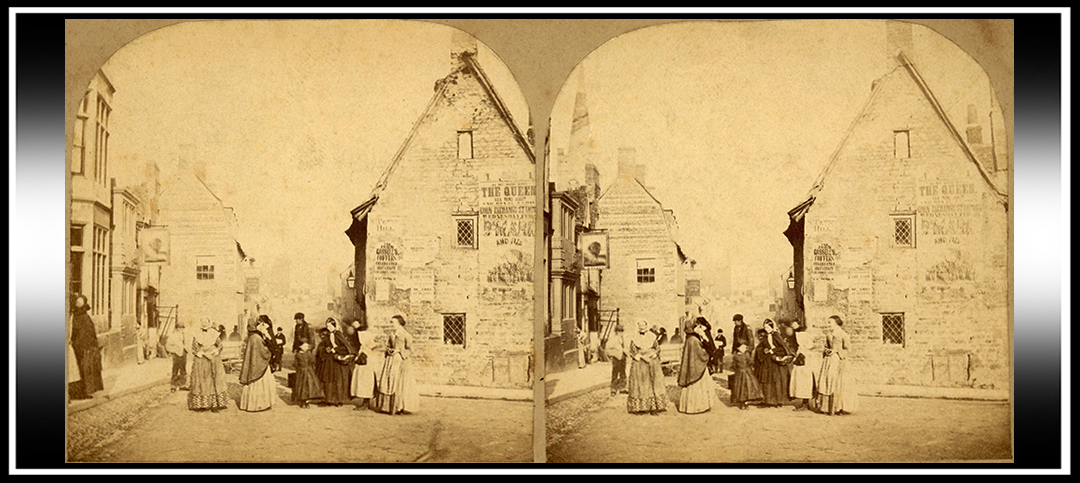
The first stereoview is the one which helped me to date the Victorian stereocards. It’s not often you find such nice clues to follow, so I was really pleased to see them. This is also one of my favourite images from the set because, with the people in the street and the posters of the contemporary happenings of Stamford on the wall, it really makes you feel like you’ve just stepped into that moment in Victorian Lincolnshire and can talk to your ancestors.

Image 1: 1859 stereoview of St. Peter’s Callis Almshouses, Stamford by an unknown photographer. Collection of R. Sharpe.
At first I didn’t recognise all of the locations in the images, and most of the backs of the cards didn’t help either, as a modern hand had simply written ‘Stamford, Lincolnshire’ on a few of them. In this first card the building to the right had a sign ‘St. Peter’s Hill’, and I spotted a pub sign to the left with ‘W. Barton’ underneath. Luckily there is a website devoted to closed pubs in the UK. After scrolling through their gallery for Stamford, I could see this was the Wheatsheaf, on 14 All Saints’ Street, which is now an accountants’. It’s where three roads meet: St. Peter’s Street, All Saints’ Street and Sheep Market. There’s also a second sign in the stereoview, very faded in the distance, which I *think* says ‘Old St. Peter’s Inn’, but I haven’t confirmed this so far. I had the exact location, but I wanted to be the ultimate nerd and find the date too.
When you look at the main poster on the building, to the right of the image, you can see the words ‘V. R. THE QUEEN…. HRH PRINCE ALBERT… CORN EXCHANGE STAMFORD. WEDNESDAY FEB….. DR MARK AND HIS LIT…..’ I wasn’t convinced that they would describe anyone as ‘lit’ and publicly announce it, which used to mean drunk at the time. I used a local newspaper archive to try and rediscover which event this poster was for, and found it in the Stamford Mercury on Friday 25th February 1859, which even included a cheeky crinoline comment bonus. I really enjoy this description because, along with the image in 3-D, you really feel like you’re experiencing the captured moments through the details:
| The new Corn-exchange in Broad-street, Stamford, was tested on Wednesday in regard to its eligibility for musical entertainments. The experiment was quite satisfactory, for though probably the room is somewhat too capacious for a weak voice to be heard effectively in all parts of it, in every respect it seems admirably adapted for concerts and lectures, and the space it affords for balls must be sufficient to content every one – even those who calculate upon a still further expansion of hoops and crinoline. Dr. Mark and his Little Men were the first to consecrate the hall to purposes of public amusement. The juvenile performers were placed on a platform at the upper or south end of the room, from which their full orchestral pieces were heard to great advantage. The Little Men, who by this time are favourably known to most of our readers, played and sang with their accustomed energy and effect, and with commendable precision. Miss Williams (designated the Welsh Nightingale) assisted in the vocal department, displaying a sweet but not powerful voice – of insufficient volume indeed to be well heard at the lower end of the room. There were three concerts – a morning one, which was somewhat thinly attended ; a second one for the accommodation of the school children of the town and neighbourhood ; and an evening performance embracing the entire programme, and including a comic song from Mr. W. Buck, of Grantham (which was heartily encored). The last two entertainments were crowded, and the room, when lit up and peopled with auditors, presented from the gallery a noble and interesting aspect. The treat to the school children must have been a treat also to Dr. Mark and the adults who were present. In one of the choruses the young people who chiefly formed the company were invited to join, and at least 1000 voices responded to the call in a manner that proved highly creditable and pleasing. The evening concert produced a crush such as is rarely experienced in Stamford. Half an hour before the time of commencing the entertainment the doors were besieged, and the scramble for places was so desperate that the intended distinction of seats was levelled, and first, second, and third class auditors were jumbled together and compactly wedged in. Large numbers had to stand. The Directors of the Exchange-Hall must have been highly pleased with the result of the first effort to render it a popular place for public amusements. |
It’s difficult to tell in the image if the bottom of the poster was damaged from being weather-worn or just over-exposed in the photograph, but we now know it was taken around or after February 1859. Coincidentally another readable poster states: ‘USE JOHN CASSELL’S COFFEES. CELEBRATED FOR THEIR GREAT STRENGTH AND FINE AROMATIC FLAVOUR’. I looked up this coffee advert, and sure enough it was being advertised in the Lincolnshire Chronicle on Friday 7th January 1859. It mentioned that they had agents selling their ‘canisters and air-tight packets’ all across Lincolnshire, the one in Stamford being ‘Dennis, High Street’. If the coffee really was as good as they said, I’d definitely like to visit Stamford in February 1859!
On a very wet Sunday morning in Stamford in June 2021, I stood in the middle of the three roads, much the amusement of the few cars I had to avoid, and took the left and right photos with my smartphone to make a modern version of the first stereoview. I had intended to use film cameras, but it was pouring with rain. If you’re interested in making your own stereoscopic 3-D images with a smartphone, please see this post.

Image 2: 2021 stereoview of St. Peter’s Callis Almshouses, from St. Peter’s Street, Stamford. Photographed by R. Sharpe.
I noticed immediately that the house with the posters had changed, so I checked when I returned home and found this was another a great clue to confirm the date when the images were taken. Historic England mentions this building, St. Peter’s Callis Almshouses, was rebuilt in 1863 by Charles Richardson in the ‘Gothic’ manner. The foundation is reputed to be of 15th century merchants of the Staple of Calais – hence its name. The Heritage Gateway website states “In 1859, the late medieval building was demolished due to its poor condition (it was described as ‘scarcely fit for habitation’) and a new callis was built and opened in 1863. In the late 18th century the almshouse had accommodated twelve poor women, although by the early 19th century this number has dropped to seven. The later almshouse housed three women, and the last occupant of the charity died in 1959”.

Image 3: 2021 stereoview of St. Peter’s Callis Almshouses, from All Saints’ Street, Stamford. Photographed by R. Sharpe.

Image 4: 2021 stereoview of St. Peter’s Callis Almshouses’ sign (SAINT PETER’S CALLIS. RE-ERECTED 1863), Stamford. Photographed by R. Sharpe.
The next image was much easier to locate as it was taken on the other side of St. Peter’s Callis Almshouses, which you can see from the other half of the poster for Dr. Mark. You can understand why they had to demolish the building when you see the condition from this side! I really love the young chimney sweeps in this image, who, along with the other men and children, also give a really nice depth in 3-D.

Image 5: 1859 stereoview looking towards Sheep Market, Stamford by an unknown photographer. Collection of R. Sharpe.
We’re now looking down Sheep Market in Stamford; in the distance you can see the spires of St. John the Baptist’s Church and St. Mary’s Church. Sadly I couldn’t quite get the exact same angle because there were people moving to the right, but I found the spot where the Victorian photographer placed their camera. I was a bit gutted that the chimney sweeps weren’t still there:

Image 6: 2021 stereoview looking towards Sheep market, Stamford. Photographed by R. Sharpe.
The next image took me a little while to find, which surprised me as chapels are usually quite easy to recognise, when they’re not demolished.

Image 7: 1859 stereoview of St. Paul’s Church, Stamford by an unknown photographer. Collection of R. Sharpe.
I’m sure residents of Stamford will get it straight away, it’s St. Paul’s Church on St. Paul’s Street. According to Heritage Gateway and Historic England, the Stamford School Chapel dates architecturally to the 12th Century and was originally the Parish Church of St. Pauls. It was restored and extended in 1929-1930, hence why it looks different now to the 1859 image. You can see the image was taken with snow on the ground, so we know this was winter-time in 1859.
Today, the Chapel is set back from the road, behind the walls and bushy trees of Stamford School. The gates were locked on the Sunday I was there, so, sadly, I didn’t get a stereoview (I’m not sure they would have been impressed with a stranger busting the ‘cha-cha’ moves in the school entrance anyway!) However, Stamford Endowed Schools’ now have a digital image archive showing some of the history of the Chapel, including both modern and historic images, so you can see how it’s changed over the years.
The last image I’m sharing for now is the only one which was labelled with an exact location, ‘St. Martin’s, Stamford’, so it was much easier to find!

Image 8: 1859 stereoview of St. Martin’s Church, High Street St. Martin’s, Stamford by an unknown photographer. Collection of R. Sharpe.
There is a great description of the church in this article. It really makes me want to go back at a more sociable hour and visit the interior too as it looks stunning. By the time I had walked around the town the road here was busy. After a few attempts, I managed to quickly take a sequential stereoview of the church without getting run over. In the 1859 image you can see another pub sign in the background, on the building just beyond the church. This time it’s for the ‘Coach and Horses Inn’, another public house which no longer exists, but thanks to the Closed Pub website, you can found out about it too.

Image 9: 2021 stereoview of St. Martin’s Church, High Street St. Martin’s, Stamford. Photographed by R. Sharpe.
After finding the only location label on the back of the last card, I realised that I know of two more images from this series, which are in a separate collection. If you think you might also have some please get in touch, I’d really love to see them and try to confirm who the photographer was. One of the images I’ve seen is of Burleigh House and I’ve found an advert, originally written on 8th December 1859 and published in the Lincolnshire Chronicle, 30th December 1859. I believe it helps us to at least find a potential retailer:
| FOR CHRISTMAS AND THE NEW YEAR. HENRY JONHSON begs to inform the Nobility, Clergy, Gentry, and Inhabitants of the Town and Neighbourhood of STAMFORD that he has, during the past week, selected from the first English and Foreign Houses in London, a large selection of Novelties, suitable as presents for Christmas and the New Year. The Goods will be ready for inspection on Wednesday, when the honour of a call is respectfully solicited. STEREOSCOPES and SLIDES ; POCKET-BOOKS, DIARIES, and ALMANACS of every description ; New CHRISTMAS GAMES, &c. ; PIANOFORTES and HARMONIUMS for Sale or Hire. St. Mary’s-street, Stamford, Dec. 8, 1859. ____________________________________________________________________ AT JOHNSON’S BOOKSELLER, &c. ; STAMFORD A New Stock of FANCY GOODS, suitable as Presents for Christmas and the New Year. A very extensive Stock of BOOKS, comprising all the principal Novelties of the Season. An elegant variety of CHURCH SERVICES, BIBLES, and PRAYERS in every variety of Binding. A large assortment of STEREOSCOPES & STEREOSCOPIC SLIDES ; Views of Burghley House & Bridge, the Lodges, Wothorpe Ruins, the Churches and other Public Buildings and Streets in Stamford &c., &c., with a great variety of other Slides recently published. |
And another possible retailer, from the Lincolnshire Chronicle, 9th December 1859:
| STEREOSCOPES and STEREOSCOPIC SLIDES W. SNEATH, High-street, STAMFORD has on Sale a splendid collection of the newest illuminated Slides and views of every description, thirty local views of Stamford and Neighbourhood. — Mahogany Stereoscopes from 1s. 6d. each, and Slides from 2s. a dozen. The largest Stock in the County to select from. |
I hope you’ve enjoyed visiting and re-visiting Stamford with me, me ducks. I must say a big thank you to Denis Pellerin and Ray Norman for making it possible for me to write this article and encouraging my Lincolnshire nerdery, and the kind folks of Stamford who didn’t run me over, despite me pulling silly moves with a camera in the middle of their roads.

Copyright © The Stereoscopy Blog. All rights reserved.


How wonderful to see these images and enjoy your research, I am a resident of Stamford and have these images in my possession along with others. I have some information regarding the photographer we suspect was involved in the production of these.
I am happy to share this with you if you contact me via messenger.
LikeLike
I spent my early school years at boarding school in Stamford and attended St.Martins Church most Sundays.It may be of interest to know that Daniel Lambert ,England’s Heaviest Man (at the time), is buried in St Martin’s Church Graveyard.
LikeLike