
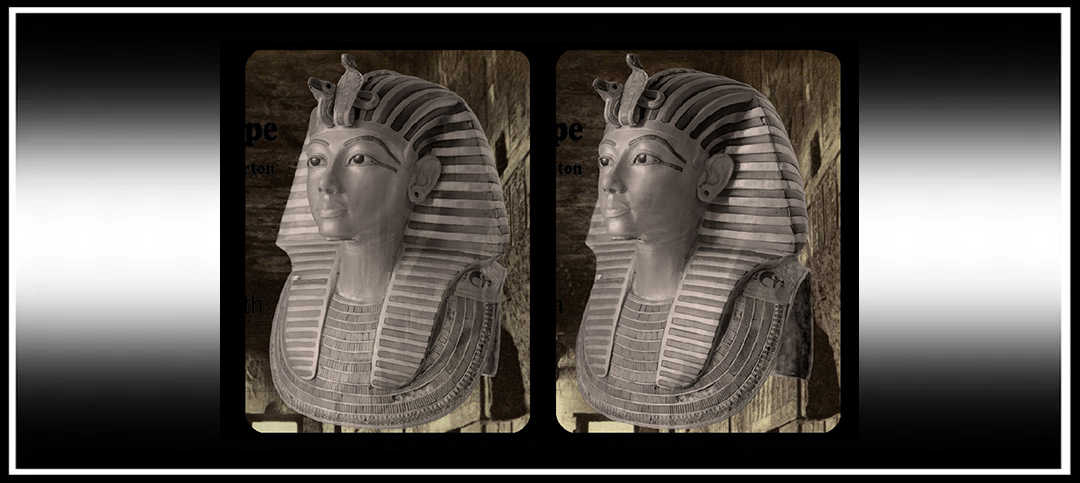
The Griffith Institute, established in 1939 as the Centre for Egyptology in Oxford, had the Beta Launch of their new Tutankhamun Spatial Archive in November 2025. It’s been the main focus of their work over the last year and features all records created during the 1925 unwrapping and examination of Tutankhamun’s mummified body.
Over the next two years, they hope to make the complete archaeological records of Howard Carter and his team’s ten-year excavation of the tomb of Tutankhamun available through this online resource.
The website includes a section on ‘Stories‘ where they upload articles which discuss new discoveries in the archive or deep dives into a particular object and its record, and the latest story will be very interesting for stereoscopy and Egyptology enthusiasts alike.
You may remember, back in 2023, the Griffith Institute and the Brian May Archive of Stereoscopy collaborated on a very popular 3-D presentation ‘Egypt in the Stereoscope: From Francis Frith to Harry Burton‘ at the Weston Library, University of Oxford. Yesterday’s story on the Tutankhamun Spatial Archive features the stereoscopic pairs the Griffith Institute’s Jennifer Navratil and Brian May Archive of Stereoscopy’s Denis Pellerin made from Harry Burton’s photographs of the contents of the tomb, including the background story to the collaboration, and making the images stereoscopic, which were then used in the 3-D presentation. Jennifer was interviewed by Lara Bampfield, who wrote the article, and reading it is highly recommended:
We’ve been following the Griffith Institute’s progress on the Tutankhamun Spatial Archive and are so excited and happy for them to see this project go from strength to strength. Congratulations to the team!
Denis Pellerin has included more stereo pairs from Harry Burton’s photographs on Instagram, as well as a description of the collaboration and process: https://www.instagram.com/p/DVA_41rDZzG/?utm_source=ig_web_copy_link&igsh=MzRlODBiNWFlZA==
Title image: Photographs by Harry Burton, reproduced with kind permission of the Griffith Institute, University of Oxford, edited by Denis Pellerin, Brian May Archive of Stereoscopy. With many thanks to Jenni Navratil for providing additional information about the Tutankhamun Spatial Archive project used in this post.

Copyright © The Stereoscopy Blog. All rights reserved.
 The Stereoscopy Blog
This is a really neat story, Bamfields brief article also, though I’m not entirely convinced by Bamfields insistence that the found stereos are not “accidental,” instead they are the result of Burton’s methodical and diligent approach. Sorry, but if Burton didn’t know about stereo photography, thus did not intend to create stereoscopic images, then the found stereo pairs are accidental, by definition. One can be grateful for happy accidents, without having to call them something else!
I hope to hear more of this story, and especially to see more of the stereo pairs!
LikeLike
I thought the article was pretty clear: “The Tutankhamun archive does not contain purpose made stereoscopic photographs of the excavation. Instead, what makes it unusual is that stereoscopic views can be created retrospectively from existing images.” “This discovery does not suggest that Burton was deliberately creating stereo photographs. Rather, it highlights the precision and consistency of his working method.” ‘Accidental’ is not a term you really come across outside of specialists or clubs, and can be confusing to include for those not familiar with it, but they have captioned the images as ‘unintentional’, which is quite clear. I think the bigger picture is once again getting stereoscopy and its techniques such a massive and incredible platform, as the Tutankhamun excavations, much like Stonehenge, still capture the public’s attention and imagination on an enormous scale.
Denis has included more stereo pairs from Harry Burton’s photographs on Instagram, as well as a description of the collaboration and process: https://www.instagram.com/p/DVA_41rDZzG/?utm_source=ig_web_copy_link&igsh=MzRlODBiNWFlZA==
LikeLike