
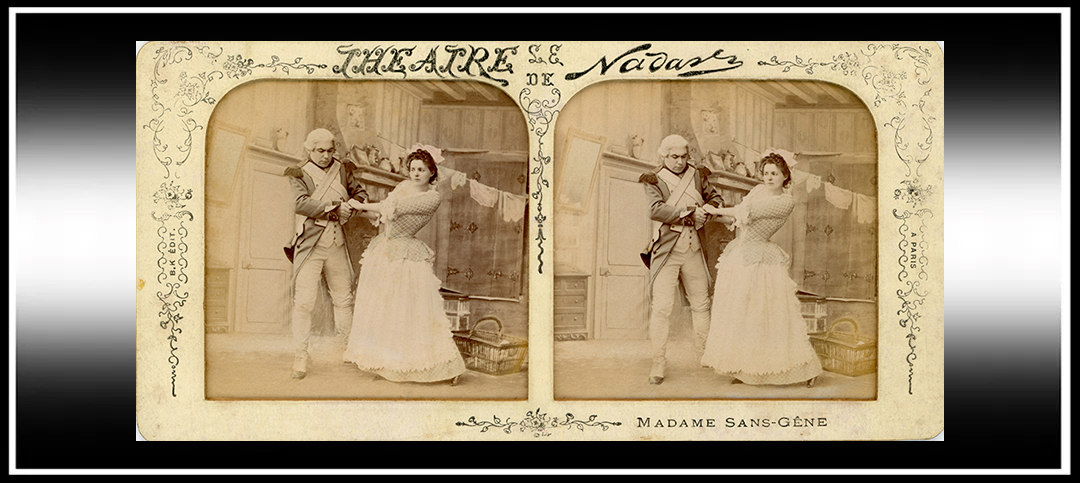
It is not by chance the present article was released on 8 February 2026 as this day marks the 170th anniversary of the birth of the photographer some of whose work I will be examining here.
Born in the former fourth arondissement of Paris on 8 February 1856, Paul Armand Tournachon was the only child of Gaspard Félix and his wife Ernestine Constance, née Lefèvre [1]. His father was none other than journalist, novelist, caricaturist, balloonist and world-famous portrait photographer Félix Nadar. His mother had often sat for his father and his uncle Adrien [2] was also a renowned photographic artist so there was no real surprise that Paul followed in their footsteps. In 1874 Paul was appointed manager of his father’s studio whose lawful owner he became in 1895 when his parents moved to Marseilles on account of Ernestine’s declining health. The relationship between Félix and Paul was sometimes rather tense as there existed artistic differences between them but the two men often collaborated like when they produced a photographic interview of French chemist Michel Eugène Chevreul (Angers, 31 August 1786 – Paris, 9 April 1889) on his one hundredth birthday. Paul was very interested in actors, actresses and the world of show business and he has left thousands of photographs of the most famous performers of his time.
Strangely enough, there is very little information about the set of stereoscopic photographs this article is about and which was published under the name “Le Théâtre de Nadar”. These images were probably never very successful and are consequently very difficult to find. They were produced by publisher Adolphe Block, of Diableries renown [3], at a time when stereoscopy was not at the height of its popularity. The photographs were all taken by Paul Nadar and there is no doubt about the latter fact as will be shown here. It is difficult to know exactly when the series was started as there is no official or complete list of the plays, fairy plays and operettas that were included in it but it is still possible to make some educated guesses.
Here is an attempt at a list of the titles in the elusive series “Le Théâtre de Nadar” in the order in which the productions they were made after were staged. It has been drawn from photographs I have seen in the flesh or online and partial lists printed inside the boxes of some stereoscopic sets published by Adolphe Block. The sets in the series generally consisted of six images.
- Théodora (drama in five acts and eight tableaux by Victorien Sardou)
- Le Petit Chaperon Rouge (operetta in three acts and four tableaux by Ernest Blum and Raoul Toché, music by Gaston Serpette)
- Le Petit Poucet (fairy play in four acts and thirty-two tableaux by Eugène Leterrier, Arnold Mortier and Albert Vanloo, music by Léon Vasseur and Frédéric Ben-Tayoux)
- Madame Sans-Gêne (play in three acts and a prologue by Victorien Sardou and Emile Moreau)
- Gismonda (melodrama in four acts by Victorien Sardou)
- Rip (operetta in three acts by Henri Meilhac, Philippe Gille and Henry Brougham Farnie, music by Robert Planquette)
- Panurge (comic opera in three acts by Charles Maurice Couÿba and Georges Spitzmüller, music by Robert Planquette)
To these must be added some untitled photographs of actors, singers and dancers without any mention of the works they performed in.

01. (left) Portrait of Victorien Sardou by Paul Boyer. (middle) Sarah Bernhardt as Mélissinde in Edmond Rostand’s La Princess lointaine by Jean Reutlinger. (right) Réjane, also by Jean Reutlinger. Author’s collection.

02. Paul Nadar, photographer, and Adolphe Block, publisher. Le Théâtre de Nadar. Although the card is untitled the name of the sitter, operatic singer Rose Caron, was pencilled on the back. A search in the Gallica website of the Bibliothèque nationale de France revealed that Paul Nadar took this photograph in 1896. Rose Caron (Monnerville, 17 November 1857 – Paris, 9 April 1930) is shown here in the part of Marguerite from Charles Gounod’s opera Faust. Author’s collection.

03. Paul Nadar, photographer, and Adolphe Block, publisher. Le Théâtre de Nadar. Singer Jeanne Thibault playing Gabrielle in the 1885 revival of Charles Lecocq’s operetta Les Cents Vierges (The Hundred Maidens) at the Bouffes Parisiens Theatre. Lecocq’s work – with a libretto by Charles Clairville, Henri Chivot and Alfred Duru – was fist performed in Brussels on 16 March 1872 where it met with immediate success but it took longer for the Paris public to appreciate it after its first performance on 13 May of the same year. It did not really become popular in France until the 1875 revival. Author’s collection.
The oldest photograph in the series I have seen so far was from the drama Théodora by Victorien Sardou which premiered at the Théâtre de la Porte Saint-Martin on 26 December 1884. The stereoscopic card is consistent with the photographs taken by Paul Nadar of the main actresses, Sarah Bernhardt and Marie Laurent. They are all dated 1884 and can be seen on the Gallica website of the Bibliothèque nationale de France. I must confess I was fairly surprised when I discovered this image and the information about the drama as I had previously thought that the series had been started later, some time in the early 1890s.
The date of the beginning of the publication of the series is, however, confirmed by the second oldest card I know of, from the operetta Le Petit Chaperon Rouge (Little Red Riding Hood). The plot has very little to do with Charles Perrault’s tale and the work was premiered in Paris at the Théâtres des Nouveautés on 10 October 1885. The actor who played the part of Mayor Bardoulet, Jean François Philbert Berthelier, died in 1888 and since he features in at least one of the images the set must have been published before his death and while the work was still running, which makes 1885 seems a very plausible date indeed. All the more so as the photos of the cast by Paul Nadar are all dated from that same year.
The stereoscopic photograph below shows two of the main actors of Le Petit Chaperon Rouge, Jean-François Philibert Berthelier (Passinières, Loire, 14 December 1828 – Paris, 29 September 1888), who appeared in many of Jacques Offenbach’s works from 1850 to 1880 and introduced him to his then mistress Hortense Schneider, and Juliette Darcourt (Paris, 11 June 1855 – Sartrouville, 4 July 1943) who plays his wife in the operetta.

04. Paul Nadar, photographer, and Adolphe Block, publisher. Le Théâtre de Nadar: Le Petit Chaperon Rouge. Jean-François Philibert Berthelier as Mayor Bourdalet and Juliette Darcourt as his wife, Églantine. Author’s collection.
I also saw and bought a card from another early set, Le Petit Poucet, after a fairy play which premiered in Paris at the Théâtre de la Gaîté on 28 October 1885 [4]. The image showed Hop o’ My Thumb under a table listening to his parents discussing how they were going to lose their children in the woods. The part of Hop o’ My Thumb was played by a little girl called Duhamel. Alfred Anatole Gobereau (Cosne, Nièvre, 14 March 1845 – Paris 18e, 26 July 1896) played the part of his father, Guillaume, and a Miss E. Petit that of his mother, Mathurine. These three names were printed on the mount of the card. This work was fairly successful and was re-staged in 1891 but with a different cast so that we are certain the photograph is from the 1885 production.
I have seen online photographs of the complete set of Gismonda, a melodrama by Victorien Sardou which is remembered mostly because of the actress who created the title part, the great Sarah Bernhardt (Paris, 22 October 1844 – Paris, 26 March 1923), and of the poster advertising the play by Czech painter and illustrator Alphonse Mucha.

05. Paul Nadar, photographer. Although the mount is here totally different this very same stereoscopic pair was published as part of the set of Le Théâtre de Nadar devoted to Victorien Sardou’s Gismonda, which was premiered at the Théâtre de la Renaissance on 31 October 1894. The photo shows actress Sarah Bernhardt in the title part. Author’s collection.
I have yet to see or find copies of the stereoscopic images created for Rip (actually Rip Van Winkle, an adaptation of Washington Irving’s short story which was first created in London in 1882 under its full title before being set up in Paris a couple of years later under the shortened title Rip). The photographs by Paul Nadar were made at the time the comic opera was revived in 1894, as can be confirmed on the Gallica website.
I haven’t seen either any stereoscopic images from the 1895 creation of Robert Planquette’s comic opera Panurge, after François Rabelais’s character in his Gargantua and Pantagruel.
The Théâtre de Nadar set I am most interested in is the one devoted to Victorien Sardou and Emile Moreau’s play Madame Sans-Gêne [5]. This work in three acts and a prologue was premiered at the Théâtre du Vaudeville, Paris, on 27 October 1893 and has proved a long-lasting success ever since. The prologue is set on 10 August 1792, an important date in French history as it saw the capture of the Tuileries Palace and led in the following weeks to the abolition of the monarchy [6], while the action in the three acts takes place in 1811. A lot of the characters in the story actually existed but the main one, Madame Sans-Gêne, is actually a composite one, drawing some traits from Marie Thérèse Figueur (Talmay, Côte d’Or, 17 January 1774 – Paris, 16 January 1861) and Catherine Hübscher (Altenbach, 2 February 1753 – Paris, 29 December 1835) the wife of Marshal François-Joseph Lefebvre.
Marie Thérèse Figueur was a real woman solider who fought in the Revolutionary and Napoleonic Wars before becoming a cantineer. She met Napoleon a couple of times and although she spent a short time with his first wife Joséphine, she never really lived at his court.

06. Postcard from the 1900s showing the birthplace of Marie Thérèse Figueur at Talmay. The plaque on the wall gives a short biography of Marie Thérèse, lists some of the campaigns she took part in and mentions she was wounded twice. Author’s collection.
Catherine Hübscher was also a laundress and a cantineer but never a soldier. She married Sergeant Lefebvre on 1 March 1783, some six years before the start of the French Revolution and they had fourteen children, thirteen of whom never made it to adulthood. Lefebvre was in turn captain (1792), brigadier general (1793), senator (1800), Marshal of the Empire (1804) then Duke of Danzig (1807) after he successfully captured the city following a two-month siege. As his lawful wife, Catherine benefited from her husband’s successive promotions and was officially the Duchess of Danzig although she never forgot her humble origins and kept the frankness, outspokenness and poor spelling of her former years. Napoleon was amused by her and defended her against the courtiers who – although mostly parvenus and parvenues themselves – pretended to be shocked by her lack of proper court manners and wanted her expelled.
Sardou and Moreau’s Catherine is a mixture of the two women. She is younger than the real Duchess of Danzig (who was nearly 40 in 1792 and 58 in 1811) but has the same frankness and outspokenness and is not only unashamed of her origins but proud of them. At some point in the play she bluntly reminds one of the sisters of the Emperor that her husband was also a commoner [7], as were most of Napoleon’s generals and marshals. Her nickname of Madame Sans-Gême (Unnconstrained or Outspoken) was actually the one given to Marie-Thérèse Figueur by her fellow soldiers who called her Petit Sans-Gêne.
The part of Catherine was created by the mistress then wife of Paul Porel, the director of the Odéon theatre. Born Gabrielle Charlotte Réju on 6 June 1856, she was better known under her stage name of Réjane and was nearly as popular as her contemporary fellow actress Sarah Bernhardt. As soon as the play opened at the Vaudeville theatre on 27 October 1893 it was a hit. Réjane was a perfect fit for the part and she was seconded by artists of talent, all of whom were photographed by Paul Nadar that same year. Sergeant then Marshal François Joseph Lefebvre was played by Adolphe Candé (Paris, 1 July 1858 – Épinay-sur-Seine, 22 September 1931) and the part of Napoleon was given to Edmond Duquesne (Angers, 25 February 1829 – 24 November 1918). Duquesne [8] was so convincing as the Emperor that he was to reprise the role several times over the next eighteen years, as Réjane did the part of Catherine Hübscher.

07. Postcards from photographs by Paul Nadar showing Réjane as Madame Sans-Gêne the laundress (left), Edmond Duquesne in the part of Napoleon I (middle), and Réjane and Adolphe Candé as the Duke and Duchess of Danzig (right). Author’s collection.
The play became so popular so quickly that a set of six chromolithographs showing the main scenes was rapidly produced and given away to customers buying Liebig products. We know from the costumes (designed by Belgian illustrator and cartoonist Draner) that this is a direct reference to the first production of the play.

08. The whole set of six Liebig chromolithographs showing the main scenes of Sardou and Moreau’s play. Author’s collection.
I have seen all of the six stereoscopic photographs which make up the set of Madame Sans-Gêne but I have only been able to find five: three in the Brian May Archive of Stereoscopy (with a variant of one of them) and two which I was very fortunate to be able to buy on a recent work trip to Paris. A photo of the sixth image was sent to me for inspection by a collector from the Netherlands who had read the first version of this article. Here are the five stereoscopic cards. They are not numbered but have been put in the right order.

09. Paul Nadar, photographer, and Adolphe Block, publisher. Le Théâtre de Nadar: Madame Sans-Gêne. Scene from the Prologue to the play set in Madame Sans-Gêne’s laundry rue Sainte Anne. Revolutionary Fouché (played by Léon Férand) is talking to Catherine (right) in the presence of two of her employees. Author’s collection.

10. Paul Nadar, photographer, and Adolphe Block, publisher. Le Théâtre de Nadar: Madame Sans-Gêne. Scene between Sergeant Lefebvre (Adolphe Candé) and Catherine Hübscher (Réjane) in the prologue of the play. Lefebvre, a very jealous man, is persuaded that Catherine is hiding a lover in her room and forces her to give him the key to it. As it turns out there is indeed a man in Catherine’s room but he is an Austrian count, Neipperg – a supporter of King Louis XVI and of his Austrian wife, Marie Antoinette – who was wounded during the storming of the Tuileries and whom Catherine knows will be killed if she delivers him into the hands of the revolutionaries. Between them Catherine and François Joseph manage to smuggle Neipperg out of the French capital. Brian May Archive of Stereoscopy.

11. Paul Nadar, photographer, and Adolphe Block, publisher. Le Théâtre de Nadar: Madame Sans-Gêne. Two of Napoleon’s three sisters (the third one, Pauline, does not appear in the play). On the left, Elisa, princess of Lucques and wife of Felice Pachale Baciocchi (played by Camille-Gabrielle Drunzer); on the right, Caroline, Queen consort of Naples, wife of Joachim Murat (played by Madeleine Verneuil). Both sisters appear in Acts I and II of the play. Brian May Archive of Stereoscopy.

12. Paul Nadar, photographer, and Adolphe Block, publisher. Le Théâtre de Nadar: Madame Sans-Gêne. The reception at Compiègne in the apartments of the Duchess of Danzig. The two sisters of the Emperor have come to make fun of Catherine and discredit her. Fouché, who is the former Minister of Police, and currently out of favour with the Emperor, is aware of their intentions and has agreed with Catherine that every time he takes out his snuff box it means she is about to say something she shouldn’t. Catherine soon ignores his repeated warnings and gives the two ladies a piece of her mind. Author’s collection.

13. Paul Nadar, photographer, and Adolphe Block, publisher. Le Théâtre de Nadar: Madame Sans-Gêne. Neipperg, who is in love with Napoleon’s second wife, Marie-Louise who, it must be said, does not love him in return, has come to say good bye to her in the middle of the night after being told by Napoleon to leave France at once but he is spotted, arrested and threatened to be executed. It will take all of Catherine’s wits, with the help of former Minister of Police Fouché, to save him. Scene from Act III. Brian May Archive of Stereoscopy.

14. Paul Nadar, photographer, and Adolphe Block, publisher. Le Théâtre de Nadar: Madame Sans-Gêne. A variant of the previous scene. Neipperg was played by Georges Grand. Marie Louise, though mentioned several times, does not appear in the play. Brian May Archive of Stereoscopy.
When the play reached its 200th performance the whole cast was taken on a day out in what had been Joséphine’s home, La Malmaison, and when it reached the 500th a celebratory supper was given [9]. Before that Réjane had travelled to London to perform in Madame Sans-Gêne, in French, at the Gaiety Theatre. Clement Scott, reviewing the play for The Illustrated London News wrote that “Madame Réjane has arrived in London at last, and won her instant success at the Gaiety without an effort. She brought with her, of course, Sardou’s semi-historical, eminently theatrical, always effective play, “Madame Sans-Gêne,” and it is with the free-and-easy laundress of the Parisian quarter of St. Anne, with the honest woman of the people who loves a Republican soldier and gives everyone a bit of her clever mind, from the women at the washtub to the satirical ladies of Court society, from the rough soldiers of the Revolution to the great little Emperor himself, that we are concerned.”[10]
In The Graphic, journalist and novelist William Moy Thomas described “Madame Réjane’s performance of the laundress whom Fortune’s freaks have made a Duchess” as “delighfully fresh and full of vivacity and humour, intermingled with many touches of womanly feeling which have a peculiar charm.” [11] Present at the London performance on Saturday 23 June 1894 were British stage stars Henry Irving and Ellen Terry. By the time Scott’s and Moy Thomas’s articles were published, Irving had already announced that he intended to bring the play to the Lyceum theatre and that the part of Madame Sans-Gêne would be given to Miss Terry while he would himself play Napoleon. Clement Scott had some doubts about casting Miss Terry as the laundress turned Duchess. “I cannot see Ellen Terry,” he wrote, “the ideal, the poetical, the fantastical, the almost medieval actress, distorting her very nature with the eccentricities of the vulgar French washerwoman. That Ellen Terry is a comedy actress we all know; that she has a keen sense of humour no one would deny; but the comedy of Portia and Beatrice and Olivia is not the comedy of the promoted French washerwoman.” [12] Just under three years later, however, Scott had to acknowledge gracefully that he had been wrong. One of his colleagues, reviewing the English production of the play in 1897 [13] wrote that “From the moment Miss Ellen Terry last night entered with a basket of linen on her arm the success of Madame Sans-Gêne was assured. […] It was evident from the outset that Miss Terry liked the part, which never travels from the domain of comedy, for she displayed the utmost confidence and self-possession, illustrating each detail with a felicity of expression that was both firm and convincing.” [14] Terry and Irving were, like Réjane and Duquesne, to play the same roles over many years.

15. Photographic postcards showing Ellen Terry as Madame Sans-Gêne. Author’s collection.
Réjane also played the original version of Madame Sans Gêne in the United States but only after it had been produced in English on Broadway on 14 January 1895. Kathryn Kidder played the part of Catherine.
Sardou and Moreau’s work made it all the way to Australia too where it was first performed at the Bijou Theatre, Melbourne, on 26 December 1898. Robert Brough and his wife Catherine gave their voices and features to Napoleon and Catherine Hübscher.
It would be tedious to list all the performances of the play that were given before the nineteenth century was over so I will just mention that Madame Sans-Gêne toured France shortly after its creation in Paris with Mme Berny as the laundress turned duchess. Everywhere it went it got the same success.
To get back to Paul Nadar and his photographs of the cast of the first production of Madame Sans-Gêne there is a curious fact worth noting. When the play was re-staged for a three-week run at the Théâtre Moncet in April 1905, with Delphine Renot [15] in the title role, Nadar’s photos of 1893 were used to promote it even though a lot of the original actors – including Réjane – were not in the cast. If you have another look at illustration 05 you can’t miss the mentions under the photographs which all read : “THÉATRE MONCET 50, Avenue de Clichy – Le 15 Avril [1905] et jours suivants – MADAME SANS-GÊNE”. Even the poster advertising this adaptation featured a photograph of Réjane in her court dress and mantle. I would love to know what Delphine Renot’s thoughts on the subject were ! I guess the production having such a relatively short run it was deemed useless to spend money taking more photos when there were lots of good ones available that could easily be turned into postcards.

16. Postcard advertising the production of Madame Sans Gêne at the Theatre Moncey in 1905. Réjane (sitting, on the right) is easily recognisable. Author’s collection.

17. Postcard advertising the production of Madame Sans Gêne at the Theatre Moncey in 1905. It is interesting to compare this image with illustration 13. Author’s collection.
As soon as the new century started Madame Sans-Gêne was adapted for the cinema (1900) and Clement Maurice directed a short silent version of the story with … Réjane, in the part she had created. She was to appear on the big screen again as Madame Sans-Gêne in a three-reel version made in 1911 [16]. She was fifty-five by then but still going strong.
Two more silent shorts were also made, the first one a twelve-minute long film shot in Denmark in 1909 and directed by Viggo Larsen [17], the second one an American production filmed in France and directed by Léonce Perret (Niort, Deux-Sèvres, 14 March 1880 – Paris, 12 August 1935). The film was released by Paramount Pictures in April 1925 in the United States and in December of the same year in France. Réjane had been dead for five years by then – she passed away on 14 June 1920 – and Catherine had the features of American star Gloria Swanson. Most of the other actors of the film were French, which did not really matter since it was still a silent production. French actor Emile Drain who played Napoleon and definitely looked the part would be cast as the Emperor again in several more movies, Un Drame sous Napoléon (1921), L’Aiglonne (1921) The Fighting Eagle (1927), Madame Récamier (1928), L’Aiglon (1931), Les Perles de la Couronne (1937), Remontons les Champs Elysées (1938), The Lame Devil (1948), and finally Si Versailles m’était conté (1953) !
The film with Gloria Swanson, which is apparently an hour and forty minutes long, was shot on location at the châteaux of Compiègne, Fontainebleau and La Malmaison, Joséphine’s property, in 1924. It is unfortunately considered lost and all that remains of it are stills and a trailer which can be watched on YouTube.

18. Gloria Swanson as Madame Sans-Gêne in the park of the Château of Compiègne. She is standing between Charles De Roche (Marshall Lefebvre) on the left and Warwick Ward (Neipperg) on the right. Standing in the second row are, I think, Henri Favières (Fouché, on the left) and Jacques Marney (Savary, on the right). I am afraid I do not know who the person in the background is. Author’s collection.

19. Gloria Swanson as Madame Sans-Gêne surrounded by a good part of the cast. It is such a pity the film was lost because the costumes do look fabulous. Author’s collection.
Paramount Pictures issued a coin or token to commemorate the movie and I was fortunate enough to be able to buy a reasonably priced copy of it on eBay. It features a profile of Gloria Swanson on one side with the words PRO PATRIA ET GLORIA – SWANSON – PARAMOUNT. The other side bears the Motto of the French Republic – which should actually read LIBERTÉ ÉGALITÉ FRATERNINTÉ, in that order –, a very approximate translation of the title, “Sans-Gêne means you’ll never worry,” [18] the title of the film, and the name of the studio.

20. Front and Back of a token issued by Paramount Pictures to commemorate the 1925 film Madame Sans-Gêne. Author’s collection.
It took some time when the talkies appeared for Madame Sans-Gêne to be made into a film. French director Roger Richebé had planned on starting shooting his version of the play in 1939 but the declaration of war put an abrupt end to his plans and the film could only be made after France had fallen and was occupied by the enemy. It meant that everything was in short supply and that Richebé, who had meant to shoot his work in colour, had to be content with black and white. Fortunately for him period costume films were among the few that were allowed by the censorship prevalent at the time and he was allowed to carry on with his project. Richebé’s Madame Sans-Gêne was released in France in October 1941 and was an immediate success. It was mostly owed to the fact that Richebé kept as close as possible to the original play and to his choice of actors. Arletty [19], despite her slim boyish silhouette, made a wonderful Catherine Hübscher. Her unique voice and her exuberance were perfect for the part and she was surrounded by a really good cast. Napoleon was played by Albert Dieudonné who had already been cast as the Emperor in Abel Gance’s 1927 562 minute long masterpiece Napoléon. Dieudonné, who bore an uncanny resemblance to Bonaparte in 1927, had come to look a lot like Napoleon fourteen years later.

21. Arletty in her dressing-room wearing her court dress from the 1941 film Madame Sans-Gêne. Author’s collection.
In 1945 Madame Sans-Gêne was in cinemas again in a version signed by Luis Cesar Amadori, an Argentine film director, with Nini Marshall as Catherine.

22. Still from the 1945 filmed version of Madame Sans-Gêne. Author’s collection.
The play was turned into a film again in 1961, as a Spanish-Italian-French co-production directed by Christian Jacque, with none other that Italian star Sophia Loren as Madame Sans-Gêne and Robert Hossein as Marshal Lefebvre. The plot is very loosely adapted from the play and includes lots of added exterior scenes but the film is still pleasant to watch, especially in Italian.

23. Stills from the 1961 filmed version of Madame Sans-Gêne with Sophia Loren. (top) in 1792, Catherine helps Sergeant Lefebvre, on the right, to get a cannon out of a pothole. (bottom) in 1811, Catherine, who is now the Duchess of Danzig, still irons herself her husband’s shirts. Author’s collection.
The play was also adapted for television, first in 1960 by John Olden, with Inge Meysel as the Maréchale Lefebvre, and in 1963 by Claude Barma, with Sophie Desmarets as Catherine. More recently, in 2002, French director Philippe de Broca brought Madame Sans-Gêne back to life on the small screen with Mathilde Seigner in the title role.

24. Contact sheet of stills from Claude Barma’s 1963 telefilm Madame Sans-Gêne, with Sophie Desmarets as Catherine Hübscher, William Sabatier as François-Joseph Lefebvre and Raymond Pellegrin as Napoleon. Author’s collection.
To conclude it is important to add that Catherine Hübscher was played on stage by some of the best French actresses since Réjane created the part back in 1893. Among them were Madeleine Renaud, Jacqueline Mailland and Clémentine Célarié, to name but a few, as well as actress and singer Annie Cordy [20]. They gave their voices and talent to animate this iconic figure of the French stage, Catherine Hübscher.
One can only regret that none of the actors, costumes and sets of these numerous stage and film productions were ever photographed for the stereoscope. We must, therefore, be thankful to Paul Nadar for the handful of stereoscopic images he took.
Denis Pellerin
NOTES
[1] Gaspard Félix Tournachon was born in Paris on 6 April 1820, the son of printer and bookseller Victor Tournachon and of his wife Thérèse Maillet. He died in the French capital on 20 March 1910.
[2] Adrien Tournachon, Félix Nadar’s younger brother, was born in the former eleventh arrondissement of Paris on 25 August 1825. He died in the tenth arrondissement of the same city on 24 January 1903.
[3] For more information about Adolphe Block (Paris, 11 December 1829 – Paris, 21 March 1903) see the book Diableries: Stereoscopic Adventures in Hell, by Denis Pellerin, Brian May and Paula Fleming.
[4] Although I bought the card I never actually held it in my hands as the seller could not find it and had to refund me. I, therefore, only saw photos of it.
[5] Victorien Sardou (Paris, 5 September 1831 – Paris, 8 November 1908) became, after a difficult start, a very successful and prolific playwright who tried his hand at several genres: comedy, historical drama, melodrama, satire and operetta.
Emile Moreau (Brienon-sur Armançon, Yonne, 8 December 1852 – Brieno, 27 December 1922) was a playwright in his own right and but collaborated with other people, including Sardou, on several works.
[6] Over 300 of the Swiss guardsmen who protected the palace as well as 400 revolutionaries were killed on that day. A plaque in the Catacombs of Paris, where many of the victims were buried, commemorates the event.
[7] Caroline Bonaparte, Queen consort of Naples, married Joachim Murat who was the eleventh child of an inn-keeper and postmaster before having such a successful military career.
[8] Duquesne was his stage name. He was born Edmond Hippolyte François Lochard.
[9] This supper took place on 31 July 1900.
[10] Clement Scott, The Illustrated London News, 30 June 1894, p. 5.
[11] William Moy Thomas, The Graphic, 30 June 1894, p. 15.
[12] Clement Scott, Idem.
[13] The play had been adapted into English by author, playwright and critic Joseph Comyns Carr (London, 1 March 1849 – London, 12 December 1916)
[14] Lloyd’s Weekly Newspaper, 11 April 1897, p. 11.
[15] Her real name was Marie Rosalie Delphine Puvilland. She was born at Bourg-en-Bresse on 8 March 1861 and died at Saint-Maur des Fossés on 25 July 1927.
[16] It is not clear who the director was and two names are suggested: André Calmettes and Henri Desfontaines.
[17] Gudrun Kjerulf was Catherine Hübscher and August Blom was Napoleon.
[18] Although it is a very difficult expression to translate which does not have a perfect English equivalent, I have already mentioned that the closest translations are unconstrained or outspoken. Sans-Gêne means that you don’t care for etiquette, that you will speak bluntly and frankly, that you will always call a spade a spade no matter who you are addressing and will never hide behind so-called manners nor be ashamed of your origins. Sardou and Moreau’s Catherine is a perfect personification of the expression.
[19] Born in Courbevoie on 15 May 1898, Léonie Marie Julie Bathiat, better known by her stage name Arletty, was a fashion model and a performer on stage in music hall, operettas, plays and cabaret before starting a film career. During the war she had a liaison with a Luftwaffe officer and although she was spared the cruel humiliation of having her head shaved, a swatiska painted on her skull and of being pararded naked in the streets of Paris, she was still arrested for treason, emprisoned, placed under house arrest for eighteen months and banned from filming for three years. She died in Paris on 23 July 1992.
[20] Madeleine Renaud played Madame Sans-Gêne at the Théâtre Sarah Bernhardt in 1957; Jacqueline Mailland was Catherine Hübscher at the Théâtre de Paris in 1973. She reprised the role once in 1974 so that her performance could be recorded and shown on television on Christmas Eve 1974; Clémentine Célarié was the laundress turned Duchess at the Théâtre Antoine in 2000; Annie Cordy first appeared as the Maréchale Lefebvre in two extracts of the play broadcast on French television in the popular show “36 Chandelles” in 1958 and reprised the part in 1981, but on stage this time, for ten performances in Versailles, then again in 1987 at the Théâtre du Gymnase-Marie Bell.

Copyright © The Stereoscopy Blog. All rights reserved.
 The Stereoscopy Blog