
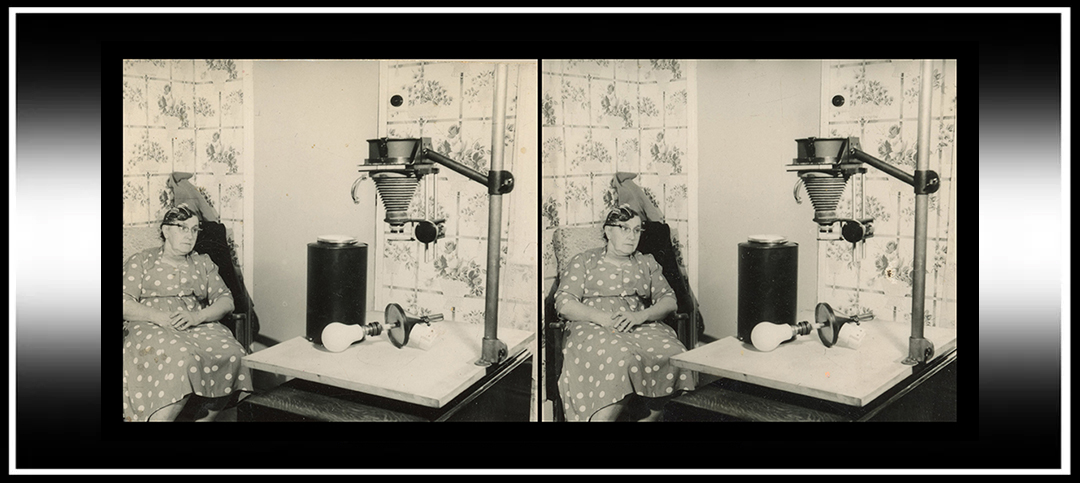
I thought I’d share some more amateur stereoscopic (3-D) images over the festive season, as they tend to get overlooked, but I think they offer a fascinating glimpse into the past and the personal life of their (often anonymous) photographer. This set I’ve dated to around 1960 due to the car in some of them, and I have to say, I absolutely love the image of the lady with the photographic enlarger.
The stereocards are about the size of the Weetabix Vistascreen images, and with them being made around the same time, I do wonder if that was their intended stereoscope. You will spot in some of them that they were photographed sequentially, so the depth can be a little confusing at times. I’m sharing scans of the original images along with aligned digital stereocards I made from them as I love mixing old and new techniques to bring old images back to life and share them. I wanted to prove that you don’t have to spend a fortune on buying immaculate stereoscopic images to still find enjoyment and education in them, as we explore some well-known historic places in Kent. I also appreciate how the photographer has recycled things to make the card mounts, as you will see!
Addington, Kent
Chestnuts Long Barrow.


On private property, Chestnuts Long Barrow is a chambered long barrow near the village of Addington. Probably constructed in the fifth millennium BC, during Britain’s Early Neolithic period, today it survives only in a ruined state
From Megalithic.co.uk: ‘The sand mound has mostly disappeared but 12 of the large sarsens remain at the east end of the barrow and the chamber and facade remain also. Some of the stones were re-erected. The capstone which is estimated to weigh around 14 to 15 tons has fallen off and is now to one side. The mound was about 20m long and 15m wide, and the chamber 4m by 2m.
The barrow was excavated in 1957 and contained traces of the cremated bones of at least nine adults and possibly two children, and artifacts dated to Late Neolithic or Early Bronze Age. The finds are in Maidstone Museum. There is further evidence that prior to the barrow being built a Mesolithic group had camped there and knapped their flints.’
Aylesford, Kent
The Friars, Aylesford Priory.


Aylesford Priory, or “The Friars” was founded in 1242 when members of the Carmelite order arrived in England from Mount Carmel in the Holy Land. Richard de Grey, a crusader, sponsored them, and conveyed to the order a parcel of land located on his manor in Aylesford in Kent. The Carmelites left at the dissolution of the monasteries in 1538, however, they were able to return in 1949 and some are still present today. You can learn more about visiting the Friars and see what events are happening on their website.
Canterbury, Kent
St. Augustines.


From English Heritage: ‘Founded in AD 598 by St Augustine himself, this once-great abbey proclaims the rebirth of Christianity in southern England. Augustine, a missionary from Rome, baptised the pagan King Ethelbert of Kent, the most powerful Anglo-Saxon monarch and the first to convert to Christianity. To mark his conversion, Ethelbert gave Augustine land to build this very first monastery in Anglo-Saxon England. St Augustine’s Abbey was one of the most important monasteries in medieval England. For almost 1,000 years, it was a centre of learning and spirituality. It was reduced to ruins during Henry VIII’s Suppression of the Monasteries.’
Canterbury Cathedral.


The water tower stands to the north of the cathedral, and was built in the 1160s, close to the dormitory passage as monks washed their hands here in the ‘laver’ (water basin) on the way to the cathedral. Source: Canterbury Historical and Archaeological Society.
Cooling, Kent
Cooling Castle.


Cooling Castle was built in the 1380s by the Cobham family, the local lords of the manor, to guard the area against French raids into the Thames Estuary. The castle has an unusual layout, comprising two walled wards of unequal size next to each other, surrounded by moats and ditches. It was the earliest English castle designed for the use of gunpowder weapons by its defenders. The gatehouse was built in 1381-85 by Thomas Crump, possibly to the designs of Henry Yevele for Sir John de Cobham. More information via English Heritage.
St. James’ Church.


This graveyard is at St. James’ Church, Cooling, and in the photo you can see the lozenge-shaped gravestones of 13 babies from the Baker and Comport families, who died between 1771-79. These are known as ‘Pip’s Graves’ and are famous for inspiring Charles Dickens, being the setting for the opening chapter of Great Expectations.
Some card mount backs
Recycling old photos and a box of toffee (which sounds delicious!)


Austin A40 Farina MKI (1958-1961)


A beautiful car with a proud owner, however, a couple of the stereos show it was in some kind of accident, with dents both ends. The registration number is no longer searchable, so it was sadly written off at some point. You can learn all about Austin A40 Farinas here.
Unidentified


Home Life


I can’t decide if she looks either kind of bored or traumatised by something out of shot, or maybe the enlarger and developing tank, on the dining table, were in the way of the TV, and Doris was silently fuming.


A nice collection of garden gnomes! Did you know that whilst originating in Germany from folklore about earth spirits, the modern garden gnome was popularised in Britain by Sir Charles Isham’s collection at Lamport Hall, making them feel quintessentially English today?


A dog called Robin.


And ending with a sequential kitty, doing what cats do best.
I hope however you do or don’t celebrate this season, you have a safe and peaceful time.

Copyright © The Stereoscopy Blog. All rights reserved.
 The Stereoscopy Blog