
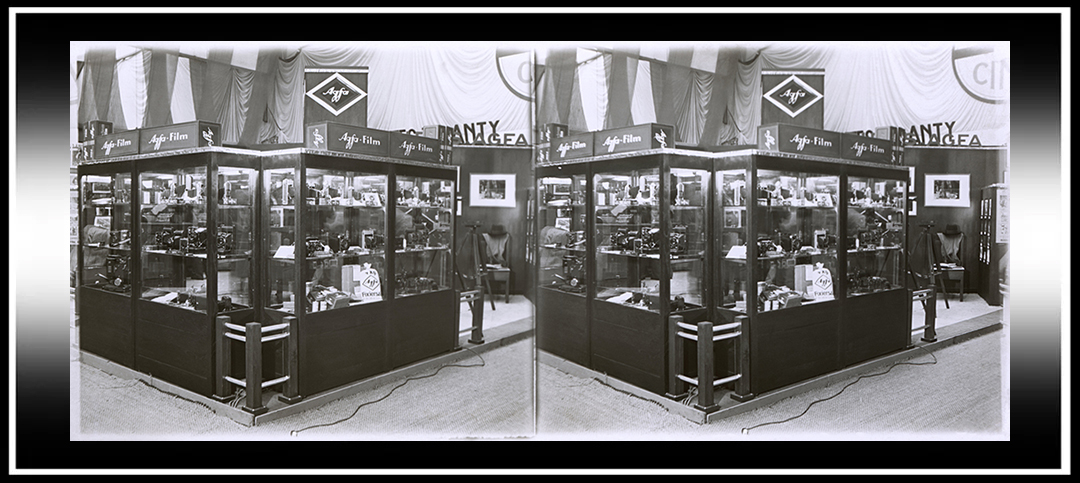
It is not very often these days that you can find stereoscopic images on eBay that really get your attention and make you want to purchase them at once. It does happen occasionally though, and a couple of months ago, while I was browsing for something completely different, I chanced upon a listing which read “Agfa photo and cine exhibition 1920s glass stereoscopic slides”. The slides were 6×13 photographs, which are not so common as the 45×107 mm Verascope Richard format ones, and represented, as described, the Agfa stand at what looked like an exhibition of photographic and amateur cinema equipment. From what could be read on the stand itself, the event photographed had taken place in France. The images looked surprisingly clean and scratch-free and since the subject was not one which I had often seen I purchased them without much hesitation.
The five slides duly arrived, well packaged and intact – you never know what you will find in the packet when it comes to glass – and I immediately did what I usually do on such occasions, I scanned them at the highest possible resolution. When I blew up the first slide on my computer display I noticed something which I had not seen in the photos that accompanied the listing. Written on a display case were the words “Nouveautés Agfa 1932” (New at Agfa in 1932).

01. One of the 6×13 glass slides of the photographic exhibition which I found on eBay and the first one I scanned. Author’s collection.

02. Stereoscopic card showing an enlargement of the slide above. The words “Nouveautés Agfa 1932” can be made out on the display case. Author’s collection.
So the slides were not from the 1920s after all but a bit later and I had the exact year when the photographs were taken. Lucky start ! When the scanning of the five cards was completed I proceeded with my favourite part, the digging for more information, or research as it is usually called. It did not take too long for me to realise that what I had bought were photographs of the ninth exhibition of photography and amateur cinematography which had been held at the Parc des Expositions, Porte de Versailles, Paris, from 19 to 28 February 1932.

03. Advertisement for the Agfa stand at the 1932 Paris exhibition. The text reads “At the ninth exhibition of photography and 16mm cinematography the Agfa stand will be even more interesting than ever before”. Author’s collection.
A little more digging online provided me with several pages from a digitized photographic magazine of the time in which the exhibition was fully advertised, described and commented upon. Since I really wanted to use some of the pages for the article I had in mind, I looked on eBay again and found a seller in France who was parting with several volumes of L’Instantané, the photographic magazine I was interested in. Now since that stupid Brexit – Britain’s dumbest hour – a lot of sellers on the Continent categorically refuse to ship anything to the UK as it is too much of a hassle. The only way for me to get the 1932 volume of L’Instantané was, therefore, to have it sent to one of my brothers in France, which I did (my warmest thanks to him). During a short visit to my native country I got the lot back and brought it home to read it and scan it. What had made me so interested in this particular volume of L’Instantané was that two of the photographs I had bought were reproduced as half stereos in an article that was published in the March issue of the magazine, shortly after the exhibition had closed its doors. The photos are rather dark and small but there is no doubt they are from the same negatives as the stereoscopic pairs. You can judge for yourself below.

04. One of the pictures I found in the March issue of the photographic magazine L’Instantané. It is bigger here than the one published in the original. Author’s collection.

05. The corresponding stereoscopic slide. Author’s collection.

06. The second picture from the March issue of L’Instantané, also much bigger here. Author’s collection.

07. The corresponding stereoscopic slide. Author’s collection.
What surprised me most when I read about this ninth Paris photographic exhibition was that stereoscopy in 1932 seemed to have been very prominent in people’s minds, much more so than I thought it would be. During the limited time the exhibition took place there was a workshop on how to develop stereoscopic pictures (25 February) and, on the same day, a conférence by Henri Bourée, President of the Society of Amateur Photographers’ Excursions, which was entitled “L’Intérêt vrai de la Stéréoscopie” (the true Interest of Stereoscopy). Commandant Bourée (1873 – 1940) was a naval officer who became Prince Albert 1st of Monaco’s aide-de-camp and chief of his scientific cabinet, accompanied him in his expeditions and helped him with the photographic and cinematographic side of things. A good photographer himself, who doubled as a lecturer and a writer on photography and stereoscopy, Henri Bourée was also the inventor of a net that allowed the capture of specimens at 6500 feet below the sea level, as well as the author of a richly illustrated book on oceanography, “De la Surface aux Abîmes” (From the Surface to the Abysses), which was published in 1912 and prefaced by Prince Albert himself. The photographs in the book are mostly by him as are some of the autochromes reproduced in it. A room at the Musée Océanographique de Monaco has been named after him.
It is very fortunate that, although Henri Bourée’s lecture was not recorded, it was summed up in a three-column article which was published in the same issue of L’Instantané as the two photographs above under the pen of the editor in chief of the magazine, Frédéric de Lanot, member of the Société Française de Photographie (SFP) and Fellow of the Royal Photographic Society (FRPS). In his talk, Henri Bourée showed that it was in the interest of every amateur to buy a binocular camera and take stereoscopic photographs as it avoided the cost and hassle of enlarging their photographs. With a 6×9 cm camera contact prints were big enough to be mounted as stereoscopic pairs and when viewed in a stereoscope, not only gave the illusion of depth and a much more interesting image than a monoscopic one but also made one totally forget how relatively small they really were. That’s the real magic of Stereoscopy ! Bourée waved aside the common complaint that stereoscopic cameras were more expensive than ordinary ones and he showed that a lot of good binocular cameras were actually cheaper than their monocular equivalents. The presentation of this man after my own heart, this “apostle of stereoscopy,” as de Lanot calls him, was much applauded.
What equipment was available then for the amateur who was already into stereoscopy or was moved by Henri Bourée’s words into having a go at it ? In the exhibition itself the amateur would could have visited the Gallus and Jules Richard stands. In the former they would have found several types of “jumelles stéréoscopiques” – as binocular cameras were often called – and in the latter, the Stéréa, a very reasonably priced 6×13 stereoscopic camera. There were other options too. Soon after buying the five glass slides this article is about, I found a 1932 catalogue from Tiranty, a firm which specialised in selling photographic equipment and had its headquarters at 91, rue La Fayette in Paris. No fewer than twelve pages are devoted to stereoscopy. The first two are a general introduction to the process, the following six describe the latest cameras and stereoscopes. The Verascope Richard cameras have pride of place but one also finds other classics: Franke and Heidecke’s Heidoscope and Rolleidoscope, and Voigtlander’s Stéréoflectoscope, all of which available in 45×107 or 6×13 formats. The seventh and eighth pages of the stereoscopic part of the catalogue introduce a new 35 mm Swiss camera, the Super-Stéréo Kern which, I must confess, I had never heard of before. It had an aluminium body, a pair of f3.5 anastigmat lenses with a fixed focus and captured 20×20 mm images. A special stereoscope with a magnification of 5 times allowed the owner of the camera to view their negatives in relief.
The remaining four pages feature several models of hand-held or table-top stereoscopes.

08. One of the pages from the Tiranty 1932 catalogue featuring hand-held stereoscopes. Author’s collection.
Since this article was written after I found five stereoscopic images of the Agfa stand, one of the largest in the exhibition according to L’Instantané, what new products was the German company showing there ? Well, there was a new camera for the amateur, the Billy III, a cine camera, the Cine Movex 30, with four interchangeable lenses, two 16 mm cine projectors, the Ciné Movector CD and its bigger brother the Movector AL, new cine and camera films, a new Brovira photographic paper in four grades and a new Lupex paper developer. There were other new products too which were aimed at professionals, including a special X-Ray film for radiologists.

09. 6×13 stereoscopic slide showing a portion of the Agfa stand with several cameras. Author’s collection.

10. 6×13 stereoscopic slide showing another side of the Agfa stand, devoted to home cinema. Author’s collection.
I was really lucky to have found and been able to purchase the five glass slides which have been the starting point of these lines, and I have greatly enjoyed exploring a period of time I was not very familiar with on a stereoscopic point of view. I can’t help wondering, however, if the other stands of the 1932 Paris photographic exhibition were also photographed for the stereoscope, and, if so, where the images are. I also wish I knew the name of the photographer who took these 6×13 slides. He or she obviously had some kind of connection with the photographic magazine L’Instantané but that’s not much to go by. I will obviously keep my eyes wide open in the hope some more slides of the same kind will turn up for sale. One never knows !

11. Front page of the catalogue of the 1932 Paris photographic exhibition. Drawing by Robert Pichon. Author’s collection.

Copyright © The Stereoscopy Blog. All rights reserved.
 The Stereoscopy Blog
Yet another fascinating article in this superb blog. Thank you. I was the person who sold these slides on eBay. I was thinning out boxes and boxes of things I had bought over the years. How wonderful to read Denis’s research. These I think were bought ‘blind’ at Bievre many years ago. Part of a case of similar French slides I saw on a stand and just bought. I find that few people have the patience to look through boxes of glass, either positives or negatives. So interesting things can often be found if you take a chance. Best wishes, John Dr John Bradley Former Hon Curator The Stereoscopic Society.
LikeLiked by 1 person
This blog is always worth reading. In this case it is fascinating to see what can be unearthed from modest beginnings.
LikeLike