
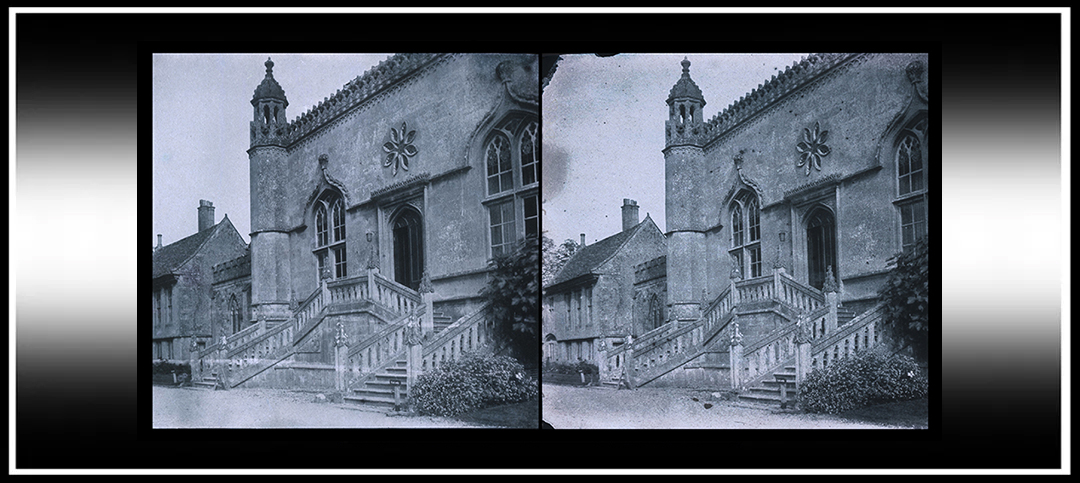
I thought to commemorate Sir Charles Wheatstone on the 150th anniversary of his death I’d share a stereoscopic calotype negative I recently made, with a heck of a lot of help, at Lacock Abbey, Wiltshire.
Charles Wheatstone commissioned the first photographs for his invention the stereoscope in 1840. In December that year, he wrote to the English inventor of photography, William Henry Fox Talbot, at Lacock Abbey, to thank him for the photographs he had sent, but to inform him, sadly, the angles between the two images were too large for them to be fused into 3-D.1

A cross-view stereoscopic salt paper positive, made from a calotype negative, by Robert Douglas. He may have heard a 3-D geek was attending his workshop!
Talbot devised the Calotype (sometimes called the Talbotype) in the Autumn of 1840, and had further refined the process when he patented it in 1841 (except in Scotland). It was the first photographic process to use a paper negative to create multiple positive prints; it involves sensitising high-quality paper with chemicals, exposing it to light in a camera to form a latent image, and then developing it in a darkened room. The resulting paper negative can then be used to contact print multiple positive images onto another piece of sensitised paper. One of the most important parts of the process, as Rob made very clear in the workshop, is the quality of the paper used.
When I saw Lacock Abbey, arguably the birthplace of stereoscopic photography, was offering a day’s workshop on historic photographic processes with two calotypists I follow and admire, I jumped at the chance.

Robert Douglas (left) and Jo Gane (right) introducing the workshop at Lacock Abbey. Notice the wonderful cameras behind Rob!
Jo Gane is a photographic artist and educator, and you can learn more about her work and research here.
Robert Douglas is a 21st century calotypist and process historian, and you can learn more about his work and research here.

Photogenic Drawings being exposed to the sun.
In the morning, we learned about photogenic drawing and made our own by sensitising pre-salted paper with silver nitrate, pruning the historic Botanic Garden at Lacock Abbey for material to make sun-prints from, arranging everything in a printing frame, and then exposing it to the bit of sun we were grateful to receive on an October’s morning. The group then washed, fixed and washed the prints in the darkroom and everyone was pleased with their results.

In the darkroom with the group’s photogenic drawings.

The final rinse of the photogenic drawings.
In the afternoon, we learned about the calotype process so we could make our own negatives. The paper had already been acidified, washed, coated with potassium iodide and silver nitrate, washed and dried. We sensitised the prepared paper with a weak solution of silver nitrate and acetic acid with distilled water. The paper was sandwiched between glass, loaded into an appropriate camera plate holder, and the group got to use several of Jo and Rob’s amazing cameras to take the photographs.

Jo Gane demonstrating how to use the cameras.

Part of the group setting off to go and find subjects for their calotype photographs, in the magical setting of Lacock Abbey, Wiltshire.

Target acquired: The entrance to Lacock Abbey.
I was extremely lucky to use Rob’s Wista Field camera, and, with a lot of guidance from him, me and my workshop partner individually took the left and right calotype negatives of a stereoscopic pair of the entrance to Lacock Abbey by carefully moving the camera and its tripod. By this time, we had been blessed with beautiful sunshine and the two exposures took about 3 minutes each. I must thank my workshop bestie here for allowing me to rope them into making a stereoscopic calotype negative; who knows if we were the first ones silly enough to try it at Lacock since Talbot!

Rob’s Wista Field camera, whilst taking a 3 minute exposure for half of the 3-D calotype negative.

Jo talking to some of the group whilst they photograph Lacock Abbey.


Rob setting up to take his own calotype photograph.
We all then headed back to the darkroom, removed our calotype negatives from the plate holders, started the 1st development with gallic acid and distilled water, and followed with a 2nd development using a solution of gallic acid with the sensitiser. The calotypes were then washed through several trays for 30 minutes, fixed in two baths of hypo (sodium thiosulphate), taken home in water, where they were washed for at least a further 2 hours and dried flat.

The darkroom chemicals for developing the calotype negatives.

Washing and fixing the calotypes.


Our calotype negatives digitised…
The next stage would be to go on to make salt prints from the calotype negatives, however, due to a lack of time and experience, I’ve cheated and used Photoshop to create positives, cleaned them up slightly, and used Stereo Photomaker to make the digital stereoscopic pair for this post.


… made into digital positives….

…and finally a stereoscopic calotype digital positive, made using StereoPhoto Maker.
Fear not, however, whilst at the workshop I purchased Rob Douglas’ book John Adamson’s Calotype Process, which includes an amazing step-by-step guide, and he’s kindly been in touch by email giving me lots of advice, so, eventually, I hope to make my own real salt print positives.
The workshop really helped me appreciate the experience, patience and effort that goes into being a calotypist. Being able to produce a good negative certainly takes a lot of skill and I’m very grateful for all the help I received from Jo and Rob, and it really was A LOT of help 😉 It was such a fantastic day, and I thoroughly enjoyed the magic of the calotype process, much more than I anticipated.
I hope to be able to attend more of their workshops and I really recommend you keep an eye on their websites and the National Trust’s Lacock Abbey’s social media if you would also like the opportunity to go. The Fox Talbot Museum at Lacock opened in 1975 and to celebrate they are offering a special programme of workshops, exhibitions and events celebrating early photography.
- You can learn more about the factual early history of stereoscopy in Stereoscopy: The Dawn of 3-D, written by Denis Pellerin and Edited by Brian May (London: London Stereoscopic Company, 2021). To make this book more accessible so people can learn about the history of stereoscopy accurately and to give due credit to Sir Charles Wheatstone on the 150th anniversary of his death, The London Stereoscopic Company are offering an amazing 25% discount on the book until 25th October 2025.

Copyright © The Stereoscopy Blog. All rights reserved.
 The Stereoscopy Blog