
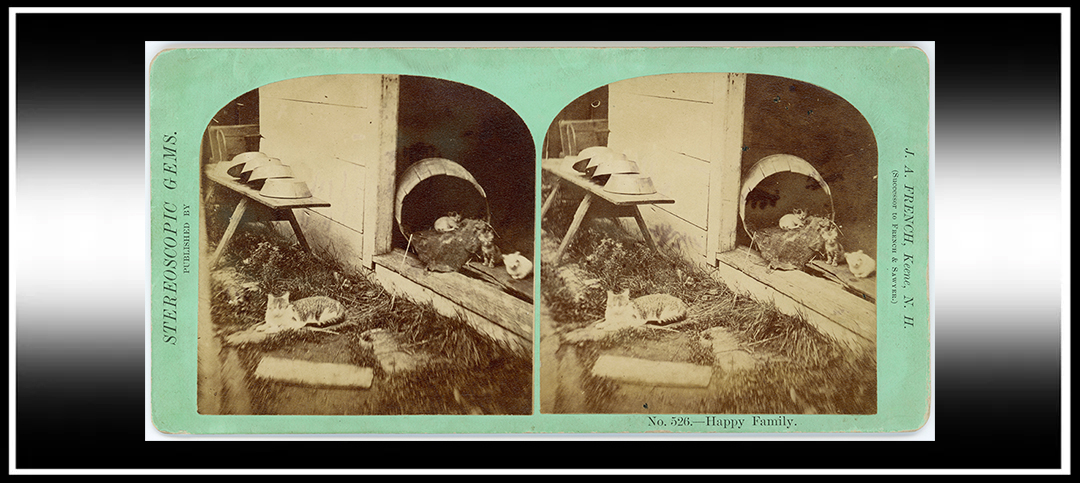
Unfortunately, I’m going to spoil your weekend by saying the title isn’t about music. A research paper published this week by Kim Bell and Robin Canham, from Queen’s University, Ontario, Canada, has revealed that some 19th century coloured stereocard mounts contain toxic heavy metals.
They used X-ray florescence spectroscopy to analyse the cardboard mounts of 69 stereoscopic photographs in the W.D. Jordan Rare Books and Special Collections, dating from between 1852 and 1940. Keeping in mind the relatively small sample size, the results revealed arsenic-based pigment was common in all the green card mounts analysed, lead-based pigment was common in all the orange card mounts analysed, and lead- and chromium- based pigments were common in all the yellow card mounts analysed. The full paper can be accessed here.
Quantification studies have not been performed yet, so it’s difficult to say exactly how toxic the mounts may be, but there are precautions collectors and institutions can take, such an mandatory protective glove wearing when handling any suspected stereocards, washing hands thoroughly afterwards, keeping stereocards in archival sleeves, and certainly no licking or ingesting the mounts (you may chortle, but you’d be surprised)! Always seek and follow advice from the institution if you’re accessing their collections and have any concerns.
This may not be a surprise to those working with Victorian collections as the emerald green colour, amongst others, in book covers was found to contain arsenic. You can read about ‘The Poison Book Project’ here, and find more information and advice from the University of Delaware about dealing with archival material containing toxic heavy metals here (spoiler: don’t panic, and it shouldn’t make collections inaccessible!)
Kim has asked for their results to be shared widely so anyone with affected stereocards in their collections can be informed and take any necessary action. Here’s her paper again if you’d also like to share it: https://www.tandfonline.com/doi/full/10.1080/00393630.2025.2450976
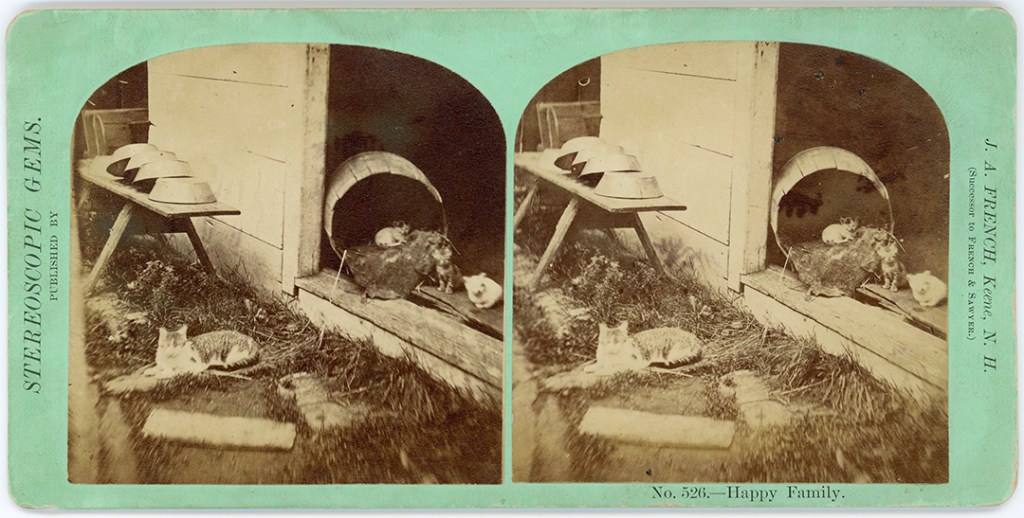
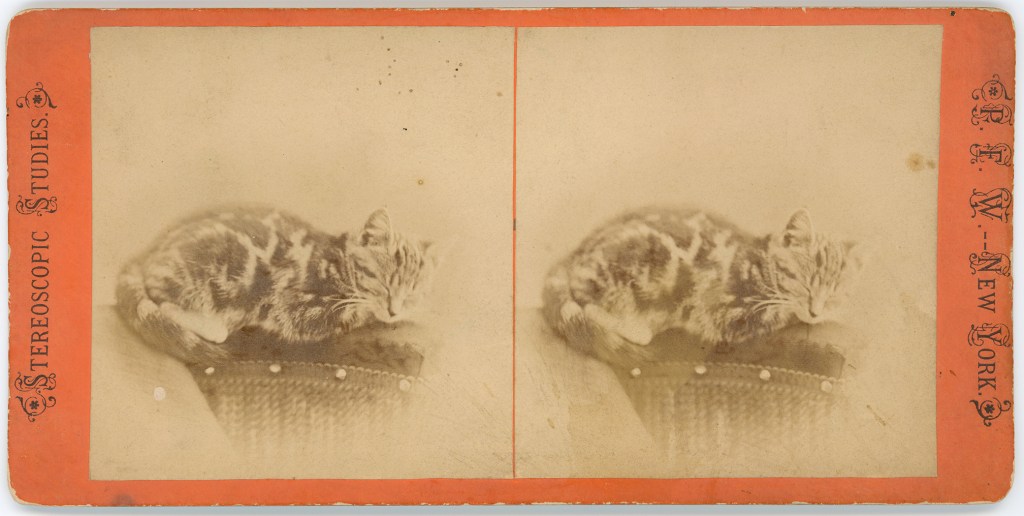
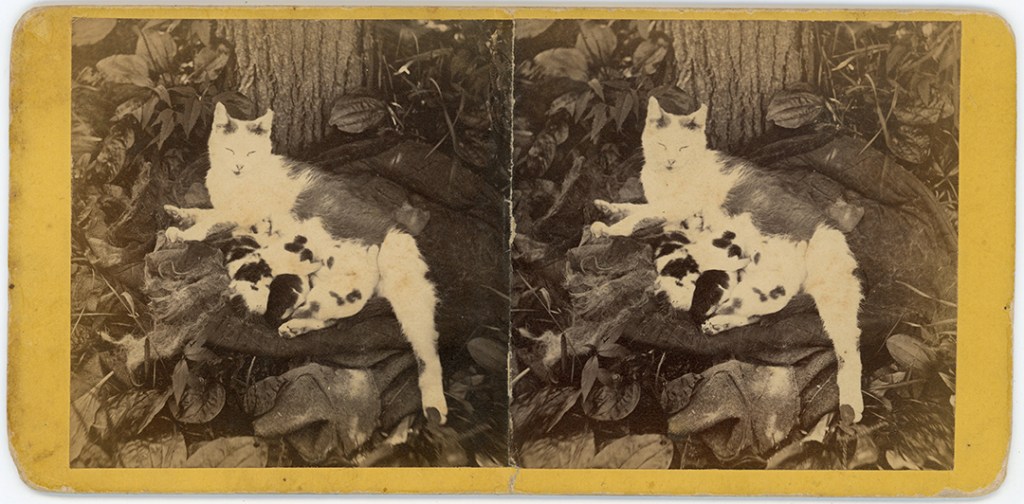
*Disclaimer: I’m not sure if the stereocards I’ve shared have toxic pigments in their cardboard mounts, it was just a gratuitous excuse to share some stereoscopic photographs of cats.
Have a great weekend, and please don’t eat any stereocards.

Copyright © The Stereoscopy Blog. All rights reserved.
 The Stereoscopy Blog
Great! If I ever feel suicidal, I wonder how many cat stereos I would need to eat to end it all?
In the meantime, I am happy to continue to invest in acetate sleeves for all my acquisitions.
Thank for helping to keep stereoscopy safe.
LikeLiked by 1 person
I absolutely do not endorse eating cat stereos, not least because they’re the best ones, but it’d be a pretty spectacular way to go.
LikeLiked by 1 person
Bonjour,
Personally, this seems obvious to me, taking into account the years of publication and the liveliness of certain colors even today! I started working in “graphic art” in 1980, there was still lead in certain red and orange inks and cadmium in the yellows… But this was eliminated in Europe, progress continued with UV curing inks, no more St Andrew’s crosses (Signal for: Irritant, harmful or toxic) But a beautiful skull for carcinogen… There is surely more danger in putting into your mouth a wooden Mickey with glitter and painted in China, or certain good perfumes which remain heavy solvents than in handling a stereo card.
@mitiés
peppin
LikeLike
Good morning Peppin,
Thank you for your message, it’s always fantastic to hear from someone with experience in the field. Yes, it’s absolutely not a surprise to many, but when you provide public access to these materials you have to put measures in place to minimise any risks, no matter how tiny these risks are. I know people who have been working with Victorian stereoscopic photographs on cardboard mounts for most of their lives without any issues, but it’s a whole different ballgame when it involves visitor and staff access. It does all seem a little strange when you consider whats in some food too, but better to keep everyone and the collections 100% safe.
LikeLike
thats a good heads up. Many thanks.
i have a gair few of the yellow ones.
LikeLiked by 1 person
I’m pleased it’s useful to know. The Victorians certainly liked their yellow mounts in particular, and I think it’s safest to treat them like they all have the potential to contain the heavy metals.
LikeLike