
Some twenty-five years ago, maybe a little more, a friend of mine, Christian Chautard, passed away. He had been a cameraman for the French national television (ORTF) but also a keen stereo photographer as well as a collector of stereo cards and of old music wax cylinders and records. We didn’t know each other for very long but we shared the same passion for stereoscopy and when he died he left me his collection of stereo images, among which were colour glass slides known as autochromes. I have cherished them and kept them safe but when I moved to Britain nearly twelve years ago I left them behind – along with tons of books, images and documents – and only took them out of their storage place recently. I then proceeded to scan and digitally clean them and, after all those years, I think now is the right time to tell their story and share their beauty.
Since I started getting interested in the history of stereoscopy I have mostly studied, collected, written about and worked with nineteenth century imagery which, as you probably know, was mostly black and white. Colours, when used, were added on the images by hand. Yes, that’s right, the images were hand-tinted, beautifully at first and then in a more slovenly way as years went by and more images were produced. Our ancestors wanted their photographs to be in relief and in bright colours. Since there were no colour processes then they had them coloured, first by former miniature painters, then by armies of colourists (mostly women) who did a very good job on the whole as it is not easy to paint those fairly small photographs in such a way that the stereoscopic effect is not destroyed by the added colours. This business of adding colours to a photograph, however, could not last forever and, from the start, several researchers all over the world worked on finding a way to reproduce the colours of nature on a photographic plate.
Inspired by the work of Isaac Newton (1642 – 1726/27) and Thomas Young (1773 – 1829) on colours, James Clerk Maxwell in Britain and Louis Arthur Ducos du Hauron in France managed to produce colour images as early as the 1860s using three black and white negatives photographed through coloured filters. Maxell (1831 – 1879) had photographer Thomas Sutton take pictures of a tartan ribbon through blue, red and green fluids. Ducos du Hauron (1837 – 1920) chose to photograph his subjects through blue, red and yellow filters. Because of the lack of sensitivity of the emulsions of the time to certain colours of the spectrum, the results were not perfect but proved nevertheless a major step forward in the advancement of colour photography.
The first two commercially viable colour processes appeared in the mid to late 1890s. The first one was, under the name Krömsköp, the brainchild of American inventor Frederick Eugene Ives (1856 – 1937), the second one, known as Trichrome, was developed by two brothers from France, Antoine and Louis Lumière (1862 – 1954 and 1864 – 1948), who are better known for the part they played in the development of cinematography. Interestingly, both processes relied heavily on stereoscopy for their success. Ives’ Krömsköp was commercialised in Britain in 1897 and the following year in the States. Originally, the three black and white photographs needed for the magic to happen were taken successively but Ives soon designed a camera that took the three necessary negatives simultaneously thus allowing portraits and outdoor scenes to be photographed. The Kromographs were viewed using an instrument which included three coloured filters of identical hues to the ones used to make the images. The registration of the three black and white positives is a bit tricky but, once achieved, the resulting colours are really convincing. The photographs also have to be observed in fairly strong light as the three filters do absorb a lot of it before it reaches the viewer’s eyes.

01. The three black and white images taken through coloured filters and the resulting Kromogram obtained once they have been properly registered and observed through filters of the exact same colour. Author’s collection.
The Lumière brothers’ process, patented on 22 March 1895, was more complex and time-consuming and involved coloured layers of bichromated glue ! Although it was commercialised, its scope and success were very limited since, owing to the length of the exposures, only still lifes could be obtained. The colours, however, are beyond description and have to be seen “in the flesh” as nothing can reproduce their perfection.

02. One of the Lumière brothers’ stereoscopic slides made with their brichromated glue process. The colours do not unfortunately do justice to those of the original. Author’s collection.
The relative failure of the Trichrome process encouraged the Lumière brothers to find another, much easier way to approach colour photography and their research culminated in their 17 December 1903 patent for a “procédé de photographie en couleurs” (colour photography process) which is now known under the name Autochrome. Like the Ives and the Maxwell processes, the autochrome uses a black and white photographic emulsion. The latter was exposed then viewed through a screen made up of millions of microscopic grains of potato starch which had been dyed in three different hues (red-orange, green and blue-green) before being mixed in equal proportions and randomly spread, one grain thick, on a transparent adhesive layer stuck to a glass plate. Spaces between the grains of the random mosaic were filled with lamp black and pressure was applied to the plate which, by slightly flattening the starch grains, made them more transparent and left less space between the starch grains. The whole colour screen was then coated with shellac prior to the application of the sensitive emulsion. The manufacture of the plates was complex and was undertaken at the Lumière factory in Lyon.
The plate was exposed with the glass facing the lens (it is usually the emulsion side which does) so that light had to go through the colour mosaic before reaching the sensitive emulsion. A thin piece of cardboard, coloured black on one side, was used not only to protect the emulsion in its box but also to prevent, or at least limit, the formation of a disturbing halo (halation) during the exposure in the camera. It was therefore loaded into the camera along with the plate.
Although it was presented to the Académie des Sciences on 30 May 1904 the Autochrome was not officially commercialised until 1907, after a public demonstration of the process was made in the offices of the French illustrated magazine L’Illustration on the 10th of June of that year. The event was attended by 500 people who listened to a conference by Auguste Lumière accompanied by the projection of dozens of images taken with their process. Between the presentation at the Académie des Sciences and the public projection of 1907 the Lumière brothers had been busy improving their autochrome plates (for instance they managed to increase the number of starch grain per square millimetre from between 3 and 4000 to 8 and 9000) but also asking the help of several photographers to test them thoroughly before they were released to the general public. One of the lucky testers was none other than camera manufacturer Hermann Mackenstein.
Hermann Josef Hubert Mackenstein was born in Doveren, Westphalia, on 17 December 1846. He was apprenticed to a carpenter near Dusseldorf from 1861 to 1866 and in 1867 left for Paris to further develop his skills. He stayed there for two nearly years before being called back to his native country to serve in the Prussian Army. When the Franco-Prussian war started on 19 July 1870 he was serving as a bugler and took part in the whole campaign which ended with the siege of the French capital from 22 September 1870 to 27 January 1871. After being demobilised in 1872 he returned to Paris where he opened a carpentry workshop at 16, rue Cuvier. His brother Henri Joseph (1849 – 1875) and two French workers were his only employees.
On 21 August 1875, at the mairie of the 5th arrondissement, Mackenstein married Irhama Augusta Paulina Fontaine d’Ocq (1846 – 1925), the daughter of a French jeweller. Their union was blessed with a son, Henri Hubert Joseph who unfortunately died, aged seven weeks, on 7 August 1876. Their only other child, Marie Augusta Catherine was born on 13 September 1877.
Mackenstein’s interest in photography began around 1878 when he started making camera parts for various manufacturers before developing his own models, the most famous of which being the Jumelle Photographique, the Jumelle Stéréoscopique and the Jumelle Stereo-Panoramique. His cameras soon won him awards and medals at several local and international exhibitions. In 1883 he became a member of the Société Française de Photographie. He was then living at 23, rue des Carmes and had his workshop in nearby Impasse des bœufs but later moved to 15, rue des Carmes. In 1897 he started publishing his own photographic magazine, L’Arc en Ciel, which survived until 1915.

03. 1897 advertisement for the Nouvelle Jumelle Photographique Mackenstein. Author’s collection.

04. 1898 full page advertisement for the Mackenstein camera. Note that the Arc-en-ciel magazine is also mentioned. Author’s collection.

05. Advertisement on a postcard issued during the 1900 Paris International Exhibition. Mackenstein’s name appears on the front and on the back of the card which was then used only to write the name and address of the person you wanted to send the postcard to. Author’s collection.
By the time the Lumière brothers patented their Autochrome, Mackenstein was a respected camera manufacturer all over the world and it is therefore not surprising he was asked to test the new colour process since he had easy access to different types of cameras of various formats. It is difficult to know for certain how many autochrome plates were actually made by him but the ones now in my possession were acquired by Christian Chautard back in 1960 from Léon Molitor, who succeeded Mackenstein after his death. There is very little doubt as to their original provenance. They are unfortunately undated but were sold to their previous owner as having been made between 1905 and 1907
The first image shows Mrs Mackenstein herself, who was then in her late fifties, and is labelled “Escalier fleuri” (Flowery steps).

06. Hermann Mackenstein. Stereoscopic autochrome. “Escalier fleuri” showing Mrs Mackenstein at the top left. Author’s collection.
The second image is a still life which includes an advertisement for the Mackenstein cameras as well as a photograph of Mrs. Mackenstein.

07. Hermann Mackenstein. Stereoscopic autochrome. Still life with advertisement and a photographic portrait of Mrs. Mackenstein. Author’s collection.

08. Close up of of the photographic portrait and of the advertisement, which reads “Amateurs, les Jumelles Mackenstein sont les meilleures” (Amateurs, Mackenstein’s cameras are the best). Author’s collection.
The third image was taken in Brussels, Belgium and shows the Anspach fountain, dedicated to a former mayor of Brussels and erected between 1895 and 1897 in the centre of the Place Brouckère. It was dismantled in 1973 during the construction of the Brussels underground and reinstalled in a different location in 1981. The photograph only shows some of the chimeras which stand around the main basin and cannot give a complete idea of the full monument which is 20 metres high.

09. Hermann Mackenstein. Stereoscopic autochrome. Anspach fountain in its former location. Author’s collection.
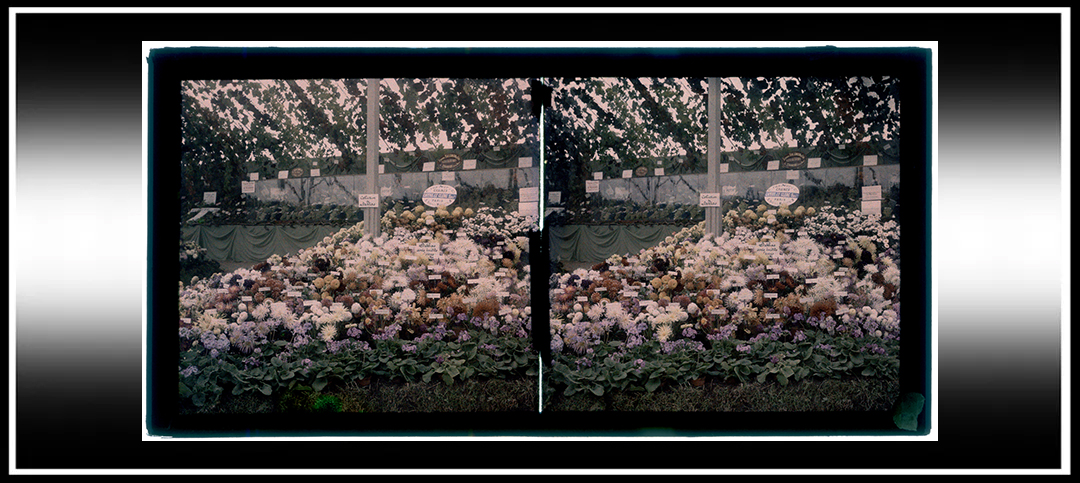
We are back in Paris with the next three stereoscopic autochromes which show the Café des Ambassadeurs, in the Champs Elysées, and two views of a flower show that was held along the Seine. The resolution of the plates is high enough to allow us to read the names of two well-known exhibitors: Lévêque et fils, 69, rue du Liégat, Ivry-sur-Seine and E. Forgeot, Graines (seeds), Cayeux & Le Clerc successeurs, 8, quai de la Mégisserie, Paris.

10. Hermann Mackenstein. Stereoscopic autochrome. Le Café des Ambassadeurs, Champs Élysées, Paris. Author’s collection.

11. Hermann Mackenstein. Stereoscopic autochrome. Flower show along the Seine. Author’s collection.

12. Hermann Mackenstein. Stereoscopic autochrome. Another view of the same flower show along the Seine. Author’s collection.

13. Hermann Mackenstein. Close ups from the two previous images showing the names of Lévêque ef fils and Cayeux & Leclerc. Author’s collection.
The last autochrome of the series (there are a few others but they may or may not be by Mackenstein) was taken after the Lumière colour process was made available to the public and shows a rare stereoscopic image of the illuminations of the Motor and Cycle Show which was held in the Grand Palais, Paris, from 12 November to 1 December 1907. The 1907 Motor Show was the tenth of the kind to be held in Paris and was often referred to as the “Exposition décennale” instead of the usual “Salon de l’Automobile et du Cycle”. It was opened by President Armand Fallières (1841 – 1931) and surpassed its nine predecessors in grandeur and lavish illuminations. It would be interesting to know how long Mackenstein had to leave the shutter of his camera open to obtain this remarkable image as the autochrome necessitated longer exposures than normal black and white plates on account of the loss of light generated by the layer of dyed potato starch. I have seen several press photos and postcards of the interior and exterior illuminations (see below) but autochromes like this must be very uncommon, especially stereoscopic ones.

14. Postcard showing the interior illuminations of the Grand Palais during the 1907 Motor and Cycle Show. Author’s collection.

15. Another postcard showing the interior illuminations of the Grand Palais during the 1907 Motor and Cycle Show. Author’s collection.

16. Hermann Mackenstein. Stereoscopic autochrome of the same illuminations. Author’s collection.
Mackenstein went on producing cameras which were advertised as allowing the use of the new autochrome plates (new plate holders had to be developed) and the Lumière brothers’ process soon gained in popularity. Their autochrome plates, which remained fairly expensive throughout their lifetime, continued being sold in boxes of four and delighted the amateurs despite the relatively longer exposures they needed, the fact they were on glass, not paper, and that they were neither easy to display or even view.

17. 1908 Advertisement for Mackenstein cameras and their use in colour photography. Note how autochrome is spelt “autochrôme”. Author’s collection.

18. Lid of a box of four autochrome plates. Author’s collection.
While the success of the autochrome held on well into the 1930s when the first colour films started to replace them, the late years of Mackenstein’s life were far from being a bed of roses. When the First World War broke out, anti-German feelings were so strong that his factory had to be guarded by the police as people saw him – along with everyone with a German-sounding name – as a spy. Even though he was by then a French citizen and his company had been around for some time with a prestigious shop at 7, avenue de l’Opéra, he thought it wiser to change its name to Établissements Francia in 1915. That same year, however, Mackenstein’s possessions were seized and the situation got even worse when he and his family were expelled from France in 1916 and had to take refuge in the neutral Netherlands. The company was allowed to run again in November 1916 but under French management.
Mackenstein’s daughter Marie was granted permission to return to France in 1919 but Hermann himself had to wait until 1922 before he could get back to Paris. After a lengthy trial he eventually got his possessions back but sold the company to two of his employees, Henri Suffize and Léon Molitor who changed its name to Suffize & Molitor and carried on manufacturing cameras.
A broken man, Hermann Mackenstein died on 24 March 1924. His wife followed him to the grave one year later in July. As for their daughter Marie, who never married, she passed away shortly after the beginning of the Second World War, thus ending that branch of the family.
Mackenstein cameras are still sought after by collectors and, being of fine manufacture, are still mostly in good working condition. Autochromes continue to delight photographic historians and amateurs of beautiful images who love their pointillist effect and their magical colours. The latter are difficult to reproduce faithfully so being fortunate to have access to original autochromes is indeed a privilege which is really appreciated by the lucky owners of these photographs. One may have seen millions of colour photographs but taking the time to examine a nicely preserved autochrome is an unforgettable experience which is ten times more intense when it happens to be a stereoscopic one.

19. 6×13 stereoscopic autochrome from the 1920s. Still life with magazine. Author’s collection.

Copyright © The Stereoscopy Blog. All rights reserved.
 The Stereoscopy Blog
Very interesting post, thank you!
LikeLike
Fascinating as ever. I envy you those still life autochromes!
LikeLiked by 1 person
Thanks for another fascinating article. I have 4 full size glass stereos of Fontgambault Abbey and its monks. It was dissolved in 1905. Under the hand-written title of each view is written “Jumelles Stereos Mackenstein”. Now I know a lot more about that. Here is the most interesting – an excellent view of the abbey’s kirsch distillery. Oh these monks!
blob:https://wordpress.com/3e6a99fe-bd50-4f22-88eb-c7bd1df1c12d
LikeLike
Hi Rebecca I tried to post a comment with an image with the description Jumelles Stereos Mackenstein in the title but was not able after much faffing around to load the image. So here it is if you think it is worth loading
cheers Peter
http://www.avg.com/email-signature?utm_medium=email&utm_source=link&utm_campaign=sig-email&utm_content=webmail Virus-free.www.avg.com http://www.avg.com/email-signature?utm_medium=email&utm_source=link&utm_campaign=sig-email&utm_content=webmail <#DAB4FAD8-2DD7-40BB-A1B8-4E2AA1F9FDF2>
LikeLike