
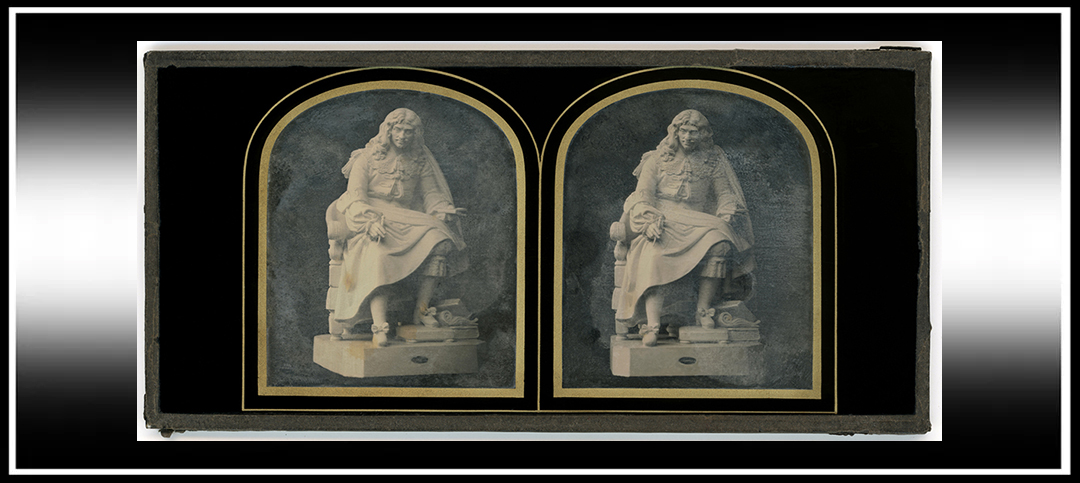
The idea for this article came to me some months ago when my colleague Rebecca, aware of my interest in them, drew my attention to some stereoscopic lithographs that were being sold on eBay. They were not the usual geometrical wire diagrams but images made after daguerreotypes of statuettes and sold by French optician Louis Jules Duboscq. I managed to buy a couple of those and the matter could have stopped there when, a few weeks later, the same Rebecca sent me the link to an eBay sale for a stereoscopic daguerreotype from the Duboscq firm representing one of the statuettes I had bought in lithographic form. I could not let this opportunity pass and though daguerreotypes are usually way out of my financial means I managed to purchase this one because there were not many people interested and it was not in the greatest condition which means its price was, consequently, not too high. I was now in possession of a daguerreotype and of its lithographic equivalent (see below) and since I am much more of a historian than a collector and only buy things I can write about at some point or other, even if it means waiting decades, I decided it was time to write about those stereoscopic images, some of the earliest that were made available for the general public to buy.

01. Stereoscopic daguerreotype showing a statuette of French playwright Molière, sold by optician Louis Jules Duboscq. Author’s collection.

02. Stereoscopic lithograph sold by the same Jules Duboscq and obviously made after the daguerreotype shown above. Author’s collection.
The statuette in the daguerreotype and the lithograph shows French playwright and actor Jean Baptiste Poquelin (baptised on 15 January 1622, died on 17 February 1673) better known under his stage name of Molière. Molière is to the French what Shakespeare is to the British and his influence on the theatre and the French language was so important that today the Comédie Française is still known as “la Maison de Molière” (Molière’s House) and the French language still called “la langue de Molière” (the language of Molière). The statuette photographed was a parian reduction of a bigger than life-size bronze statue which still exists today and can be seen adorning the Molière Fountain, at the junction of the rue Molière and rue Richelieu, in the 1st arrondissement of Paris. The original maquette of the statue was the creation of sculptor Bernard Gabriel Seurre (11 July 1795 – 3 October 1867) and was bought by the Musée Carnavalet in 2021. It was made in 1843, the year before the Molière Fountain was inaugurated. This fountain replaced an existing one, the Richelieu Fountain, which was pulled down in 1838 as it was becoming a hindrance to growing traffic. Thanks to the efforts of François-Joseph Régnier (1 April 1807 – 27 April 1885), one of the “sociétaires de la Comédie française”, it was decided that the new replacement fountain would be dedicated to Molière who had died in 1673, close by, at 40 rue Richelieu, and who had never had the honour of a statue in Paris. The fountain, built by architect Louis Tullius Joachim Visconti (11 February 1791 – 29 December 1853), who designed the tomb of Napoleon I at the Invalides, also includes two sculpted figures by Genevan born French artist James or Jean-Jacques Pradier (23 May 1790 – 4 June 1852), representing “Serious Comedy” on one side and “Light Comedy” on the other. The two females figures are each holding a scroll on which is carved a list of Molière’s works. The fountain was inaugurated on 15 January 1844 and the issue of the illustrated magazine Le Magasin Pittoresque for that month features a woodcut showing the monument as it was discovered by the Parisians at the time.

03. Woodcut published in the January 1844 issue of the illustrated magazine Le Magasin Pittoresque. The rue Molière is on the right of the image and the rue Richelieu on the left. Author’s collection.
The fountain was apparently daguerreotyped some time in the mid to late 1840s and a steel engraving, published in a volume entitled “Vues de Paris prises au Daguerréotype” [1], was made by Jean-Baptiste-Marie Chamouin (1768 – ?), after the original image by an unnamed photographer.

04. Steel engraving by Jean-Baptiste-Marie Chamouin, after a daguerreotype by an unnamed photographer, showing the Molière Fountain in Paris. Mid to late 1840s. Author’s collection.
Also in the 1850s, the fountain, which had by then become a famous Parisian landmark, was photographed for the stereoscope. The two stereo cards below, as is very common, bear no indications whatsoever as to who the photographers or publishers were.

05. Stereo card from the mid to late 1850s showing the Molière Fountain in Paris. The two images were taken sequentially. Notice a cart laden with barrels on the right half of the picture is not to be seen on the left half. Author’s collection.

06. Stereo card from the mid to late 1850s showing the Molière Fountain in Paris. This is another example of a sequential stereo pair. People have moved between the two exposures. Author’s collection.

07. Two animated postcards from the 1900s showing the Molière Fountain. Author’s collection.
Now that the source of the statuette represented in the stereoscopic daguerreotype sold by Jules Duboscq has been clearly established, it is time to get back to that very daguerreotype and the story behind it.
As most people know by now, stereoscopy was invented in the latter part of 1832 by English polymath Charles Wheatstone (6 February 1802 – 19 October 1875). His reflective stereoscope, however, along with the first part of his paper on Binocular vision, were only revealed, before the Royal Society, on 21 June 1838, six years after they had been conceived. The photographic processes of Louis Jacques Mandé Daguerre (18 November 1897 – 10 July 1851) and William Henry Fox Talbot (11 February 1800 – 17 September 1877) were disclosed the following year, 1839, which means that the first images viewed in Wheatstone’s optical device had to be hand-drawn. This certainly did not help popularise the reflective stereoscope and, although we know that Wheatstone also invented a smaller prismatic and lenticular instrument he was never really keen on its development and commercialisation, preferring to the last his more cumbersome but, in his opinion, more versatile mirror stereoscope. In 1849, Scottish scientist Sir David Brewster (11 December 1781 – 10 February 1868) modified Wheatstone’s prismatic and lenticular apparatus by replacing the prisms and lenses (which could be used separately) by the two halves of a single convex lens joined at their thinner end, thus allowing them to act as prisms and lenses combined. Brewster’s first instruments were manufactured by Dundee optician George Lowden (1825 – 1912) who, like many other people before and after him, fell out with Sir David after he had dared suggest an improvement to the latter’s instrument. Failing to find anyone else in Britain to manufacture his instrument, Brewster took it along with him, when, to get over the death of his wife, he went on a trip to the continent with his daughter Margaret Maria (24 October 1823 – 8 November 1907) in the spring of 1850. After a short stay in Belgium, Brewster and his daughter arrived in Paris where we know they were still staying there on 9 May 1850, the day French chemist and physicist Joseph Louis Gay-Lussac breathed his last. While in Paris Brewster met with several scientific-minded people, one of whom, science populariser Abbé François Napoléon Marie Moigno (15 April 1804 – 14 July 1884) took him to the business premises of optician Louis Jules Duboscq, 35, rue de l’Odéon, where Brewster showed the Scottish version of his stereoscope plus at least two stereoscopic pairs: a lithograph of a man holding a horse, by Frederick Ernst Schenk, and a stereoscopic portrait on paper of Dr. John Adamson, brother of Robert Adamson (26 April 1821 – 14 January 1848) of the famous photographic tandem Hill and Adamson. Duboscq agreed to manufacture the stereoscope which started being sold in Paris before the year was over.
Louis Jules Dubosq was born at Villaines-sous-Bois, Seine et Oise, on 5 March 1817, the son of shoe-maker Denis Lubin Duboscq and of his wife Louise Geneviève Meunier. At the age of seventeen he was apprenticed to the famous Parisian optician Jean-Baptiste-François Soleil (21 June 1798 – 17 March 1878). Five years later, on 27 April 1839, he married his master’s only daughter, Rosalie Jeanne Joséphine (26 September 1821 – 22 July 1859), and in 1849, succeeded his father-in-law at the head of the firm, along with his brother-in-law Henri Jean-Jacques Soleil (24 February 1827 – 4 April 1884). From then on Duboscq was often referred to as Mr. Duboscq-Soleil and chose the monogram DS, which is often seen on the back of the daguerreotypes he sold.

08. Duboscq’s monogram on the back of the Molière daguerreotype. Author’s collection.
We know for a fact that Duboscq’s Brewster-type stereoscopes were sold with stereoscopic daguerreotypes in the latter part of 1850 thanks to an article by the Abbé Moigno which was published in the daily newspaper La Presse on 28 December 1850.
“Sir David Brewster, in his last trip to Paris, entrusted the model of his stereoscopes to Mr. Jules Duboscq, son-in-law and successor of Mr. Soleil, whose intelligence, activity and affability, will further increase the reputation of the learned workshops of rue de l’Odéon, 35. Mr. Jules Duboscq set to work with tireless ardor: without needing to resort to the binocular camera obscura, with an ordinary daguerreotype, he obtained a large number of dissimilar images, statues, bas-reliefs, reliefs, famous or beloved faces, etc. ; His stereoscopes are constructed with more elegance, and even with more perfection than the English original; and when he shows its prodigious effects to the physicists and amateurs who have already flocked to his premises, it is a spontaneous and unanimous cry of admiration.”
The Abbé Moigno was definitely a champion of the stereoscope but his enthusiasm for the instrument makes him somewhat exaggerate the success it originally met with, which is why we should take his “flocked to his premises” with a pinch of salt. The stereoscope undoubtedly aroused some interest in the scientific community but certainly not to the point of causing crowds to besiege 35, rue de l’Odéon.
Manufacturing a stereoscope is one thing but as is the case for any new product of the kind, be it a stereoscope or, to take a more recent example, Apple’s Vision Pro headset – these devices are pretty useless without some contents, in our case stereoscopic images to look at. We learn from Moigno’s article that Duboscq was selling daguerreotypes of statues, etc., obtained with a single camera, as early as December 1850. What Moigno doesn’t say, however, is that the photos were not actually taken by Duboscq, who was an optician and not a photographer, but most probably by Claude Marie Ferrier (20 February 1811 – 13 June 1889). The stereoscopic daguerreotypes were, however, published by Duboscq and a lot of them bear his monogram on the back. I have yet to see a stereoscopic portrait from that period but it is not uncommon to come across bas-reliefs and statues, which were much easier to photograph in those days of fairly long exposures. They are statuettes rather than statues, though, since the images were never taken from original marbles but usually from reduced parian reproductions.
If we are to believe the catalogue – the first of its kind – published by Duboscq at the back of the Abbé Moigno’s “Stéréoscope, ses effets merveilleux; Pseudoscope, ses effets étranges” – the first book to have been written on the stereoscope, published in February 1852 – just under 40 different subjects were available, namely:
Rubens — Plat genre Bernard de Palissy — Cheval de Marly — Molière — Chien — Vase de Médicis — Buste d’Arago — Poésie légère — Groupe de Laocoon — Saint Bruno — Bénitier porté par deux anges — Portefaix et charron, bronze style Louis XIV — Buste de Robert Peel — Les Trois Grâces de Canova — Portrait d’après nature — Amazone — Epervier — Bouquet de fleurs — Bacchante et faune — Vénus couchée — Buste du Prince Albert — Buste de la Reine Victoria — Jenny Lind — Vénus de Médicis — Buste de Napoléon — Bouquet en pastillage — Groupe d’oiseaux — Danseuses de Canova — Esclave grecque — Deux Vénus avec oiseaux — Groupe d’histoire naturelle, oiseaux, coquillages — Vase antique, ciselure sur argent — Buste de Newton — Wellington, statue équestre — La prière — L’enfant et l’oiseau — Deux lutteurs — Shakespeare.
As you can see for yourself, these are almost exclusively statues, busts, bas-reliefs, taxidermied animals and flowers, with the exception of one single “portrait d’après nature” (portrait from life) which I would really love to see one day.
Some of the daguerreotypes have a number on the back, either printed or handwritten on a small label and, from what I have seen so far, they match, at least for the earlier ones, the order of the list above. The Brian May Archive of Stereoscopy recently acquired two of these Ferrier-Duboscq daguerreotypes: “Rubens” and “Saint Bruno”. If you look at the list published in Moigno’s book, Rubens is number 1 and Saint Bruno number 10, which corresponds to the numbers found on the back of the daguerreotypes. I have not yet been able to find who made those two statuettes but I am still looking.


09. “Rubens”, stereo daguerreotype sold by Jules Duboscq and bearing number 1 on the back. Brian May Archive of Stereoscopy.


10. “Saint Bruno”, stereo daguerreotype sold by Jules Duboscq and bearing number 10 on the back. Brian May Archive of Stereoscopy.
We also have in the archive “Bénitier porté par deux anges”, numbered 11 on the back, and I have seen online “Amazone” with number 18 on the back, “Danseuses de Canova” with number 30, “Esclave grecque” with number 31, and “La Prière” with number 38. The last four may not match the corresponding numbers in the “catalogue” but are still in the right order of appearance, which means that some more images may have been added before the numbering was done, or that not all images were listed in the 1852 catalogue. It is also interesting to note that the photographs, although taken in France, include quite a few famous British personages: Queen Victoria, Prince Albert, Prime Minister Robert Peel, Isaac Newton, the Duke of Wellington and William Shakespeare. This has probably something to do with the fact that Duboscq’s stereoscope was on display at the Great Exhibition which opened in London in May 1851 and that British eminent figures were most likely to catch the attention of the public there.
Going back to the catalogue of views offered for sale by Duboscq, it seems that the pictures appear in the order they were taken which implies that Rubens could well be the oldest stereo image in the Brian May Archive of Stereoscopy (pre-dating by nearly a year the few stereo daguerreotypes we have of the interior of the Crystal Palace in Regent’s Park) and that the photo of Molière after Seurre I started this article with was taken not long afterwards (it is in fourth position on the list), which makes it quite ancient too, at least for a stereoscopic image.
It was all very well to have daguerreotypes to sell with the stereoscope but with a price of 10 francs per daguerreotype (the equivalent of at least three days’ wages for a skilled workman) and the 12 francs necessary to buy the cheapest kind of stereoscope, not many people could afford to fuel their passion for stereoscopy for very long. Something had to be done to give cheaper access to images. Duboscq came up with the idea of selling lithographed stereo diagrams, printed on thin card. They were much cheaper to buy and still brilliantly demonstrated the ability of the stereoscope to recreate the illusion of depth from two flat perspectives. Duboscq had a set of 40 of these lithographed cards printed and we know they were already available in the first months of 1851, thanks to an article published in Le Moniteur universel, on 22 February of that year, which also mentions “Daguerrean images of statuettes, vases or bas-reliefs”.
“Among the geometric figures that make up the collection that Mr. Duboscq-Soleil attaches to his stereoscope, there is one which, because of the illusion to which it gives rise, deserves particular mention: it consists of a white arrow traced in a circle of the same color on a black background; the arrow corresponding to the left eye is slightly oblique from left to right; the one on the right offers an obliquity in the opposite direction. In the stereoscope, the double arrow gives way to a single arrow seen in perspective and crossing the circle as if to strike the observer.”

11. Stereoscopic lithograph sold by Jules Duboscq. This one, described above, bears number 6 in the collection of 40 subjects Duboscq had printed. Author’s collection.
It is unfortunate, however, that the more complex lithographs, drawn straight from daguerreotypes like the one of Seurre’s statue of Molière, are not advertised anywhere in the press, so that there is no way of knowing when exactly they were released. Jules Duboscq was apparently not too keen on advertising and while his name features fairly regularly in the press of the time it is never because he paid to put it there but solely on account of his achievements, inventions, awards, etc. In the absence of a list of these images and of any numbering it is also difficult to estimate how many were made. From what we hold in the archive, what I have in my own collection and what I have seen in books, in articles or online, I would say there are twenty to twenty-five of these lithographs but it is not impossible a set of 40 was made as a pendant to the one with the geometrical figures. If some of the cards are fairly easy to find, probably because they were the most popular ones, others are particularly hard to track down which would explain why we may not have seen them all. Interestingly but not surprisingly, some of them were made from the daguerreotypes listed in the 1852 catalogue. To our knowledge these are: “Cheval de Marly”, “Molière”, “Chien”, “Laocoon” and possibly “Bouquet de fleurs” – of which there are two variants – as well as “Portrait d’après nature”.

12. Stereoscopic lithograph after a daguerreotype, sold by Jules Duboscq. “Cheval de Marly”. Author’s collection.

13. Stereoscopic lithograph after a daguerreotype, sold by Jules Duboscq. “Chien”. Author’s collection.

14. Stereoscopic lithograph after a daguerreotype, sold by Jules Duboscq. “Bouquet de Fleurs”. Author’s collection.

15. Stereoscopic lithograph after a daguerreotype, sold by Jules Duboscq. “Bouquet de Fleurs”. Brian May Archive of Stereoscopy.

16. Stereoscopic lithograph after a daguerreotype, sold by Jules Duboscq. “Portrait d’après nature”. Author’s collection.
Among the stereoscopic lithographs are some representing famous ancient statues or busts which can still be admired in museums. One is the “Borghese Gladiator”, which is actually misnamed and does not feature a gladiator but a warrior (Louvre Museum), another one is the “Diana of Versailles”, also called “Artemis, Goddess of the Hunt” (Louvre Museum), a third one shows what I have seen described as a bust of Dionysus, Ariadne, or Melpomene, the Muse of Tragedy (take your pick). To these must be added a stereoscopic lithographic image of the “Laocoon” (the original of which is in the Vatican) which I have only seen so far in the enlargement of a photograph.

17. Stereoscopic lithograph after a daguerreotype, sold by Jules Duboscq. The so-called Borghese Gladiator. Brian May Archive of Stereoscopy.

18. Stereoscopic lithograph after a daguerreotype, sold by Jules Duboscq. The Diana of Versailles. Author’s collection.

19. Stereoscopic lithograph after a daguerreotype, sold by Jules Duboscq. Bust of Dyonisus, Ariadne or Melpomene ! Author’s collection.
Duboscq’s collection also includes lithographs after statues by artists who were famous at the time the cards were issued. One shows Dying Eurydice by Charles François Lebœuf-Nanteuil (9 August 1792 – 1 November 1865). The original marble was sculpted in Italy in 1822 and exhibited at the Paris Salon in 1824. It features a snake which has just bitten the young woman (a ruse by Pluto who was in love with Eurydice and wanted her dead to take her with him to Hades) but the reptile has completely disappeared in the lithograph.

20. Stereoscopic lithograph after a daguerreotype, sold by Jules Duboscq. “Dying Eurydice” by Charles-François Lebœuf-Nanteuil. Brian May Archive of Stereoscopy.
In a second card we can see Icarus trying out his wings and ready to soar. The statue from which this was drawn was exhibited at the 1831 Salon by its maker, Philippe Grasse (6 May 1801 – 12 April 1876). Copies of it can be seen at the V&A, London, and the Minneapolis Institute of Art.

21. Stereoscopic lithograph after a daguerreotype, sold by Jules Duboscq. “Icarus” by Philippe Grasse (also spelt Grass). Author’s collection.
A third card shows a standing Sappho by Jean-Jacques Pradier, a sculptor I have already mentioned in connection with the Molière Fountain. This work in bronze, shown at the Salon in 1848, is not as well-known as his 1852 seated Sappho, the last statue he worked on, shortly before his sudden death. The latter can be admired these days at the Musée d’Orsay.

22. Stereoscopic lithograph after a daguerreotype, sold by Jules Duboscq. “Sappho” by Jean-Jacques Pradier. Author’s collection.
The original daguerreotypes which were used to make these lithographs may be in some public or private collections but to this day I haven’t found any copies of them. If you have photos or scans of or information about these works, please contact me at denis@brianmayarchiveofstereoscopy.
There is still a lot to be found about the partnership between Duboscq and Ferrier and the early stereoscopic daguerreotypes, glass slides and lithographs they produced. Since both men appear to have avoided publicity little is actually known about their work during the years 1850 to 1852. Hopefully this article is just the start of a more thorough research into the fascinating first years of commercial stereoscopy. If you have any additional information, do not hesitate to contact me. Thank you !
NOTES
[1] Daguerreotypes are images on metal (a copper plate with a very thin layer of silver) so it is not really possible to use them to illustrate books. In the 1840s a lot of publications used “Daguerreotypes” or “Épreuves Daguerriennes” in their title but all were actully engravings afer daguerreotypes. People still loved them because, for the first time in the history of art engravings were made straight from a faithful representation of the monument or location represented.

Copyright © The Stereoscopy Blog. All rights reserved.
 The Stereoscopy Blog
Fascinating reading as ysual!
LikeLike