
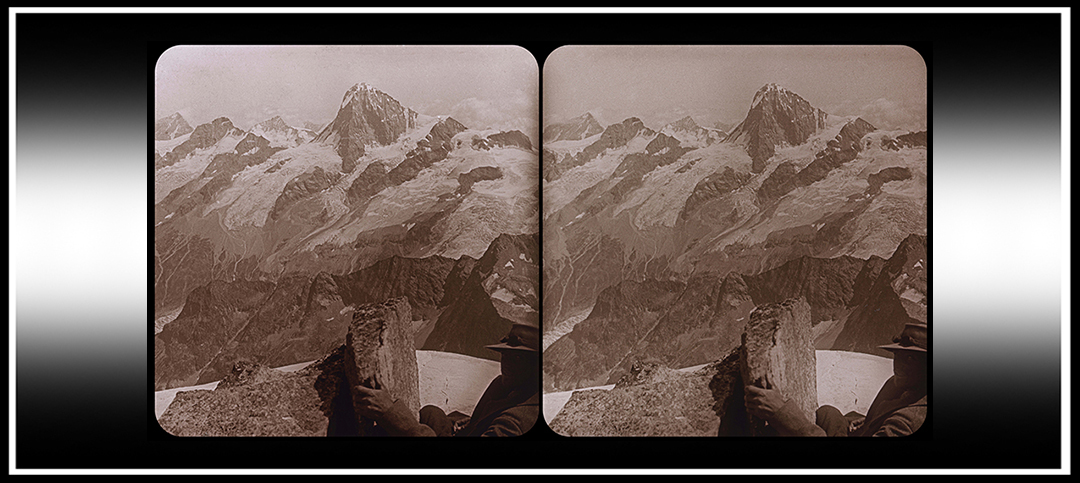
There’s a heatwave today in UK and so I thought it’d be nice to share my small collection of glass positives taken in the Alps in the early 1900s, with a Jules Richard Verascope camera, and we can cool down with them.
All of the glass slides are 107 x 45mm format, with most of them having a ‘Richard Verascope’ stamp on them. The Jules Richard Verascope stereo cameras were first produced in France towards the end of the 19th Century and the 107x45mm format ones were still being made in the 1930s. For more information and some beautiful examples of the cameras, please see EarlyPhotography.co.uk and the History of Science Museu, Oxford.

Verascope Stereoscopic Camera, by Jules Richard, Paris, c. 1927, History of Science Museum Collection. © History of Science Museum, University of Oxford, inv.79152
You can also find an excellent write-up about Jules Richard and the Verascope at Oxford’s History of Science Museum, from when they made some new acquisitions.

I do not know who the photographers were or the exact years in which they were taken. You will spot that the slides are numbered and Jules Richard actually sold views taken by amateurs, so although the quality in some suggest that they were taken by amateurs, they were mostly likely sold commercially.


‘3036 D. L. Le Lyskamm sude la cabane Bétemps’.
Stereo cameras’ lenses are a fixed distance apart, so you will see that in some of the images there is very little depth because the photographer was too far away from the subject. Sometimes adding a person to the foreground helps…
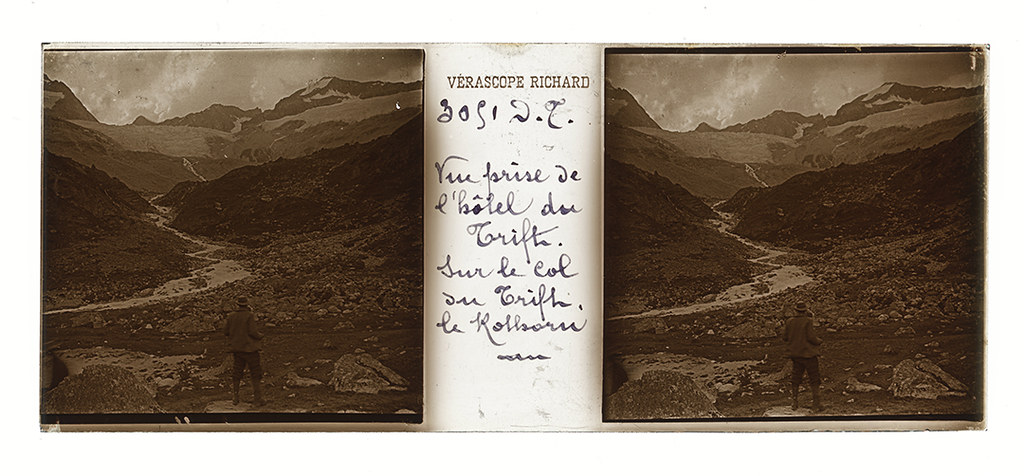
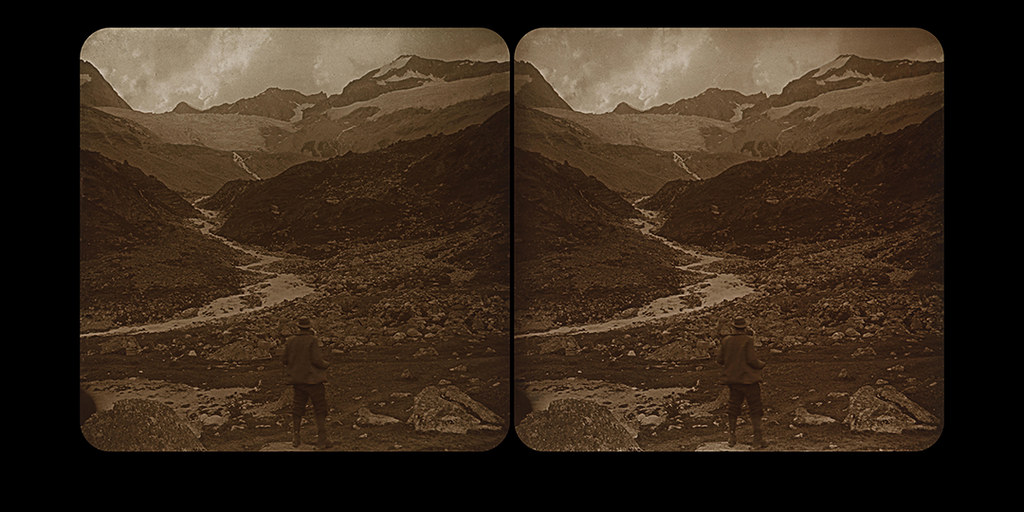
‘3051 D.L. Vue prise de l’hôtel du Trift. Sur le col du Trift, le (Rolhorn?)’.
For each image I’ve added a scan of the original glass slide and the digital stereoview below it, which I’ve made by aligning them and gently digitally cleaning them. Glass slides are easily scratched and often grubby but I was surprised by the condition of these considering how old they are.
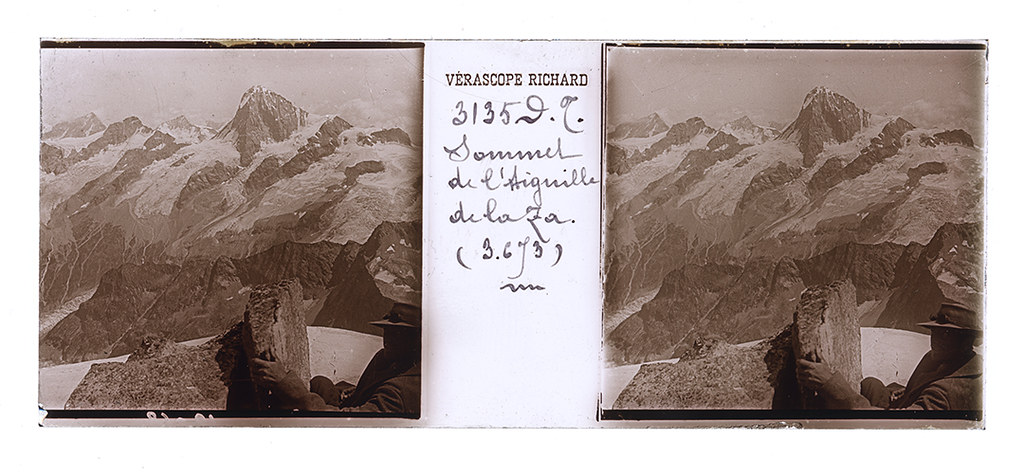

‘3135 D. L. Summet de l’Aiguille de la Za (Tsa) (3.6 T 3)’
I really like the person in the foreground of the above image, even if their face is in the shadow of their hat. It’s also nice that they carried a Verascope three thousand meters up a mountain for us to visit a Century or so later with them in stereoscopic 3-D!


‘3165 D.L. Crevasse du glacier (Durand?). Descent du Col de la Dent Blanche’.
I’m afraid I’m no expert on the Swiss Alps so if anything needs correcting please get in touch.


‘4399 Suisse. Vallée de la Reuss’.
You can find an example of a stereoview of this Valley taken much earlier in the Getty Museum Collection, they even added some nice foreground for you.
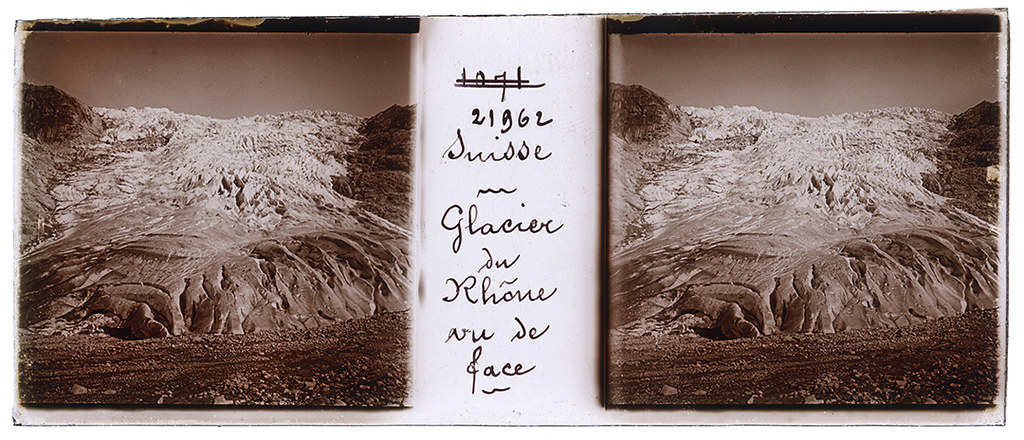

‘21962 Suisse. Glacier du Rhône vu de face’.
I’ve seen in a presentation by Dr. Peter Blair that old stereoscopic images of glaciers and comparisons with modern images can be used to study how much they have retreated over time, due to the affects of climate change. For more information and to order his book ‘Chamonix Mont Blanc in 3D, please visit his website This glacier sadly doesn’t look as impressive as this now! Dr Blair has since contacted me and has sent me a link so you can see more of his alpine stereoviews: https://3dalps.wordpress.com/
**Update 19/09/2021** I’ve been contacted by Martin Blum about a blog post he’s made, also about the disappearing glaciers and using stereoviews to study this, scary but necessary reading: link to the post here (thanks Martin!)

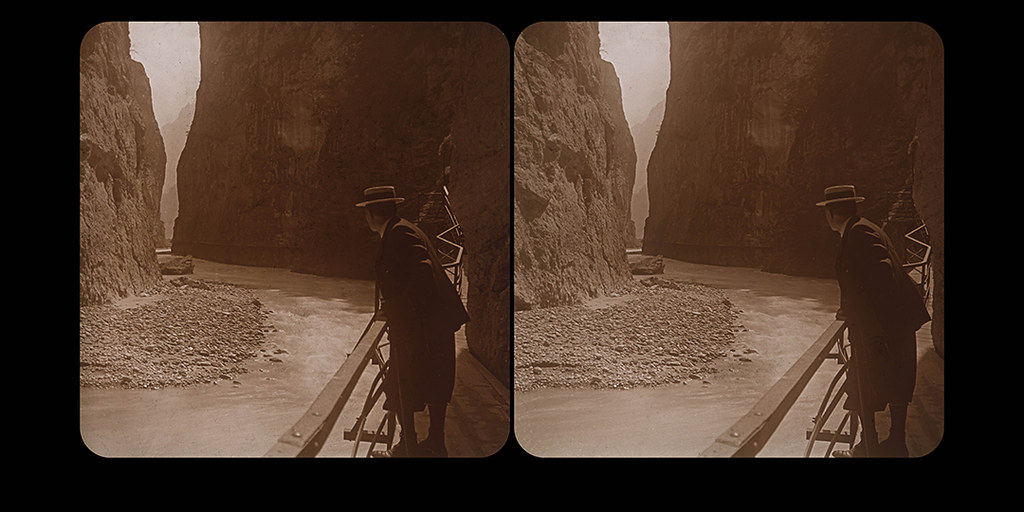
‘30921 Suisse Meiringen. Gorges de l’Aar’.
And so we finish in Meiringen, Switzerland. As well as seeing the Aare Gorge (Aareschlucht), I really recommend that you try the meringues and retrace the footsteps of Sir Arthur Conan Doyle.
If you need any help viewing stereoscopic images, please see this post.

Copyright © The Stereoscopy Blog. All rights reserved.
 The Stereoscopy Blog
interesting comment about the retreating glaciers over time. Another example of what I mean when I refer to stereoscopy as being a time machine.
LikeLike
Hi Rebecca, I am very pleased to read this review from you concerning the past two days! The intellectual twaddle about stereoscopy with pseudo-anaglyph photos as illustrations was really embarrassing. Many have probably never actually seen a photo in 3D.
But….
As always, Denis’ talk was wonderful. It is so much fun to hear him, with his genuinely felt enthusiasm, coupled with so much in-depth knowledge.
By the way, nice stereos from Switzerland, with an impressive Rhone glacier
Regards, Thomas
LikeLike
Good rant Rebecca – thanks for the mention – more alpine stereoviews available here https://3dalps.wordpress.com/
LikeLike
Hi, love these views of the Alps, and your comments about how these can be used historically. I have about 600 slides taken by a family from all over Europe – the Alps, plane show is Nice, France, a Joan of Arc festival held in Orleans, France in 1915, and I’ve always had that same thought. I also own one of the richard Stereoscopic cameras, and have always wanted ti figure out how to take pictures with it. Would you know if any resources that could help me figure that out?
LikeLike
Hello History Geek. The family slides sound fantastic, it’s always interesting to see what people photographed in 3-D when you have a whole set! Is your Jules Richard Verascope camera one for taking glass plates or a later f40 film camera? I can help with either.
Take care, Rebecca
LikeLike
Hi Rebecca, I had originally posted a comment on November 13 2021, and I guess I never made my way back to this page to see that you responded 3 days later! I have the Richard stereocopic camera that takes photos on the glass slides. I also have a bunch of slides that were never used and still sealed. Would you still be willing to offer any help on how to operate the camera?
I’d also be happy to share some of the images if you are interested.
LikeLike
Ooh, I just found it: https://www.instagram.com/tv/CNQWuewH0dG/?igsh=MTc5ZmV6MXpxN2ZnMA%3D%3D
LikeLike
Good morning History Geek,
There are a couple of free manuals online for the camera: https://www.cameramanuals.org/stereo/verascope.pdf
http://licm.org.uk/livingImage/Verascope.html
I’m not sure if you’re based in the UK, but I saw a few years ago Dave Shrimpton using a Verascope glass slide camera, and I’m sure he’ll be able to give you some pointers: https://daveshrimpton.co.uk/ I’ll try and find the video he made using it and then add the link in here 🙂
LikeLike
Thank you so much for this information! I have come across some of this previously, but because I am not an expert (at least with this type of antique camera), I just haven’t yet been able to figure it out. But I did send a message to Dave Shrimpton, so hopefully I might get some help there. I really appreciate the information and I will keep at it! Thank you again so much!
LikeLike